
For most vehicles in the United States, all-terrain tires should be inflated to the cold tire pressure listed on the driver’s door-jamb placard or in the owner’s manual. There is no single PSI that fits every all-terrain tire.
Many SUVs and light trucks use a recommended pressure between 30 and 40 PSI, but your vehicle may require more or less. The correct setting depends on the vehicle, tire size, load, axle weight, and driving conditions—not simply on the fact that the tire has an all-terrain tread pattern.
Check pressure when the tires are cold, before driving or after the vehicle has been parked for at least three hours. Do not use the maximum PSI molded into the tire sidewall as your normal setting.
Introduction
Drivers in the United States often switch from highway tires to all-terrain tires for gravel roads, snow, mud, camping trips, or light off-road use. A common mistake is to assume that the new tires need a different pressure just because the tread looks more rugged.
In most cases, the vehicle maker’s recommended cold pressure remains the correct starting point. The tire may have a different load rating or size, so a tire professional should confirm the fit and pressure if the replacement tire differs from the original equipment.

The Correct PSI Depends on the Vehicle, Not Just the Tire
The best PSI for all-terrain tires is the pressure that lets the tire carry the vehicle’s load safely while maintaining proper handling. That number is set for a specific vehicle and tire fitment.
Look for the recommended pressure in these places:
- The driver-side door frame or door pillar
- The driver’s door edge
- The owner’s manual
- The manufacturer’s tire information label
- The vehicle manufacturer’s official specifications
The label may list separate pressures for the front and rear tires. It may also list a higher pressure for a heavily loaded vehicle.
For example, a door placard might say:
| Vehicle condition | Front tires | Rear tires |
|---|---|---|
| Normal load | 35 PSI | 35 PSI |
| Full load or towing | 35 PSI | 41 PSI |
This is only a hypothetical example. Use the numbers printed for your vehicle.
Why the tire sidewall number is different
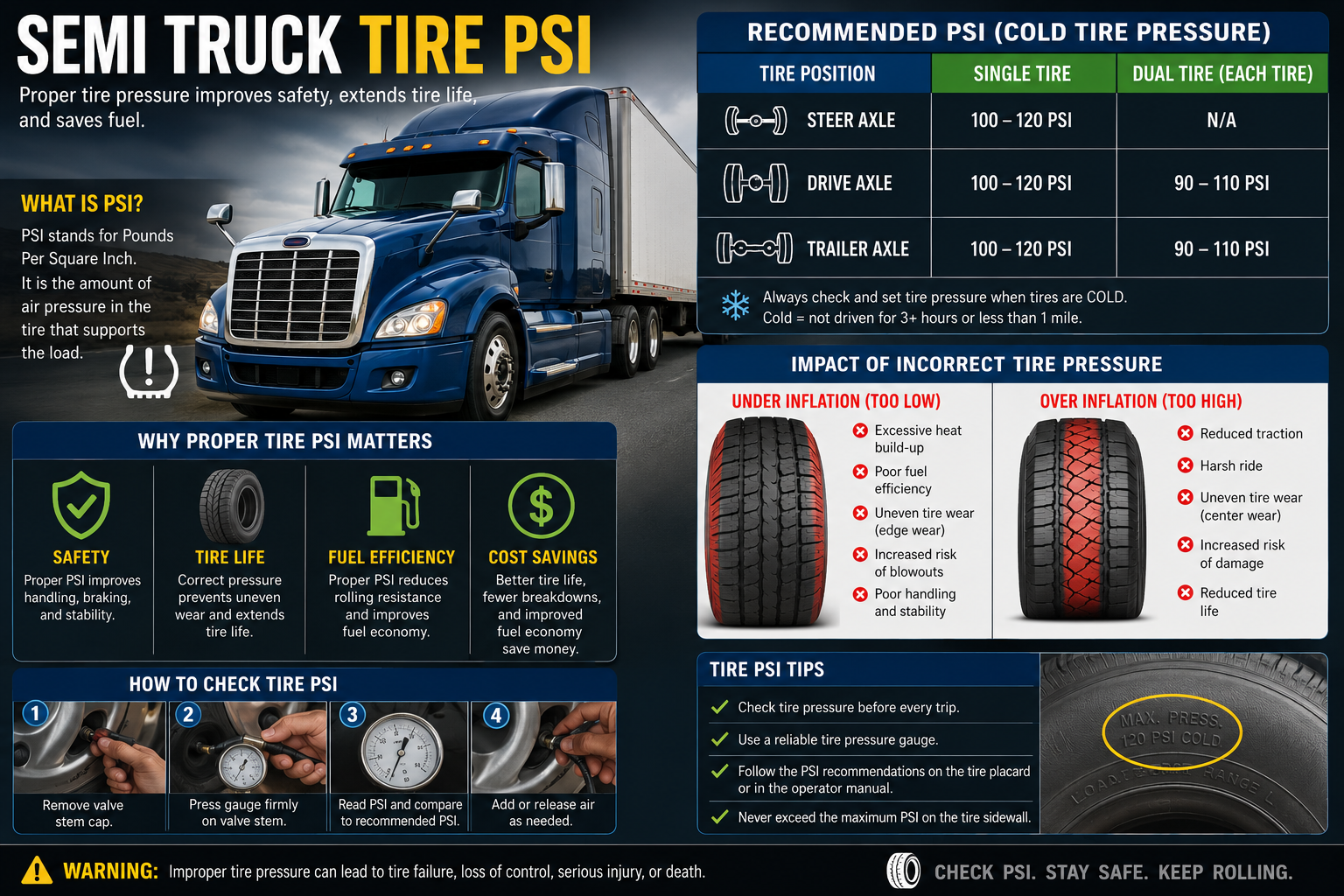
The number molded into the tire sidewall is usually the maximum permitted cold inflation pressure for that tire under stated conditions. It is not a recommendation for your particular SUV or truck.
A tire may say “maximum 50 PSI,” while the vehicle placard calls for 35 PSI. That does not mean the tire should be filled to 50 PSI. Filling it to the sidewall maximum can make the ride harsh, reduce grip on some surfaces, and cause uneven tread wear.
The sidewall also shows the tire’s maximum load at that pressure. It does not account for your vehicle’s suspension, weight balance, steering design, or electronic stability systems.

How to Find the Right All-Terrain Tire Pressure
Use this simple process before setting the pressure.
1. Find the vehicle placard
Open the driver’s door and inspect the door jamb and door edge. The label often includes:
- Original tire size
- Recommended cold PSI
- Maximum passenger and cargo load
- Sometimes the spare-tire pressure
If you cannot find the label, check the owner’s manual or contact the vehicle manufacturer.
2. Confirm the tire size and load rating
Compare the tire size on the placard with the size mounted on the vehicle. A replacement all-terrain tire may have:
- A different section width
- A different aspect ratio
- A larger or smaller wheel diameter
- A higher load range
- LT construction instead of P-metric construction
A different tire size can change the pressure needed to carry the vehicle’s load. Do not assume that a higher load rating automatically means you should use higher PSI.
3. Measure the tires while cold
Check the pressure before driving, ideally in the morning. If the vehicle has been driven, wait about three hours or follow the tire maker’s guidance for a true cold reading.
Driving creates heat. Heat raises air pressure, so a reading taken after a long trip can be several PSI higher than the cold pressure.
4. Adjust all four tires
Use a quality pressure gauge and set each tire to the recommended value. Replace the valve cap after checking the pressure.
Do not reduce pressure simply to make the ride softer. A tire that is too soft can flex more than intended, build excess heat, wear at the edges, and respond slowly during steering.
5. Check the result with the TPMS
Most vehicles sold in the United States have a tire pressure monitoring system, or TPMS. The system can warn you about low pressure, but it may not show the exact pressure on every vehicle.
TPMS is a warning aid, not a substitute for a manual pressure check. If the warning light stays on after you correct the pressure, the system may need time to reset or may have a fault.
Should All-Terrain Tires Use More PSI Than Highway Tires?
Usually, no. All-terrain tires do not automatically need more PSI than the original highway tires.
The correct pressure can change when the tire’s construction or size changes. For example, a light truck tire marked LT may have different load and pressure requirements than a passenger-rated tire marked P. That does not mean every LT tire should be inflated to the same pressure.
A tire professional may need to calculate the proper pressure when:
- The replacement tire is a different size
- The replacement tire has a different load range
- The vehicle uses LT tires instead of P-metric tires
- The vehicle carries heavy tools or equipment
- The vehicle is modified with suspension or wheel changes
- The vehicle is used for towing or hauling
The calculation must match the tire’s load-carrying data and the vehicle’s actual axle loads. A generic internet PSI chart cannot safely replace that information.
P-metric and LT tires
P-metric tires are commonly used on passenger vehicles, crossovers, and some light-duty pickups. LT tires are designed for certain heavier loads and commercial or work applications.
The tire sidewall may include markings such as:
- P235/75R15
- LT265/70R17
- Load Range C, D, or E
These markings describe tire size and construction. They do not, by themselves, tell you the correct pressure for your vehicle.

PSI for Highway Driving, Gravel, Snow, and Off-Road Use
Use the vehicle placard pressure for normal paved-road driving. Off-road pressure is a separate setup and should be treated with care.
Highway driving
For highways and city streets, use the recommended cold pressure from the vehicle placard. Proper pressure helps the tire maintain its designed shape and supports:
- Steering response
- Braking stability
- Fuel economy
- Tread life
- Heat control
Check pressure at least once a month and before long trips. Also check it after major temperature changes, because air pressure falls as temperatures drop.
Gravel roads
For maintained gravel roads, the normal road pressure is often the safest starting point. Lowering pressure is not always needed and can increase the chance of sidewall damage if the vehicle hits a sharp rock or pothole.
Drive at a sensible speed and inspect the tires after rough travel.
Sand and loose terrain
Some off-road drivers lower pressure in sand to increase the tire’s contact area. This may improve flotation, but it also reduces ground clearance and makes the tire more vulnerable to bead unseating, sidewall damage, and rim damage.
Do not lower pressure unless you know the tire and wheel limits. Carry a portable compressor so you can restore road pressure before returning to pavement.
Mud and rocky trails
There is no universal off-road PSI. The correct setting depends on the tire, wheel, vehicle weight, terrain, speed, and driving technique.
Very low pressure can cause:
- The tire bead to separate from the wheel
- The rim to strike an obstacle
- The sidewall to fold or pinch
- The tire to come off the wheel
- Loss of steering control
Use the tire manufacturer’s off-road guidance when available. Reinflate all tires to the road setting before driving at highway speed.

A Simple PSI Decision Table
The following table gives a safe way to think about pressure. It does not replace your vehicle’s placard or tire manufacturer’s instructions.
| Situation | Starting point |
|---|---|
| Normal city and highway driving | Vehicle placard PSI, checked cold |
| Long road trip | Vehicle placard PSI; use the full-load setting if required |
| Towing or hauling | Follow the vehicle manual’s load and trailer instructions |
| Gravel roads | Usually the normal road PSI |
| Sand or technical trails | Use only a tire-specific off-road plan |
| After off-road driving | Restore road PSI before pavement or highway travel |
| Different tire size or construction | Ask a tire professional to confirm pressure |
A useful rule is this: change pressure for a documented vehicle or tire requirement, not because a number “feels right.”

How Temperature Changes Tire Pressure
Tire pressure changes with air temperature. As the air inside the tire cools, pressure drops. As it warms, pressure rises.
A common rule of thumb is that pressure changes by about 1 PSI for every 10°F change in temperature, although the exact change varies. Treat this as an estimate, not a calibration rule.
For example, a tire set to 35 PSI on a warm afternoon may read lower on a cold winter morning. That lower reading may be enough to trigger the TPMS warning.
Do not bleed air from a warm tire just because the reading is higher. Wait until the tire is cold, then adjust it to the recommended pressure.
In the United States, seasonal temperature changes can be large, especially in areas with cold winters. Check pressure more often during fall and winter.

Signs Your All-Terrain Tires Have the Wrong PSI
Tire wear can provide clues, but it should not replace a pressure gauge.
Possible signs of underinflation
- Wear concentrated on both outer shoulders
- Slow steering response
- A soft or vague feeling in turns
- Excess heat after driving
- Lower fuel economy
- A tire that looks visibly flattened at the bottom
A tire can look normal and still be underinflated. Always measure it.
Possible signs of overinflation
- Wear concentrated near the center of the tread
- A harsh ride
- Reduced grip on uneven roads
- More nervous steering
- A tire that feels unusually firm
Modern tread designs can make wear patterns difficult to read. Check pressure first, then have the tires inspected if the wear continues.
Uneven wear on only one tire may point to alignment, suspension, wheel balance, or damage rather than incorrect PSI.

Common Mistakes to Avoid
Several pressure mistakes can reduce safety and tire life.
Using the sidewall maximum as the target
The sidewall maximum is not the vehicle recommendation. Follow the door placard unless a qualified tire professional has confirmed a different pressure for a changed tire fitment.
Checking pressure after driving
A warm tire gives a higher reading. Check it cold for the most useful result.
Setting all tires to the same pressure
Some vehicles specify different front and rear pressures. Follow the placard.
Ignoring the spare tire
A spare may require a different pressure from the four tires on the ground. Check it at the interval recommended by the vehicle maker.
Letting air out for comfort
A softer ride does not prove that the pressure is correct. Low pressure can raise heat and reduce control.
Forgetting to reinflate after off-road travel
Low trail pressure is not suitable for normal highway speed. Refill the tires before driving on pavement.
Ignoring a TPMS warning
A warning light may indicate a slow leak, puncture, sensor problem, or temperature-related pressure loss. Inspect the tire and measure it as soon as possible.

When to Ask a Tire Professional
Get professional help before driving if a tire has a bulge, cut, puncture, exposed cord, damaged bead, or unexplained pressure loss.
Ask a tire professional to confirm the setup when you have changed:
- Tire size
- Wheel width or diameter
- P-metric tires to LT tires
- Load range
- Suspension height
- Vehicle use, such as frequent towing or commercial hauling
A professional can compare tire load tables with the vehicle’s axle requirements. For heavily loaded trucks, an axle-weight measurement at a certified scale can provide useful information, but the result still needs to be interpreted against the tire and vehicle limits.
FAQs About All-Terrain Tire Pressure
Is 35 PSI good for all-terrain tires?
It may be correct for some vehicles, but it is not a universal setting. Use 35 PSI only if the vehicle placard or a qualified tire professional specifies it.
Should I inflate all-terrain tires to the maximum PSI on the sidewall?
No. The sidewall maximum is not normally the correct operating pressure for your vehicle. Use the recommended cold PSI on the door placard or in the owner’s manual.
Do bigger all-terrain tires need more air?
Not always. A larger tire may carry the load at a different pressure. The correct answer depends on the tire’s construction, load rating, size, and the vehicle’s axle loads.
Should I lower PSI in snow?
Do not lower pressure automatically for snow. Normal road pressure is usually the safest starting point. Lower pressure may reduce control and increase damage risk on pavement.
Why does my TPMS light come on after a cold night?
Cold air can lower tire pressure enough to trigger the warning. Check all tires while cold and inflate them to the vehicle’s recommended pressure. If the light returns, have the tires and TPMS inspected.
Key Takeaways
- There is no single correct PSI for every all-terrain tire.
- Start with the cold pressure on the driver’s door placard or in the owner’s manual.
- Do not use the tire sidewall maximum as your normal target.
- Check pressure before driving, when the tires are cold.
- Confirm the pressure setup after changing tire size, construction, or load rating.
- Reinflate tires after off-road use before returning to highway speeds.
- Treat a TPMS warning or unexplained pressure loss as a reason to inspect the tire.
Conclusion
The right all-terrain tire pressure is the pressure specified for your vehicle and tire combination—not a universal number printed on an online chart. For most drivers, the safest method is simple: find the vehicle placard, check the tires cold, use the listed PSI, and inspect the tires regularly.
If the all-terrain tires differ from the original size or construction, pause before adjusting the pressure on your own. Have the fitment and load requirements confirmed by the tire manufacturer, vehicle manufacturer, or a qualified tire professional.