

Most car seats are good for six to 10 years after the date of manufacture, but there is no single expiration period for every seat sold in the United States. The exact limit comes from the car seat manufacturer and may vary by model.
Find the “Do Not Use After” date on the seat, label, or manual. If the label lists only a manufacture date, check the manual or the manufacturer’s website for the useful life. Do not count from the date you bought the seat.
For example, if a seat has a six-year service life and was made in March 2024, it may expire in March 2030. If you cannot confirm the seat’s expiration date, the safest choice is to replace it.
Why Car Seats Have Expiration Dates
Car seat expiration dates help limit the use of products that may have aged, changed, or lost their support documents. The seat may still look clean after several years, but appearance alone cannot show whether every part remains suitable for use.
Common reasons for a service life include:
- Material aging: Plastic, foam, fabric, and belts face heat, cold, sunlight, and repeated use.
- Wear and damage: Harness straps, buckles, padding, and adjustment parts may wear over time.
- Changing vehicle design: Newer cars may have different seat shapes, head restraints, or lower anchors.
- Updated instructions: Manufacturers may revise installation or use guidance.
- Lost parts or labels: A used seat may no longer have all the parts needed for safe use.
- Product recalls: Older seats may be affected by a recall that has not been repaired.
The expiration date is a manufacturer’s service-life limit. It is not the date when the seat suddenly stops working at midnight. Still, once the seat reaches that limit, you should stop using it because the manufacturer no longer supports it for regular use.
The National Highway Traffic Safety Administration (NHTSA) advises parents and caregivers to follow the seat maker’s instructions, including its guidance on expiration and replacement.
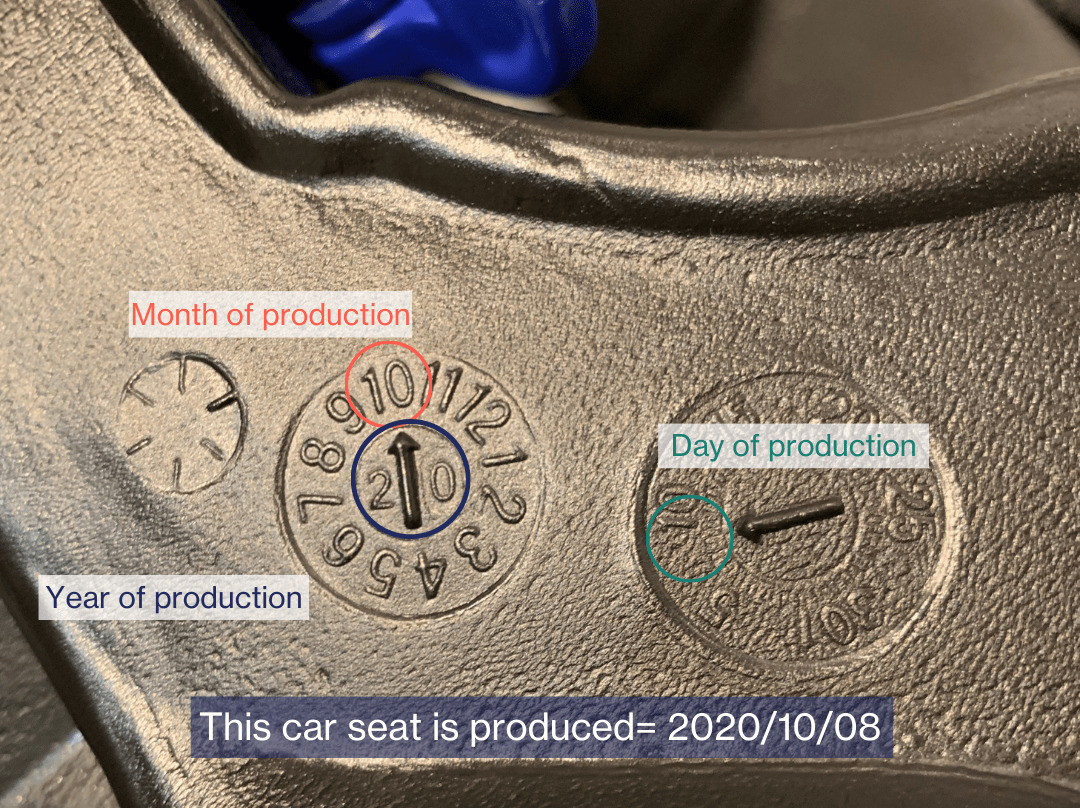
How to Find the Manufacture Date and Expiration Date
Look for a white, gray, or black label on the car seat shell. The label is often on the back, bottom, side, or underside of the seat. Some seats also have the information printed on the base.
Search for these terms:
- Date of manufacture
- DOM
- Made on
- Do not use after
- Expiration date
- Useful life
The manufacture date may appear as a month and year, such as 03/2024, or as a full date. Some labels use a code instead. If the code is unclear, contact the manufacturer with the model name, model number, and serial number.
If the label shows only a manufacture date
Use the manufacturer’s stated service life. Do not assume that every car seat lasts six years. One model may have a six-year limit, while another may have a seven-, eight-, or 10-year limit.
Check these sources in this order:
- The label on the seat.
- The printed owner’s manual.
- The manufacturer’s current support page.
- The manufacturer’s customer service team.
Use the instructions for the exact model. A similar-looking seat may have a different expiration period.
If the label is missing
Do not guess the age of the seat. A missing label can also make it hard to confirm the model, recall status, installation limits, or correct replacement parts.
Replace a seat if you cannot verify:
- Its manufacture date
- Its model number
- Its instructions
- Its recall history
- Its expiration date
- Its crash history

Does a Car Seat Expire Six Years After Manufacture?
Some car seats do expire six years after manufacture, but six years is not a universal rule. Many manufacturers use a service life between six and 10 years. The correct answer depends on the exact seat.
A simple calculation can help:
Manufacture date + manufacturer’s service life = approximate expiration date
Hypothetical example
Suppose:
- Manufacture date: August 2023
- Manufacturer’s service life: 7 years
The seat should not be used after approximately August 2030, unless the label gives a more specific “do not use after” date.
If the label says “Do not use after August 2030,” follow that date even if a general manual suggests a different way to calculate the limit.
What if the seat is unused?
An unused seat still ages from its manufacture date. A seat made in 2018 does not become a fresh 2024 seat because it stayed in a box.
This matters when buying a clearance, warehouse, or secondhand seat. Before buying, ask for:
- The manufacture date
- The expiration date
- The model number
- Proof that the seat has never been in a crash
- Confirmation that all parts and instructions are included
A lower price may not be worthwhile if much of the seat’s service life has already passed.

What Should You Do When a Car Seat Expires?
Stop using an expired car seat and replace it with a seat that fits the child, vehicle, and installation method. Do not give an expired seat to another family.
Before disposal, make the seat difficult to reuse:
- Remove the cover and padding if possible.
- Cut the harness straps.
- Mark the plastic shell as “Expired—Do Not Use.”
- Check local recycling or disposal rules.
- Ask a local car seat recycling program, waste center, or retailer whether it accepts seats.
Do not place an expired seat at the curb in an intact condition if someone could take it and use it. Some communities accept car seats during special recycling events, but programs vary by location.
An expired seat should also not be used as a spare seat, travel seat, daycare seat, or emergency seat. A crash can happen during the one trip when you decide to keep using it.
Should You Replace a Car Seat After a Crash?
Replace a car seat after a moderate or severe crash. NHTSA says a seat may not need replacement after a minor crash only when all of its conditions are met:
- The vehicle can be driven away from the crash.
- The vehicle door nearest the car seat is not damaged.
- No one in the vehicle has an injury.
- The airbags did not deploy.
- There is no visible damage to the car seat.
Even when all five conditions apply, check the seat manufacturer’s instructions. Some manufacturers recommend replacing the seat after any crash.
Do not use a seat again if it has:
- Cracks or dents in the shell
- Broken or bent parts
- Torn harness webbing
- A damaged buckle
- Missing pieces
- A changed installation fit
- An unknown crash history
A crash can damage parts that are not easy to see. Do not try to repair a car seat with glue, tape, unapproved hardware, or replacement parts from another model.

How to Check a Used Car Seat Before Using It
A used car seat may be safe only when you can verify its full history and condition. NHTSA recommends checking several points before using a secondhand seat.
Confirm that the seat:
- Is not expired
- Has never been in a moderate or severe crash
- Has not been recalled
- Has every required part
- Has readable labels
- Includes the correct manual
- Has no visible damage
- Fits your vehicle and child
Search the model at the NHTSA recalls website. You can also contact the manufacturer to ask about recalls and replacement parts.
Avoid a used seat when the seller cannot answer basic questions. “It was barely used” does not tell you whether it was stored in extreme heat, involved in a crash, or missing a key part.
A seat that came from an unknown source is a poor safety choice, even if it looks new. You need a trustworthy history, not just a clean cover.
How Car Seat Expiration Differs by Seat Type
The expiration rule applies to the specific product, not just the broad type of seat. Infant seats, convertible seats, combination seats, and booster seats may have different service lives.
| Seat type | What to check |
|---|---|
| Infant car seat | Check both the carrier and its base. They may have separate labels and model information. |
| Convertible car seat | Check the seat shell, harness limits, rear-facing limits, and forward-facing limits. |
| Combination seat | Confirm the expiration for both harness use and booster use. |
| High-back or backless booster | Follow the booster manufacturer’s service-life instructions. |
| All-in-one seat | Check the full seat life and the limits for each mode. |
Do not assume that an infant seat base is good forever because the carrier is still within its service life. Use only the base approved for that carrier and model.
Likewise, do not move a harness or buckle from one seat to another unless the manufacturer specifically approves the part for that model.

What Is the Difference Between Expiration and Size Limits?
Expiration is based on the age of the product. Size limits are based on the child’s height, weight, age, or developmental stage.
A seat can be:
- Not expired but too small for the child
- Large enough for the child but expired
- Within its size range but recalled or damaged
- Safe by age but unsuitable for the vehicle
Check all limits before each stage change. The seat manual should explain:
- Rear-facing height and weight limits
- Forward-facing height and weight limits
- Harness fit
- Booster height and weight limits
- When to move from one mode to another
- Whether the child should remain rear-facing longer
The American Academy of Pediatrics recommends keeping children rear-facing as long as possible within the seat’s height and weight limits. After a child outgrows the rear-facing limits, the child should use a forward-facing seat with a harness and top tether until reaching that seat’s limits.
Do not move a child to a booster only because the car seat is old. If the seat has expired, replace it with an appropriate current seat that matches the child’s size and stage.
Common Mistakes With Car Seat Expiration
Several mistakes can lead families to keep using a seat longer than intended.
Counting from the purchase date
A seat bought in 2025 may have been made months or years earlier. Use the manufacture date and the maker’s service-life rule.
Assuming every seat lasts six years
Six years is common, but it is not a nationwide rule. Read the exact label and manual.
Ignoring the base
Infant seat carriers and bases are separate products. Check both for dates, damage, recalls, and correct matching.
Using a seat with no history
A clean used seat may have been in a crash or stored poorly. Unknown history is a safety limitation.
Keeping an expired seat for emergencies
An emergency is the wrong time to discover that a seat is expired, missing parts, or incompatible with the vehicle.
Confusing a recall with expiration
A recalled seat may need a repair or replacement before its expiration date. An expired seat should be replaced even if there is no recall.
Buying a seat without checking the date
Ask for the manufacture and expiration dates before purchasing. This is especially useful for clearance seats and marketplace listings.
Car Seat Expiration Checklist
Use this quick checklist before installing a seat:
- I found the manufacture date.
- I confirmed the manufacturer’s expiration date or service life.
- The seat is not expired.
- The model is not under an unresolved recall.
- The seat has no crash history, or the manufacturer confirms it can be used.
- The shell, harness, buckle, and base have no damage.
- All required parts are present.
- I have the correct manual.
- The seat fits the child’s current size and stage.
- The seat can be installed correctly in this vehicle.
- The child’s harness or seat belt fits correctly.
If you are unsure about installation, find a certified child passenger safety technician through the NHTSA child passenger safety directory. A technician can help check fit and installation, but they cannot extend an expired seat’s service life.
FAQs About Car Seat Expiration
Can I use a car seat one day after its expiration date?
No. Once the seat reaches the manufacturer’s “do not use after” date, replace it. The manufacturer has defined the supported service period, and there is no safe grace period.
Do car seat bases expire too?
Yes. A base is a separate safety product and can have its own manufacture date and expiration information. Check the base label and the carrier instructions.
Do booster seats expire?
Yes. Booster seats have manufacturer-specific service lives. Check the label or manual rather than assuming a booster lasts as long as a vehicle.
Can I donate an expired car seat?
Do not donate an expired seat for a child to use. Mark it clearly as expired and check whether a local recycling program accepts it.
Is a car seat still safe if it looks new?
Not necessarily. Appearance does not prove the seat is within its service life, has never been in a crash, contains all parts, or is free from a recall.
Can I use an expired car seat for a short trip?
No. A short trip still involves crash risk. Use a current, undamaged seat that fits the child and vehicle.
Key Takeaways
- Most car seats last six to 10 years after manufacture, but the exact period depends on the model.
- The useful life begins on the manufacture date, not the purchase date.
- Check the label, manual, or manufacturer for the exact expiration date.
- Replace a seat after a moderate or severe crash, and follow the manufacturer’s crash guidance.
- Do not use a seat with an unknown history, missing label, missing parts, visible damage, or unresolved recall.
- An expired seat should not be donated or kept as an emergency spare.
Conclusion
The safest way to answer “how long is my car seat good for?” is to identify the exact model, find its manufacture date, and confirm the manufacturer’s service life. If the date or history cannot be verified, replace the seat rather than guessing.
For a seat you already own, check the label today. Then check the recall status, condition, crash history, and fit for your child. That small review can prevent a last-minute safety problem.