
For most drivers in the United States, the right all-terrain tire size is the size listed on the vehicle’s driver-door tire placard or in the owner’s manual. You can often choose a tire with the same size, load index, and speed rating, while selecting an all-terrain tread pattern for gravel, mud, snow, and light trails.
Larger tires are possible on some trucks and SUVs, but they may need more wheel-well clearance, different wheels, suspension changes, or speedometer correction. Before buying, check the tire size, load rating, wheel fit, clearance, drivetrain needs, and local laws.

Start With the Tire Size Listed on Your Vehicle
The safest starting point is the original equipment tire size. Find it in one of these places:
- The tire and loading information label on the driver-side doorjamb
- The owner’s manual
- The fuel door on some vehicles
- The vehicle manufacturer’s fitment guide
- The sidewall of the tires currently installed
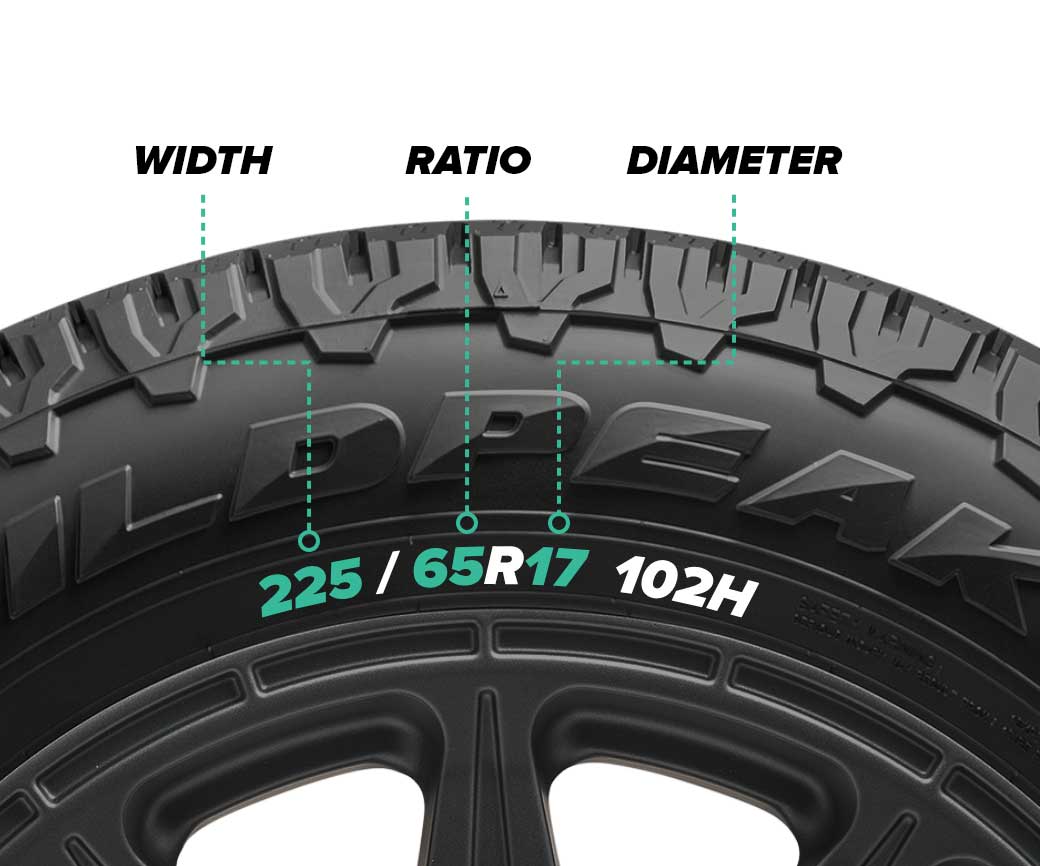
A tire size looks like this:
265/70R17 115T
Each part gives useful information:
| Marking | Meaning |
|---|---|
| 265 | Tire width in millimeters |
| 70 | Sidewall height as a percentage of width |
| R | Radial construction |
| 17 | Wheel diameter in inches |
| 115 | Load index |
| T | Speed rating |
The first three parts describe the tire’s physical size. The load index and speed rating describe how much weight the tire can carry and how fast it is rated to operate under specified conditions.
The tire placard may also list the correct cold inflation pressure. Use that pressure as your starting point, unless a qualified tire professional or the vehicle manufacturer gives a different instruction.
The National Highway Traffic Safety Administration recommends checking tire condition, pressure, and fit. NHTSA also explains that the vehicle label and owner’s manual contain key tire and loading information.
What “same size” really means
A tire can have a different brand name or tread design and still be the correct size. For example, a vehicle marked for 265/70R17 can use an all-terrain tire marked 265/70R17, as long as the tire also meets the required load and speed ratings.
Do not rely only on the first numbers. Two tires with the same width and diameter may have different load ranges, construction, or approved wheel-width requirements.

Choose the Tire Size Based on How You Drive
The best all-terrain tire size depends on the vehicle and the work it must do. A daily-driven crossover has different needs from a three-quarter-ton pickup that carries a slide-in camper.
Use this basic rule:
- Mostly paved roads: Keep the factory size or a manufacturer-approved equivalent.
- Frequent gravel and dirt roads: Keep the factory size and choose a suitable all-terrain tread.
- Rocky trails: Consider more sidewall protection, but confirm clearance and load needs.
- Heavy towing or hauling: Focus on load capacity before adding tire width or diameter.
- Deep mud or sand: A larger or wider tire may help in some conditions, but wheel clearance and flotation become major concerns.
- Winter driving: Check the tire’s snow rating and local conditions. All-terrain does not always mean severe-snow capable.
A larger tire is not automatically better. More diameter can improve ground clearance, but it can also add weight, reduce acceleration, affect braking, increase steering effort, and cause rubbing.
A wider tire may provide a larger contact patch in some conditions. It can also follow road grooves, throw more spray, reduce fuel economy, and perform poorly if mounted on a wheel that is too narrow or too wide.
Factory size versus upsizing
Keeping the factory size is usually the simplest choice because the vehicle was designed around it. The original size also works with the factory spare, speedometer calibration, suspension geometry, and electronic systems.
Upsizing may make sense when:
- The vehicle manufacturer lists the larger size as an approved option.
- The larger tire fits the wheel correctly.
- The tire carries enough weight.
- There is enough clearance at full steering lock and suspension travel.
- The spare tire remains usable.
- The change does not create drivetrain problems on a four-wheel-drive vehicle.
If the change is not listed by the vehicle maker, have a tire or suspension professional check the complete fitment.

Understand Tire Diameter, Width, and Sidewall Height
Tire size changes affect more than appearance. They change the tire’s outer diameter, sidewall height, ground clearance, and revolutions per mile.
How to estimate tire diameter
For a metric tire, use this formula:
Sidewall height = tire width × aspect ratio
Overall diameter = (2 × sidewall height) + wheel diameter
Convert millimeters to inches by dividing by 25.4.
For a 265/70R17 tire:
- Width: 265 mm
- Sidewall height: 265 × 0.70 = 185.5 mm
- Two sidewalls: 371 mm
- Sidewalls in inches: 371 ÷ 25.4 = about 14.6 inches
- Overall diameter: 14.6 + 17 = about 31.6 inches
For a 285/70R17 tire:
- Width: 285 mm
- Sidewall height: 285 × 0.70 = 199.5 mm
- Two sidewalls: 399 mm
- Sidewalls in inches: 399 ÷ 25.4 = about 15.7 inches
- Overall diameter: 15.7 + 17 = about 32.7 inches
This change adds about 1.1 inches to diameter and raises the axle by about 0.55 inch. The actual measured diameter can differ by tire model and inflation pressure.
Why tire diameter matters
A larger tire can:
- Increase ground clearance slightly
- Reduce engine speed at a given road speed
- Make the vehicle feel less responsive
- Reduce effective torque at the wheels
- Change the speedometer reading
- Affect automatic transmission shift behavior
- Change anti-lock braking and stability-control operation
If the vehicle’s computer still assumes the original tire size, the speedometer may no longer be accurate. The amount of error depends on the size difference and the vehicle.
A rough calculation is:
New indicated speed = actual speed × original tire diameter ÷ new tire diameter
Hypothetical example:
- Original tire diameter: 31.6 inches
- New tire diameter: 32.7 inches
- Speedometer reading: 60 mph
Actual speed ≈ 60 × 32.7 ÷ 31.6 = 62.1 mph
This is only an estimate. Tire growth, wear, inflation, and the vehicle’s calibration also affect the result.
Check Load Index and Load Range Before Buying
Load capacity is one of the most important parts of choosing an all-terrain tire. The tire must support the vehicle at its maximum loaded weight, including passengers, cargo, fuel, trailer tongue weight, and accessories.
The load index is a number such as 115 or 121. It corresponds to a maximum load under the tire industry’s specified conditions. A higher number generally indicates more capacity, but the full rating and tire type still matter.
Light-truck tires may also show a load range:
- C
- D
- E
- F
Load range is related to construction and inflation capability. It is not simply a universal “strength score.” Always compare the actual load-carrying capacity printed on the tire’s sidewall or in its specification sheet.
Passenger tires versus light-truck tires
All-terrain tires may be available as:
- P-metric tires, commonly used on passenger vehicles and lighter SUVs
- LT-metric tires, designed for light trucks and heavier service
- Euro-metric tires, used on some vehicles sold in the United States
An LT tire may offer stronger construction and higher load capacity. It may also be heavier, firmer, noisier, and less efficient than a P-metric tire.
Do not install an LT tire simply because it sounds tougher. Match the tire to the vehicle’s required load, use, wheel, and ride needs.
For a pickup that regularly carries heavy loads or tows, an LT all-terrain tire may be appropriate. For a family crossover used on pavement with occasional dirt roads, a P-metric all-terrain tire may provide better comfort and efficiency.
Never reduce the vehicle’s required load capacity. The replacement tire should meet or exceed the vehicle manufacturer’s requirement.

Confirm Wheel and Tire Fit
A tire size is only correct if it fits both the vehicle and the wheel. Check these items before purchase.
Wheel diameter
The tire’s final number must match the wheel diameter. A tire marked R17 needs a 17-inch wheel. It cannot be mounted on a 16-inch or 18-inch wheel.
Wheel width
Every tire has an approved rim-width range. The range may differ between tire models, even when the nominal tire size is the same.
A 285-width tire often needs a wider wheel than a 265-width tire, but you must use the exact tire manufacturer’s specification. Mounting a tire outside its approved range can affect handling, bead seating, wear, and safety.
Offset and backspacing
Wheel offset controls where the tire sits in relation to the suspension and fender.
- More negative offset moves the tire outward.
- More positive offset moves the tire inward.
- Backspacing measures the distance from the wheel’s mounting surface to its inner edge.
A tire may fit with the factory wheel but rub after installing an aftermarket wheel with a different offset.
Clearance at all positions
Check clearance with the vehicle:
- Parked on level ground
- At full left steering lock
- At full right steering lock
- With the suspension compressed
- With the suspension extended
- Carrying a normal load
Look for contact with:
- Inner fender liners
- Upper control arms
- Sway bars
- Brake lines
- Struts
- Frame components
- Bump stops
- Mud flaps
A tire that clears while parked may rub when the suspension compresses over a bump.
Lift kits can create additional clearance, but a lift does not solve every fitment problem. The wheel offset, suspension geometry, bump-stop position, and steering clearance still matter.
Match All-Terrain Tires on Four-Wheel-Drive Vehicles
Four-wheel-drive and all-wheel-drive vehicles need special care when tire sizes change. Tires on the same vehicle should have closely matched rolling circumference.
If the front and rear tires rotate at different rates, the center differential, transfer case, or other drivetrain parts may work harder. Some systems can react badly to mismatched tire sizes, especially on dry pavement.
For these vehicles:
- Replace all four tires when the manufacturer requires it.
- Keep the same tire size on every wheel unless the vehicle has a factory staggered setup.
- Match the tire model and tread depth as closely as possible.
- Check the owner’s manual for limits on tire circumference differences.
- Do not mix a full-size spare with tires of a different diameter for extended driving.
If only one tire is damaged, ask the tire manufacturer or vehicle dealer whether the tire can be replaced, shaved to match tread depth, or paired in another approved way. The answer depends on the vehicle’s drivetrain and the remaining tread.
What about a different spare tire?
A smaller temporary spare is meant for limited use. It may have a lower speed rating and different handling characteristics. Follow the instructions printed on the spare and in the owner’s manual.
A full-size spare is more useful for off-road travel, but it must be maintained. Check its age, pressure, tread condition, and compatibility with the vehicle’s drivetrain.

Compare Common All-Terrain Tire Size Choices
The table below shows common ways drivers approach tire sizing. These are general patterns, not approval for a specific vehicle.
| Choice | Main benefit | Main drawback | Best fit |
|---|---|---|---|
| Factory size | Easy fit, correct calibration, normal ride | No extra ground clearance | Daily driving and light trails |
| Same diameter, wider tire | More sidewall or flotation in some uses | May rub and may need a wider wheel | Vehicles with confirmed clearance |
| Larger diameter | More ground clearance and sidewall | May reduce performance and affect calibration | Vehicles with approved fitment |
| LT version of factory size | Higher load capability in some models | More weight, noise, and firmness | Heavy hauling or towing |
| Smaller wheel with taller sidewall | More sidewall flex and protection | Requires brake and wheel clearance | Some off-road builds |
| Oversized tire with lift | More clearance and trail focus | Cost, rubbing, geometry, and legal concerns | Purpose-built vehicles |
The best choice is usually the smallest change that solves your actual problem. If you want better gravel-road traction, changing from a highway tread to an all-terrain tread may help more than adding several inches of diameter.

Use This Tire-Size Selection Process
Follow this sequence before ordering all-terrain tires.
1. Record the factory specifications
Write down:
- Factory tire size
- Required load index
- Required speed rating
- Recommended cold pressure
- Wheel diameter
- Vehicle payload rating
- Trailer and tongue-weight needs
Use the door placard and owner’s manual rather than guessing from the current tires. Previous tires may not be the correct size.
2. Define the vehicle’s real job
Ask how you use the vehicle:
- How many miles are on pavement?
- Do you tow?
- Do you carry heavy cargo?
- Do you drive in deep snow?
- Do you travel on rocks, sand, or mud?
- Do you need a quiet ride?
- Is fuel economy a priority?
Your answers determine whether you need a factory-size P-metric tire, an LT tire, a stronger sidewall, or simply a more suitable tread.
3. Select the closest approved size
Stay with the factory size unless the vehicle manufacturer, wheel maker, or qualified tire professional confirms another size.
If you compare sizes, check:
- Overall diameter
- Section width
- Approved wheel width
- Load capacity
- Speed rating
- Revolutions per mile
- Clearance
- Spare-tire compatibility
4. Confirm the wheel
Make sure the tire fits the wheel diameter and approved rim-width range. If you are buying new wheels, verify bolt pattern, center bore, offset, load rating, and brake clearance.
5. Test for physical clearance
Ask the installer to check steering lock and suspension movement. A small amount of clearance while parked may not be enough in real driving.
6. Verify pressure and alignment
After installation, set cold pressure according to the vehicle placard unless a qualified professional provides a documented reason to use another setting.
Have the alignment checked if you changed wheels, installed suspension parts, or notice:
- Pulling
- Uneven wear
- A crooked steering wheel
- Vibration
- Steering-wheel shake
7. Recheck after driving
Inspect for rubbing after the first trip. Look behind the tire and inside the fender liner. A shiny or scraped area can show contact.
Check pressure when the tires are cold. Inspect tread and sidewalls often, especially after rocky trails.

Avoid These Common All-Terrain Tire Mistakes
Choosing by appearance alone
A tire that fills the wheel well may look appealing but still reduce clearance at the steering or suspension. Fitment must come before appearance.
Assuming “bigger” means “better”
A larger tire can reduce acceleration, increase unsprung weight, affect braking, and create rubbing. It can also reduce the amount of cargo capacity left after passengers and accessories are added.
Ignoring load capacity
A tire that fits physically may not support a fully loaded truck or SUV. Check the load index and the vehicle’s maximum axle and vehicle weight limits.
Mixing tire sizes
Do not mix different diameters on an all-wheel-drive or four-wheel-drive vehicle unless the vehicle manufacturer permits it. Even small differences can matter to some drivetrains.
Using the wrong inflation pressure
The maximum pressure printed on the sidewall is not the normal pressure for every vehicle. The door placard gives the vehicle-specific starting point.
Forgetting the spare
A new tire size may not match the spare. A mismatched spare can affect handling and drivetrain operation.
Expecting an all-terrain tire to perform like a mud tire
All-terrain tires balance road manners and off-road traction. They may be quieter and smoother than mud-terrain tires, but they may not clear deep mud as well.
Treating the 3PMSF symbol as a guarantee
The three-peak mountain snowflake symbol identifies a tire that meets a severe-snow traction test under specified conditions. It does not make the tire a dedicated winter tire, and it does not guarantee traction on ice.

Frequently Asked Questions
What is the most common all-terrain tire size for a truck?
There is no universal truck tire size. Common sizes include 265/70R17, 275/70R18, 285/70R17, and 275/65R18, but the correct size depends on the truck, wheel, axle rating, and clearance. Use the door placard and owner’s manual for the final answer.
Can I put larger all-terrain tires on my truck without a lift?
Sometimes, but not always. A slightly larger tire may fit a specific truck with factory wheels, while another tire with the same listed size may rub because its actual section width or tread shape differs. Check full-lock steering and suspension compression before driving.
Are wider all-terrain tires better in snow?
Not automatically. A wider tire may offer flotation in some snow, while a narrower tire may cut through loose snow more effectively. Tread design, rubber compound, pressure, vehicle weight, and road conditions all matter.
Should I choose P-metric or LT all-terrain tires?
Choose based on load and use. P-metric tires often provide a smoother, lighter ride for ordinary SUV and crossover use. LT tires may suit heavier loads, towing, or rough service but can add weight, noise, and firmness. The tire must still meet the vehicle’s required load capacity.
Do larger tires lower fuel economy?
They can. Larger or heavier tires may increase rolling resistance and rotating mass. The result depends on tire construction, tread, pressure, vehicle gearing, driving speed, and the size change.
How much bigger can I go?
There is no safe universal percentage. The vehicle’s suspension, wheel offset, brake clearance, drivetrain, payload, and local rules determine the limit. A manufacturer-approved size is the most reliable starting point.
Final Recommendation
For most U.S. drivers, buy an all-terrain tire in the vehicle’s original size. Match or exceed the required load index and speed rating, use the correct wheel width, and choose the tire type based on towing, cargo, pavement, snow, and trail use.
If you want a larger tire, confirm the exact tire’s measured dimensions, wheel requirements, clearance, drivetrain limits, spare compatibility, and speedometer effect before purchasing. When the fit is uncertain, have a qualified tire or suspension professional inspect the vehicle rather than relying on appearance or online size charts alone.