

The BFGoodrich Trail-Terrain T/A is one of the best all-terrain tires for highway driving because it balances quiet road manners, wet traction, winter grip, and light off-road use. It suits drivers of pickups, SUVs, and crossovers who spend most of their time on paved roads but still use gravel roads, dirt trails, or snowy routes.
However, the best tire depends on how you drive. If you use your vehicle almost entirely on U.S. highways, a highway-terrain tire such as the Michelin Defender LTX M/S 2 may be quieter and more efficient. If you want stronger trail ability, consider the Falken Wildpeak A/T Trail or Continental TerrainContact A/T.
The right choice must also match your vehicle’s tire size, load rating, speed rating, drivetrain, and owner’s manual.

Best all-terrain tires for highway driving
An all-terrain tire for highway use should have a road-focused tread, firm handling, low noise, good wet braking, and enough sidewall strength for unpaved roads. Aggressive tread alone does not make a tire better for highway travel.
Here are several strong choices for the U.S. market:
| Tire | Best for | Main strengths | Main limits |
|---|---|---|---|
| BFGoodrich Trail-Terrain T/A | Balanced highway and light trail use | Quiet ride, wet grip, winter rating on many sizes, light off-road ability | Not designed for deep mud or hard rock trails |
| Falken Wildpeak A/T Trail | Crossovers and light SUVs | Stable road handling, snow capability, reinforced construction | Can cost more than basic all-season tires |
| Continental TerrainContact A/T | Drivers who want road comfort with trail ability | Smooth highway behavior, wet-road focus, moderate off-road traction | Less suited to severe mud and deep sand |
| Yokohama Geolandar A/T G015 | Mixed pavement, gravel, and winter driving | Balanced tread, broad vehicle fitment, strong all-season use | Road noise may rise as the tire wears |
| Michelin Defender LTX M/S 2 | Mostly highway driving | Quiet ride, strong road manners, long-wear focus | It is a highway-terrain tire, not a true all-terrain tire |
The BFGoodrich Trail-Terrain T/A is the best general answer for many highway-focused all-terrain buyers. It has a less aggressive tread than a mud-terrain tire, so it is better suited to daily driving, long interstate trips, rain, and occasional dirt roads.
Best for a crossover: Falken Wildpeak A/T Trail
The Falken Wildpeak A/T Trail is aimed at crossovers and smaller SUVs. It is a sensible option for vehicles such as the Subaru Outback, Toyota RAV4, Honda Passport, Ford Bronco Sport, and similar models when the correct size and rating are available.
Its road-focused design makes it more suitable for highway use than a heavy-duty, truck-oriented all-terrain tire. It is also available with a severe-snow rating in applicable sizes. That rating is shown by the three-peak mountain snowflake symbol, or 3PMSF.
Best for a quiet road-focused ride: Continental TerrainContact A/T
The Continental TerrainContact A/T is a good fit for drivers who want an all-terrain appearance and added gravel-road traction without giving up too much highway comfort.
It is not the right choice for frequent mud, sharp rocks, or technical trails. Its advantage is balance: it targets pavement, rain, light snow, gravel, and mild off-road use rather than one extreme condition.
Best if highway use is almost total: Michelin Defender LTX M/S 2
Many drivers ask for an “all-terrain” tire when they really need a durable highway tire. The Michelin Defender LTX M/S 2 is worth considering if at least 80% to 90% of your driving occurs on paved roads.
A highway-terrain tire generally uses a more continuous tread pattern. That can reduce noise, improve steering feel, and support better fuel economy. The trade-off is weaker traction on loose dirt, mud, and uneven trails.
What makes an all-terrain tire good on the highway?
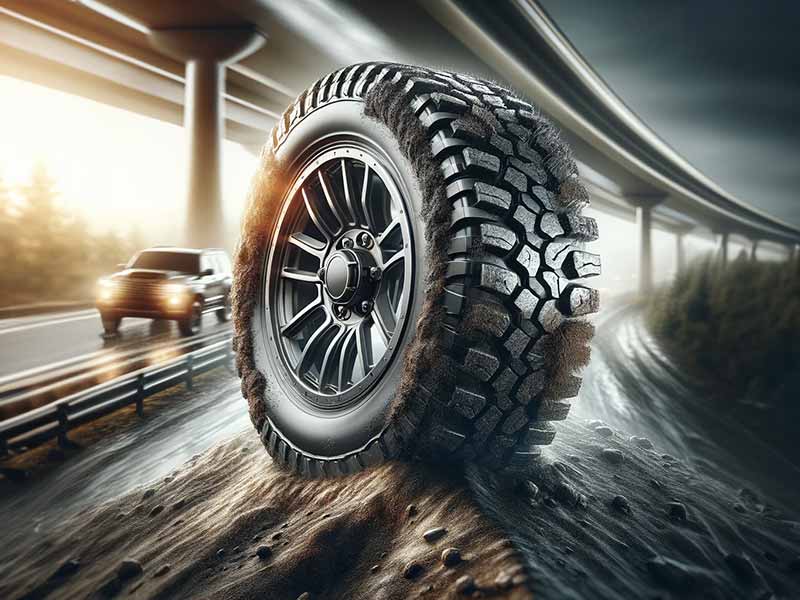
A highway-friendly all-terrain tire uses tread blocks that are strong enough for loose surfaces but closely linked enough for stable pavement driving. That design reduces tread squirm, which is the slight movement you may feel during braking or steering.
Look for these features:
- Closely spaced tread blocks: Usually quieter and more stable on asphalt.
- Wide circumferential grooves: Help move water away from the contact patch.
- Stable shoulder blocks: Improve cornering and reduce wandering.
- Rigid internal construction: Can improve steering response and resistance to road damage.
- 3PMSF snow rating: Indicates that the tire passed a defined severe-snow traction test.
- Correct load and speed ratings: Ensure the tire is suitable for your vehicle.
An aggressive all-terrain tire can look capable but still perform poorly on the highway. Large gaps between tread blocks may help in mud, yet they can create more noise, vibration, and wandering at 65 to 75 mph.
All-terrain versus highway-terrain tires
The terms describe different design priorities.
Highway-terrain tires focus on:
- Quiet operation
- Smooth steering
- Wet pavement
- Long road mileage
- Lower rolling resistance
All-terrain tires focus on:
- Pavement and gravel-road use
- Better traction on loose dirt
- Stronger shoulders and sidewalls
- More resistance to cuts and chips
- Greater snow and trail capability
Mud-terrain tires focus on:
- Deep mud
- Large rocks
- Uneven trails
- Self-cleaning tread
Mud-terrain tires are usually the least comfortable choice for long highway trips. Their large tread gaps can add noise and reduce smooth pavement grip.
What the 3PMSF symbol means
The 3PMSF symbol does not mean a tire is equivalent to a dedicated winter tire. It means the tire met a standardized severe-snow traction test under defined conditions.
A 3PMSF-rated all-terrain tire can be a useful choice for drivers in states with regular snow. Still, winter tires remain the stronger option for frequent ice, packed snow, and very low temperatures. Studded tires may also be legal in some areas during set seasons, but state rules vary.
How to choose the best tire for your driving
Start with your actual driving pattern, not the tire’s appearance. A tire that works well in Arizona desert trails may be a poor choice for a driver who spends every day on crowded New Jersey or California highways.
1. Check the original tire size
Find the size on the driver’s door-jamb label, owner’s manual, or current tire sidewall. A common format is:
265/70R17 115T
This means:
- 265: Tire width in millimeters
- 70: Sidewall height as a percentage of width
- R: Radial construction
- 17: Wheel diameter in inches
- 115: Load index
- T: Speed rating
Do not select a replacement based only on width or wheel diameter. The replacement must meet the vehicle maker’s requirements.
2. Match the load rating
The load index shows how much weight one tire can carry under specified conditions. A heavier tire is not automatically safer or better.
A tire with too low a load rating may be unsuitable for a loaded pickup, full-size SUV, or towing use. A much heavier tire can add ride harshness, steering effort, and rolling resistance.
Check the vehicle placard first. For trucks with a LT tire designation, also check whether the vehicle requires Load Range C, D, or E.
3. Consider your highway percentage
Use this simple guide:
- 90% or more pavement: Choose a highway-terrain tire.
- 70% to 90% pavement with gravel and snow: Choose a road-focused all-terrain tire.
- Frequent dirt roads and mild trails: Choose a more durable all-terrain model.
- Regular mud, rocks, or technical trails: Consider a more aggressive tire, but accept more noise and lower road comfort.
This is not a legal rule. It is a practical way to match the tire to its main job.
4. Think about weather
For rain, prioritize wet braking and water evacuation. For snow, look for the 3PMSF symbol. For ice, an all-terrain tire remains a compromise; a winter tire usually provides better cold-weather grip.
Do not assume that the “M+S” marking means severe-snow performance. The M+S marking is different from the 3PMSF symbol and does not represent the same test.
5. Check the full tire specification
Before buying, confirm:
- Tire size
- Load index
- Speed rating
- 3PMSF status, if needed
- XL or LT construction
- Approved wheel width
- Vehicle clearance
- Warranty terms
- Spare-tire compatibility
Tire models can differ by size. One size may have a 3PMSF rating while another size does not. Always check the exact size listed by the manufacturer.

Highway performance trade-offs to expect
Every all-terrain tire gives up something to gain off-road ability. The key is choosing a trade-off you can live with.
Noise
Tread noise often comes from large blocks striking the road at different intervals. More open tread usually creates more sound. Noise can also increase as the tire develops uneven wear.
A road-focused all-terrain tire should be quieter than a mud-terrain tire, but it may still be louder than a highway-terrain tire.
Fuel economy
Rolling resistance affects fuel use. A heavier tire with a stiffer casing and deeper tread may require more energy to turn.
The difference varies by vehicle, tire size, pressure, load, speed, and weather. Do not rely on a general fuel-economy claim without a controlled test using the same vehicle and conditions.
Steering and braking
A stiff all-terrain tire can feel less quick to turn than a road tire. Tread movement may also affect braking feel on dry pavement.
Correct inflation matters. Use the pressure on the vehicle placard, not the maximum pressure printed on the tire sidewall. The sidewall number is the tire’s maximum rated pressure, not necessarily the correct pressure for your vehicle.
Ride comfort
A tire with strong sidewalls may resist damage better on gravel, but it can transmit more bumps into the cabin. Lowering pressure may improve comfort off-road, but it should only be done within safe limits and with a plan to restore road pressure before highway travel.
Never drive at reduced trail pressure on the highway.

Common mistakes when buying all-terrain tires
The most common mistake is choosing the most aggressive-looking tire instead of the tire that matches the vehicle’s real use.
Avoid these errors:
Buying for appearance alone
Large sidewall lettering and deep tread do not prove better highway performance. Compare construction, ratings, warranty terms, and independent test conditions.
Ignoring tire pressure
Underinflation can increase heat, wear, steering effort, and fuel use. Overinflation can reduce the contact patch and make the ride harsh. Check pressure when the tires are cold.
Mixing tire types
Avoid mixing different tire models or tread designs unless the vehicle maker or a qualified tire professional confirms that the setup is suitable. Four-wheel-drive and all-wheel-drive systems can be sensitive to differences in tire diameter.
Using a tire that is too large
A larger tire may rub the suspension, body, or fender liner. It can also affect speedometer readings, acceleration, braking, and transmission behavior.
Treating treadwear numbers as direct comparisons
The UTQG treadwear number can help compare tires within a manufacturer’s range, but it is not a universal mileage promise across brands. Driving style, alignment, climate, load, and rotation habits all affect tire life.
Forgetting alignment
If the steering wheel is off-center, the vehicle pulls, or one edge wears quickly, have the alignment checked. A new set of tires cannot fix a worn suspension part or a bent component.

How to maintain all-terrain tires for safer highway use
Good maintenance can matter as much as the tire model.
- Check pressure at least once a month and before long trips.
- Inspect for cuts, bulges, punctures, and exposed cords.
- Rotate tires according to the vehicle and tire maker’s schedule.
- Check tread depth across the full width of each tire.
- Watch for irregular wear, such as cupping, feathering, or one-sided wear.
- Inspect the spare tire, especially before towing or remote travel.
- Replace damaged tires, even if the tread looks deep.
The U.S. Tire Manufacturers Association recommends regular tire inspections and proper inflation. The National Highway Traffic Safety Administration also advises checking tire pressure, tread, and condition before driving.
If a tire has a sidewall bulge, visible cord, major cut, or repeated air loss, do not continue highway use. Have it inspected by a qualified tire professional.

Best choice by driver type
Use this quick guide:
- Mostly interstate and city pavement: Michelin Defender LTX M/S 2 or another highway-terrain tire.
- Highway driving with gravel roads and snow: BFGoodrich Trail-Terrain T/A.
- Crossover with occasional trails: Falken Wildpeak A/T Trail.
- Quiet road manners with light off-road use: Continental TerrainContact A/T.
- More frequent dirt-road travel: Yokohama Geolandar A/T G015 or a similar moderate all-terrain tire.
- Heavy mud and technical trails: A mud-terrain tire, but expect more road noise and weaker pavement comfort.
The final decision should be made using the exact tire size and vehicle fitment. A model that works well on a midsize crossover may not be the right choice for a loaded three-quarter-ton pickup.

Frequently asked questions
Are all-terrain tires good for long highway trips?
Yes, road-focused all-terrain tires can work well for long highway trips when correctly sized and inflated. They will usually be noisier and less fuel-efficient than highway-terrain tires, especially as the tread wears.
Are all-terrain tires safe in rain?
Many all-terrain tires provide good wet-road traction, but performance varies by model and wear. Slow down in heavy rain, maintain tire pressure, and replace tires when tread or condition becomes unsafe.
Do all-terrain tires improve snow traction?
Some do, especially models with the 3PMSF symbol. They can improve traction in loose snow compared with standard all-season tires. They are still not a substitute for dedicated winter tires on ice or frequent packed snow.
How long do highway all-terrain tires last?
There is no reliable universal mileage figure. Tire life depends on compound, vehicle weight, alignment, inflation, rotation, speed, road surface, and driving style. Use the tread and condition as the main guide rather than a mileage promise.
Should I use different all-terrain tires on the front and rear?
Usually, no. Use a matched set unless the vehicle manufacturer specifically permits a different arrangement. AWD and 4WD vehicles may require closely matched rolling circumference at all four corners.
Can I lower tire pressure for off-road driving?
You may be able to reduce pressure for slow off-road travel, but the correct value depends on the vehicle, tire, load, wheel, and terrain. Restore the vehicle-maker’s recommended cold pressure before returning to the highway.
Final recommendation
For most U.S. drivers who want one tire for commuting, interstate travel, rain, occasional snow, gravel roads, and light trails, the BFGoodrich Trail-Terrain T/A is a strong all-around choice.
If your vehicle rarely leaves pavement, choose a highway-terrain tire instead. If you drive a crossover and want extra trail and snow ability, compare the Falken Wildpeak A/T Trail and Continental TerrainContact A/T.
Before buying, confirm the exact size, load index, speed rating, 3PMSF status, vehicle clearance, and pressure requirements. The best all-terrain tire is not the most aggressive one. It is the one that matches your roads, weather, vehicle, and daily priorities.