

No new car is truly 100% made in the United States. Modern vehicles use global supply chains. Parts such as chips, sensors, batteries, steel, glass, and raw materials may come from several countries.
Still, many cars are assembled in the USA and contain a high share of U.S. and Canadian parts. Some also use engines, transmissions, and batteries made in North America. If your goal is to buy an American-made car, the best approach is to check the vehicle’s official labeling rather than rely on the brand name.
This guide explains what “made in America” means, which vehicles tend to rank highly for U.S. content, and how to check a specific car before you buy it.

What Does “Made in America” Mean for a Car?
“Made in America” can mean several different things. The phrase may refer to final assembly, parts content, company ownership, or the location of the factory.
These are not the same thing:
- Assembled in the United States: The final factory work takes place in the USA.
- American-made parts: Some or many parts come from U.S. suppliers.
- North American content: Parts come from the United States, Canada, or Mexico.
- American brand: The company has U.S. roots or a U.S. headquarters.
- Made in USA: A stronger claim that suggests nearly all important parts and processing come from the United States.
A Ford, Chevrolet, Tesla, Toyota, Honda, or BMW may be built in an American plant. That does not mean every part came from the United States.
The FTC standard for a “Made in USA” claim
The Federal Trade Commission says an unqualified “Made in USA” claim requires that a product be “all or virtually all” made in the United States.
That standard covers more than final assembly. It also considers the origin of important parts and processing. Most modern cars would not meet this strict standard.
A company may instead use a qualified statement, such as:
- “Assembled in the USA with domestic and imported parts”
- “Made in America of U.S. and imported parts”
- “Built in the United States”
The exact wording matters.
Why Canadian content is often included
Federal vehicle labels commonly report U.S. and Canadian parts content together. This comes from the American Automobile Labeling Act, or AALA.
The label may show:
- The percentage of U.S. and Canadian content
- The country of final assembly
- The countries where the engine and transmission were made
This means a car listed with 60% domestic content may include parts from both the United States and Canada. It does not necessarily contain 60% U.S.-only content.

Are Any Cars 100% Made in America?
No mass-produced passenger car can be safely described as 100% American without checking every part and raw material. Even a vehicle assembled in the USA may use imported electronics, minerals, fabrics, glass, fasteners, or battery materials.
The strongest candidates are vehicles that have:
- Final assembly in the United States
- A U.S. or North American engine and transmission
- High U.S. and Canadian parts content
- A large U.S. supplier base
- Batteries made in the USA or North America, when applicable
Even these factors do not prove that every component is American.
Why total U.S. production is difficult
A car has thousands of parts. One supplier may make a part in the USA but use imported materials. Another may make a component in Mexico or Canada. A third may source chips from Asia.
Electric vehicles add another layer. Their batteries depend on:
- Battery cells
- Cathode and anode materials
- Lithium
- Nickel
- Cobalt
- Graphite
- Electronics and control systems
A vehicle can have U.S. final assembly and still rely on a global battery supply chain.
The best practical answer
If you want the most American-made vehicle possible, look for a model with:
- A high AALA domestic-content percentage
- U.S. final assembly
- A U.S.-built engine or battery
- A U.S.-built transmission, if it uses one
- A strong score in a transparent American-made ranking
Treat the result as a comparison, not proof of 100% U.S. origin.

Which Cars Have the Most American Content?
The answer changes by model year, trim, factory, and supplier contract. A vehicle’s parts content can change during the year.
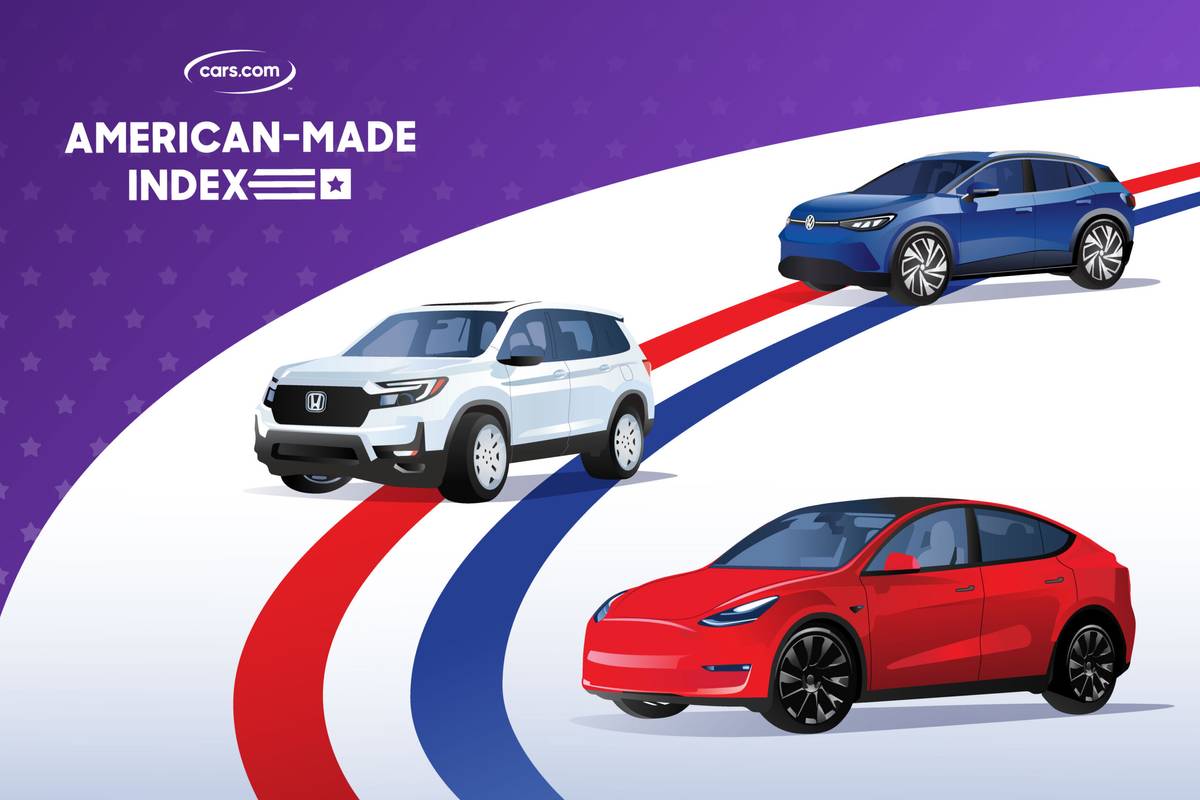
Independent rankings can help. For example, the Cars.com American-Made Index reviews factors such as:
- U.S. assembly
- Parts content
- U.S. manufacturing workforce
- Engine origin
- Transmission origin
- Sales volume
Recent editions have placed several Tesla models near the top. Other strong performers have included certain Jeep, Ford, Honda, and Volkswagen models built in U.S. plants.
That does not mean every model on such a list is fully American. It means the model performed well under that ranking’s method.
Common examples of highly American-built vehicles
The following vehicles have often received attention for U.S. production or high domestic content. Verify the exact model year and trim before buying.
| Vehicle or vehicle family | Why it may qualify | What to verify |
|---|---|---|
| Tesla Model 3 | U.S. production for some versions and strong domestic manufacturing | Final assembly, battery source, and exact configuration |
| Tesla Model Y | U.S. production for some versions and a large U.S. manufacturing base | Factory location and battery origin |
| Jeep Gladiator | Built in the United States and often associated with high domestic content | AALA percentage and powertrain origin |
| Jeep Wrangler | U.S. assembly and a large domestic supplier network | Trim, engine, and transmission source |
| Ford F-Series | Major U.S. production and deep North American manufacturing | Specific plant, engine, and parts percentage |
| Chevrolet Corvette | Final assembly in Kentucky | Imported parts and component sources |
| Honda Passport | U.S. assembly in Alabama for applicable model years | Engine, transmission, and AALA content |
| Volkswagen ID.4 | U.S. assembly for applicable versions | Battery and component origin |
This list is not a claim that each vehicle is completely American. It is a starting point for research.
Why the trim level matters
Two versions of the same model may have different origins. A vehicle may use:
- Different engines
- Different batteries
- Different transmissions
- Different wheels
- Different electronics
- Different suppliers
The factory may also shift production during a model year. Always check the window sticker for the exact vehicle identification number, or VIN.
How to Check Whether a Car Is Made in the USA
Use the vehicle’s official label and build information. Do not rely only on the badge or the location of the dealership.
Step 1: Check the final assembly country
The window sticker should identify the country where the vehicle was finally assembled.
Look for wording such as:
Final assembly point: United States
This tells you where the vehicle became a finished vehicle. It does not show that all parts came from the USA.
Step 2: Find the domestic parts percentage
The sticker may list the percentage of U.S. and Canadian parts content.
Use this number as a comparison tool. Remember:
- It may combine U.S. and Canadian content.
- It may apply only to that exact vehicle.
- It may not include every raw material.
- It can change between model years.
A higher percentage is useful, but it is not the same as 100% U.S. content.
Step 3: Check the engine and transmission countries
The label often lists where the engine and transmission were made.
A vehicle assembled in Michigan may have an engine from Mexico and a transmission from Canada. That is still a North American supply chain, but it is not fully U.S.-made.
Step 4: Confirm the VIN and build plant
The VIN can help identify the vehicle’s manufacturing plant. You can also ask the dealer for the vehicle’s build sheet.
For used cars, check:
- The VIN
- The original window sticker
- The build sheet
- The model year
- The factory recall or service record
A used vehicle may have been built before a production change.
Step 5: Check the manufacturer’s current information
Manufacturers publish plant and production details on corporate websites. These pages can confirm where a model is assembled, but they may not list every supplier or component source.
Use manufacturer information for factory location. Use the vehicle label for the exact vehicle’s domestic-content details.

U.S. Assembly vs. U.S. Parts Content
U.S. assembly and U.S. parts content measure different things. A car can score high in one category and low in the other.
Consider these examples:
| Example | Final assembly | Parts content | What it means |
|---|---|---|---|
| Vehicle A | USA | Low | Built here, but many parts come from abroad |
| Vehicle B | Mexico | High North American content | Not assembled in the USA, but uses many regional parts |
| Vehicle C | USA | High U.S. and Canadian content | A stronger American-made choice |
| Vehicle D | USA | Unknown battery origin | More research is needed for an EV |
This distinction matters because “American made” can reflect different priorities.
You may care most about:
- Supporting U.S. factory jobs
- Buying from U.S. suppliers
- Reducing overseas shipping
- Supporting U.S. battery production
- Choosing an American-owned company
- Meeting a fleet or government purchasing rule
No single label answers all of these questions.

Do American Brands Make American Cars?
Sometimes, but brand ownership is not a reliable guide to vehicle origin.
A company may be American-owned but build a car in Canada, Mexico, Japan, South Korea, or Europe. A foreign-owned company may build a large share of its vehicles in the United States.
Examples include:
- Toyota plants in the United States
- Honda plants in the United States
- BMW production in South Carolina
- Mercedes-Benz production in Alabama
- Volkswagen production in Tennessee
- Hyundai and Kia production in the United States
The company’s headquarters and the car’s factory can be in different countries.
For this reason, ask three separate questions:
- Where was the car assembled?
- Where were its major parts made?
- Who owns the company?
The first two affect the vehicle’s production origin. The third describes corporate ownership.

Are Electric Cars More or Less American-Made?
Electric vehicles can be either more or less American-made than gasoline vehicles. The answer depends on the battery and the production site.
An EV assembled in the United States may have a U.S.-built battery pack. However, the battery cells and raw materials may come from different countries.
A gasoline vehicle may have a U.S.-built engine but imported electronics. A hybrid may combine a U.S.-assembled vehicle with a battery system from another country.
For an EV, check:
- Vehicle final assembly
- Battery pack assembly
- Battery cell origin
- Critical-mineral sourcing
- U.S. and Canadian content
- Eligibility under current federal clean-vehicle rules, if that affects your purchase
The U.S. Department of Energy Alternative Fuels Data Center explains federal clean-vehicle incentives and sourcing rules. Those rules are not the same as a general “made in America” test.
A vehicle can qualify for an incentive under a legal formula without being entirely made in the United States.
Does the “American-Made Index” Prove a Car Is 100% American?
No. An index is a ranking system, not a legal certificate of origin.
A ranking can be useful because it compares vehicles using several factors. However, every ranking has its own:
- Data sources
- Weighting system
- Model-year rules
- Treatment of engines and transmissions
- Treatment of batteries
- Definition of “American-made”
Read the method before using the ranking. A vehicle may rank highly because it creates many U.S. jobs or uses a domestic engine. That does not establish that every component is American.
Use rankings to build a shortlist. Then verify the exact car’s label.
Common Mistakes When Shopping for an American-Made Car
Mistake 1: Assuming an American badge means U.S. production
Brand history does not prove where a specific car was built. Check the sticker and VIN.
Mistake 2: Treating final assembly as total origin
Final assembly is only one part of the supply chain. A vehicle assembled in the USA may use many imported parts.
Mistake 3: Comparing different model years
Production locations and suppliers can change. Compare the same model year and trim when possible.
Mistake 4: Ignoring batteries
For an electric or hybrid vehicle, the battery can represent a major part of the vehicle’s manufacturing footprint.
Mistake 5: Treating U.S. and Canadian content as U.S.-only content
A domestic-content label may combine both countries. Read the wording carefully.
Mistake 6: Trusting a sales claim without documentation
Ask the dealer for the window sticker or build sheet. If the answer is vague, verify it through the manufacturer or official labeling data.
A Simple Buying Checklist
Before you decide, use this checklist:
- Confirm the exact model year.
- Confirm the trim level.
- Check the final assembly country.
- Record the U.S. and Canadian parts percentage.
- Check the engine country.
- Check the transmission country.
- Check the battery origin for an EV or hybrid.
- Compare the result with a transparent independent ranking.
- Keep the window sticker for your records.
If U.S. origin is part of a business, government, or tax decision, review the exact rule that applies. Commercial and legal programs may define “domestic” differently from consumer vehicle labels.
Frequently Asked Questions
Is there a car made entirely in the United States?
No mass-market car can be confirmed as 100% U.S.-made without tracing every part and raw material. The closest practical measure is a vehicle with U.S. final assembly, high U.S. and Canadian content, and a North American powertrain.
Which car has the most American parts?
The answer changes by model year and trim. Tesla, Jeep, Ford, Honda, and some other manufacturers have produced vehicles that rank highly for U.S. production and content. Check the current vehicle label rather than relying on a fixed list.
Are Tesla cars completely made in America?
No. Some Tesla vehicles are assembled in the United States, but Tesla uses a global supply chain. The factory, battery, and parts origin can differ by model and configuration.
Does buying an American-brand car support U.S. jobs?
It can, but the effect depends on where the vehicle and its parts are made. A foreign-owned company with a U.S. factory may employ more American workers on a particular model than an American-owned company that imports that model.
How can I verify where a used car was made?
Use the VIN, original window sticker, build sheet, and manufacturer information. Check the model year because production details may change over time.
Bottom Line
There are many cars assembled in the United States, but no ordinary new car should be described as completely made in America. Modern vehicles use global parts, materials, and technology.
For the most American-made choice, compare the exact vehicle’s final assembly location, U.S. and Canadian parts percentage, engine origin, transmission origin, and battery source. The window sticker is usually the best place to start.
The practical rule is simple: buy the vehicle with the strongest documented U.S. production profile, not the vehicle with the most patriotic badge.