

A new Goodyear tire usually costs about $100 to $500 per tire in the United States. That puts a set of four at roughly $400 to $2,000 before installation, taxes, and shop fees.
Most drivers will pay less than the top of that range. A common price for a Goodyear passenger-car tire is about $120 to $250 each. Large SUV, pickup, performance, run-flat, and electric-vehicle tires can cost much more.
The exact price depends on the tire line, tire size, vehicle, speed rating, load rating, retailer, and current sale. Installation often adds $25 to $50 per tire, although some stores include mounting and balancing in a package.
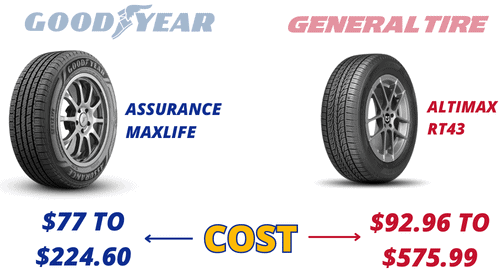
Goodyear tire prices at a glance
The table below gives useful planning ranges for the U.S. market. These are estimates, not guaranteed quotes. Retail prices change by size, dealer, region, and promotion.
| Goodyear tire type | Approximate price per tire | Approximate set of four |
|---|---|---|
| Basic all-season passenger tire | $100–$170 | $400–$680 |
| Touring all-season tire | $130–$230 | $520–$920 |
| Premium all-season tire | $160–$280 | $640–$1,120 |
| All-weather or winter tire | $150–$300 | $600–$1,200 |
| Performance tire | $150–$350 | $600–$1,400 |
| SUV or crossover tire | $150–$300 | $600–$1,200 |
| Pickup or light-truck tire | $170–$400 | $680–$1,600 |
| Run-flat tire | $200–$450 | $800–$1,800 |
| Large, premium, or specialty tire | $250–$500+ | $1,000–$2,000+ |
A tire listed at $180 does not always cost $180 at checkout. The final bill may include installation, sales tax, tire disposal, valve stems, road-hazard coverage, and an alignment.
A useful starting estimate is:
Total tire cost = tire price × number of tires + installation fees + taxes + optional services
For example, four Goodyear tires priced at $185 each would cost:
- Tires: 4 × $185 = $740
- Installation at $35 each: 4 × $35 = $140
- Estimated pretax total: $880
- Sales tax and other fees: added at checkout
What affects the cost of Goodyear tires?
The tire’s size is often the biggest price factor. A 225/65R17 tire for a midsize SUV may cost far less than a 275/55R20 tire for a full-size truck, even when both come from the same product family.
Tire size
You can find the correct size on the tire sidewall or inside the driver’s door frame. A marking such as 235/55R18 100V includes several details:
- 235: tire width in millimeters
- 55: sidewall height as a percentage of width
- R: radial construction
- 18: wheel diameter in inches
- 100: load index
- V: speed rating
Do not switch to a different size only because it costs less. The replacement tire should match the vehicle maker’s approved size, load capacity, and speed rating unless a qualified tire professional confirms an alternative.
Tire line and intended use
Goodyear sells different tire families for different driving needs. A basic commuter tire may cost less than a tire designed for wet grip, severe snow, high speed, towing, or extended mobility after a puncture.
Common Goodyear categories include:
- All-season passenger tires for daily driving
- Touring tires for quiet rides and highway use
- Performance tires for sharper handling
- All-weather tires for drivers who see regular snow but want one set year-round - Winter tires for cold weather and snow
- SUV and crossover tires for heavier vehicles
- Light-truck tires for towing, hauling, and off-road use
- Run-flat tires for limited driving after certain punctures
- Electric-vehicle tires designed around the needs of some EVs
A higher price does not mean a tire is better for every driver. It may reflect a different goal, such as wet braking, snow traction, low road noise, or high load capacity.
Load rating and speed rating
Heavier vehicles need tires that can carry more weight. Pickup trucks, large SUVs, and vehicles used for towing often require a higher load range. That extra capacity can raise the price.
Performance cars may need a higher speed rating. Those tires often use specialized tread compounds and construction, which can also increase cost.
Never reduce the load or speed rating below the vehicle manufacturer’s requirement to save money.
Run-flat construction
Run-flat tires usually cost more than standard tires. They use reinforced sidewalls that may allow limited travel after a loss of air pressure.
They can be useful for some vehicles, but they may produce a firmer ride and can cost more to replace. The vehicle must be designed for the correct run-flat system. Check the owner’s manual before changing between run-flat and standard tires.
Seasonal demand
Winter tires may become more expensive or harder to find before major snow events. Buying late in the season can limit your choices.
Prices can also change during holiday sales, manufacturer rebates, warehouse promotions, and retailer events. Compare the final installed price rather than focusing only on the advertised tire price.
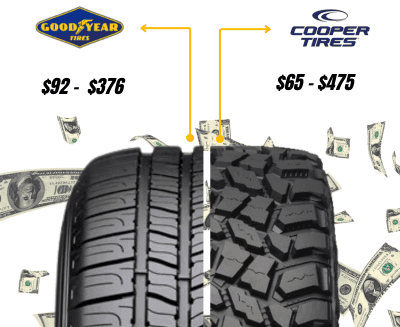
How much does a full set of Goodyear tires cost?
A full set of Goodyear tires commonly costs $500 to $1,400 before installation. Large trucks, luxury SUVs, sports cars, and vehicles with run-flat tires may exceed that range.
Here are three hypothetical examples:
Example 1: Compact sedan
- Four tires at $135 each: $540
- Installation at $30 each: $120
- Pretax total: $660
Example 2: Midsize SUV
- Four tires at $205 each: $820
- Installation at $35 each: $140
- Pretax total: $960
Example 3: Full-size pickup
- Four tires at $285 each: $1,140
- Installation at $40 each: $160
- Pretax total: $1,300
These examples do not include taxes, alignment, road-hazard coverage, or other shop charges.
Some vehicles use different tire sizes on the front and rear axles. Others require special tires with manufacturer-specific markings. In those cases, a “set of four” may not mean four identical tires.
What do Goodyear installation fees include?
Installation usually includes mounting the tire on the wheel and balancing the wheel and tire assembly. The package may also include new valve stems or a basic tire-pressure monitoring system service.
Ask the shop to list each fee before approving the work. Common charges include:
- Mounting
- Computer balancing
- Valve stems
- Tire-pressure monitoring system service
- Tire disposal
- Shop or environmental fees
- Road-hazard protection
- Alignment
- Taxes
An alignment is not automatically needed with every tire purchase. It may be useful when the vehicle pulls to one side, the steering wheel is off-center, or the old tires show uneven wear. A bent wheel or worn suspension part may also cause uneven wear, so an alignment alone may not solve the problem.
A sample installed-price calculation
Suppose a retailer lists a Goodyear tire at $210:
- Four tires: $840
- Mounting and balancing: $140
- Disposal fees: $20
- Estimated pretax total: $1,000
If the shop also recommends a four-wheel alignment for $120, the pretax total becomes $1,120.
The best comparison is the out-the-door price for four tires, not the tire-only price.

How to get the lowest safe Goodyear tire price
You can often reduce the total cost without choosing an unsuitable tire. Compare the correct tire size and required specifications across several sellers.
1. Confirm the vehicle requirements
Check:
- Tire size
- Load index
- Speed rating
- Run-flat requirement
- Original-equipment markings
- Seasonal requirements
- Front and rear size differences
The driver’s door placard and owner’s manual are better starting points than a generic online search.
2. Compare installed prices
Ask each retailer for the same information:
“What is the total price for four Goodyear tires in this exact size, including mounting, balancing, disposal, taxes, and any mandatory fees?”
This question helps uncover a low advertised price with high service charges.
3. Check manufacturer rebates
Goodyear and retailers may offer rebates at certain times. Read the terms closely. A rebate may require:
- A minimum purchase
- A specific tire line
- A qualifying retailer
- Online submission
- A purchase window
- A limited redemption period
Treat the rebate as a possible discount, not an immediate reduction, until you confirm how it is paid.
4. Compare nearby tire lines carefully
A less expensive Goodyear tire may meet your needs if your driving is mostly local and highway travel in mild weather. A premium tire may be worth the added cost if you drive long distances, face heavy rain, use a high-performance vehicle, or need stronger snow performance.
Do not compare only the name. Compare the tire’s intended use, warranty terms, traction rating, treadwear information, and fit for your vehicle.
5. Consider buying two tires only when appropriate
Replacing two tires can cost less than replacing four, but it is not always the right choice.
If the other two tires are worn, damaged, old, or have a large tread-depth difference, replacing only two may affect handling. On many all-wheel-drive vehicles, the owner’s manual may require closely matched tire circumference. Ask a tire professional before mixing new and partly worn tires.
If only two tires are replaced on a vehicle that permits it, the new tires are commonly installed on the rear axle to help maintain stability on wet roads. Follow the vehicle and tire maker’s guidance.
Are Goodyear tires worth the price?
Goodyear tires can be worth the price when the selected model fits your vehicle, weather, and driving needs. Brand name alone does not determine value.
A useful value check includes:
- Expected tread life
- Wet-road grip
- Snow performance, if relevant
- Ride comfort and noise
- Fuel economy
- Warranty coverage
- Availability in the correct size
- Installed price
- Cost of replacement if one tire is damaged
A cheap tire that wears quickly may cost more over time. A premium tire may also be poor value if its features do not matter to your driving.
Treadwear numbers need context
Many U.S. passenger tires carry a Uniform Tire Quality Grading, or UTQG, treadwear number. The number can help compare tires tested under the same grading system, but it is not a guaranteed mileage promise.
Actual life depends on alignment, inflation, rotation, road surfaces, climate, vehicle weight, driving style, and maintenance. A tire warranty also has conditions and exclusions. Read the specific warranty for the tire model.
Warranty terms vary
Goodyear warranties may differ by tire family and may cover workmanship, materials, tread life, or road hazards under separate terms. Coverage can depend on:
- Proper rotation
- Inflation maintenance
- Proof of purchase
- Vehicle alignment
- Tire age
- Remaining tread
- Damage type
- Service records
A warranty does not make an unsafe or damaged tire suitable for continued use. Inspect tires regularly and replace them when they reach the legal or manufacturer safety limit.

When should you replace Goodyear tires?
Replace a tire when it has unsafe damage, insufficient tread, or age-related deterioration. Do not wait for a tire to fail at highway speed.
Look for:
- Tread at or near the wear bars
- Cracks in the sidewall or tread
- Bulges or bubbles
- Cuts that reach the internal structure
- Repeated air loss
- Exposed cords
- Severe vibration
- Uneven wear
- Damage from a pothole or curb
The National Highway Traffic Safety Administration advises drivers to inspect tires and follow the vehicle maker’s guidance. Many tire makers also recommend replacing tires based on age, even when tread remains. Check the tire manufacturer’s current guidance and the DOT date code on the sidewall.
A tire with a bulge, exposed cord, or suspected internal damage should not be repaired. Have it inspected promptly by a qualified tire professional.
How to check the age of a Goodyear tire
The last four digits of the Department of Transportation, or DOT, tire identification number show the week and year of manufacture.
For example:
- 2423 means the tire was made in the 24th week of 2023.
The full code may appear on only one side of the tire. You may need to look at the inner sidewall or ask a technician to inspect it.
Age is only one factor. Storage, heat, sunlight, inflation, loading, and use also affect tire condition. A tire can have good tread and still need professional inspection because of age or cracking.
Common mistakes when shopping for Goodyear tires
The most costly mistake is choosing a tire by price alone. A bargain tire that does not meet the vehicle’s load requirement is not a safe bargain.
Avoid these errors:
- Buying the wrong tire size
- Ignoring load or speed ratings
- Comparing tire-only prices instead of installed prices
- Assuming every Goodyear tire has the same warranty
- Replacing only one tire on an all-wheel-drive vehicle without checking the manual
- Skipping an inspection for alignment or suspension problems
- Ignoring tire age
- Treating a rebate as an instant discount
- Choosing winter tires based only on the word “all-season”
- Forgetting to check whether the vehicle requires run-flat tires
Do not use a tire-pressure number printed on the sidewall as the normal inflation setting. That number is usually the tire’s maximum pressure. Use the pressure listed on the vehicle placard or in the owner’s manual.
Where should you buy Goodyear tires?
You can buy Goodyear tires from the manufacturer’s dealer network, national tire chains, independent tire shops, warehouse clubs, and online retailers.
The best option depends on more than the sticker price. Compare:
- Total installed cost
- Availability of the exact size
- Installation appointment time
- Free rotation policy
- Flat repair policy
- Warranty support
- Road-hazard coverage
- Return and replacement terms
- Local service after purchase
An online seller may have a lower tire price but charge separately for installation. A local shop may cost slightly more while offering easier warranty service and inspection.
Use Goodyear’s official website to identify the correct tire size and product category, then compare final prices from reputable U.S. retailers.

Frequently asked questions
How much are four Goodyear tires with installation?
Four Goodyear tires with installation often cost about $600 to $1,600 for common cars, crossovers, and light trucks. Large truck, luxury, performance, run-flat, and specialty applications can cost more than $2,000.
Is Goodyear a budget tire brand?
Goodyear sells tires across several price levels. Some models are priced for value, while others are premium products for performance, snow, heavy loads, or specialized vehicles. The brand cannot be classified as only budget or only premium.
Does Goodyear offer free installation?
Installation terms depend on the retailer, promotion, and purchase package. Some sellers include mounting and balancing, while others charge per tire. Confirm the full price before ordering.
How long do Goodyear tires last?
There is no single mileage figure for every Goodyear tire. Tire life depends on the model, alignment, inflation, rotation, climate, road surface, vehicle, and driving habits. Use the tread indicators and inspect the tire’s condition rather than relying on mileage alone.
Can I replace just one Goodyear tire?
Sometimes, but it depends on tread wear, drivetrain, tire model, and the vehicle maker’s instructions. Replacing one tire beside three much newer or much older tires can affect handling. All-wheel-drive vehicles may have stricter limits on tread-depth differences.
Bottom line
Plan on $100 to $500 per Goodyear tire in the United States, with many everyday passenger tires falling near $120 to $250 each. A typical installed set often lands between $600 and $1,600, but large trucks, run-flats, performance cars, and specialty vehicles can cost more.
Before buying, confirm the exact size and ratings, compare installed prices, check current rebates, and ask whether the vehicle needs an alignment or matched tires. The lowest safe cost is the price of a tire that fits the vehicle and performs well in the conditions you actually drive.