Where to Put Coolant in Car: Essential Guide
Title: Where to Put Coolant in Car — Quick, Safe Guide to Topping Up Your Radiator Fluid
Meta description (suggested): Need to know where to put coolant in your car? Learn the safe, step-by-step way to find the coolant reservoir, top up the correct fluid, avoid burns, and spot signs of leaks. Tips on coolant types, disposal, and when to see a mechanic.
Intro
If your temperature gauge spikes or a red dashboard light appears, you may need to add coolant. Knowing exactly where to put coolant in your car — and how to do it safely — is a basic but vital skill for every driver. This guide gives a clear, SEO-friendly walkthrough: the quick answer, a step-by-step topping-up process, coolant types to use, how to check levels, troubleshooting, and safety/environmental tips.
Quick answer (TL;DR)
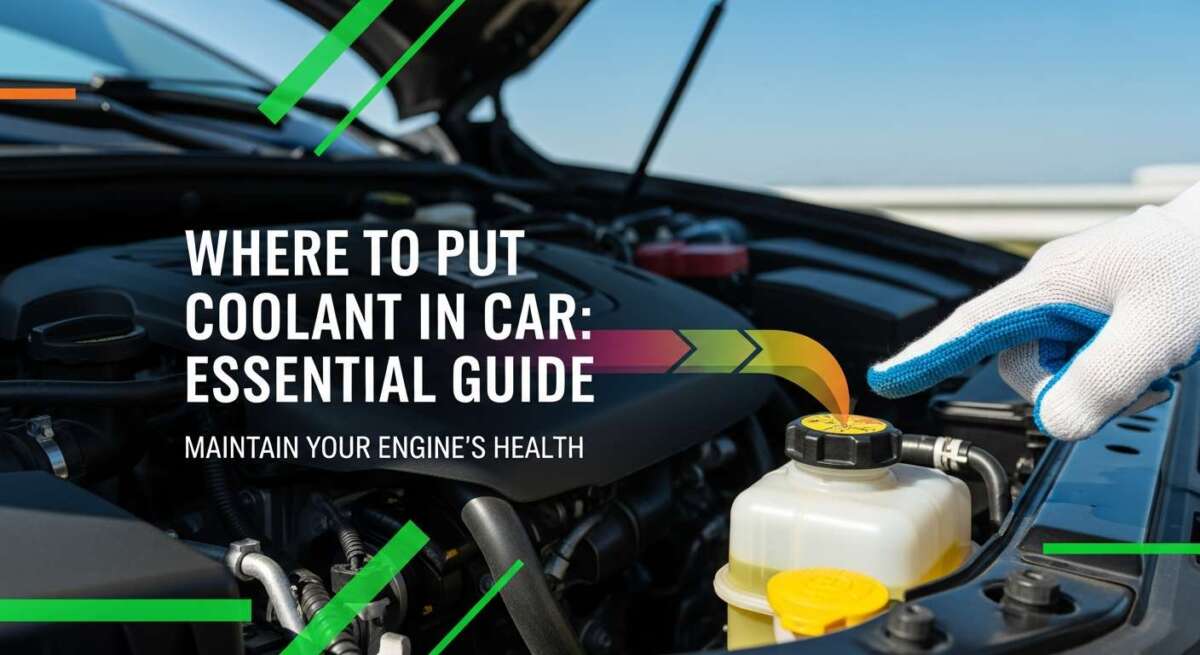
Look under the hood for a semi-transparent plastic tank marked with MIN and MAX (the coolant reservoir or overflow tank). Add a 50/50 coolant/antifreeze and distilled water mix into the reservoir until the level reaches the MAX line — but only when the engine is cold. Never open the metal radiator cap while the engine is hot.
Why coolant matters
The engine produces a lot of heat. Coolant (antifreeze mixed with water) circulates through the engine and radiator, removes heat, and prevents freezing in winter and boiling in summer. Without adequate coolant the engine can overheat, warp, or suffer serious damage.
Safety first — four golden rules
- Only open the reservoir or radiator cap when the engine is cold. Hot coolant is under pressure and can cause severe burns.
- Use gloves and safety glasses to avoid splashes and contact.
- Squeeze the upper radiator hoses (when cold) — if they’re rock hard and hot, wait longer.
- Work on level ground and engage the parking brake.
Where to put coolant in your car — step-by-step
- Prep the car
- Park on flat ground, turn off the engine, set the parking brake. Wait at least 30 minutes for the engine to cool.
- Open the hood
- Release the interior hood lever, then the exterior safety latch. Prop the hood open.
- Locate the coolant reservoir
- Find the semi-transparent plastic jug with colored fluid inside. It will have MIN and MAX or LOW and FULL marks and possibly a thermometer-in-waves symbol or the words “Engine Coolant.”
- Check the level visually
- Do not open anything. If the fluid is between MIN and MAX, no topping up is needed. If below MIN, you should add coolant.
- Choose the right fluid
- Use the coolant type recommended by your owner’s manual. Common types:
- IAT (Inorganic Additive Technology) — typically green (older vehicles)
- OAT (Organic Additive Technology) — often orange or red (long-life)
- HOAT (Hybrid OAT) — various colors
- Dex-Cool — a long-life orange/red formula used in many GM vehicles
- If you cannot confirm the type, buy a labeled “Universal” or “All makes” coolant or use premixed 50/50 coolant. Avoid mixing different coolant chemistries unless the product explicitly states compatibility.
- Pour carefully
- Use a funnel to avoid spills. Slowly open the reservoir cap (if cold). Pour the 50/50 premixed coolant until the level reaches the MAX/FULL line. Do not overfill — the system needs space for expansion.
- Close up
- Screw the cap back on securely. Wipe up any spills. Close the hood and dispose of any waste responsibly.
Reservoir vs radiator cap — which to use?
- Reservoir (plastic tank): Use this for routine topping up — it is safe and designed for maintenance.
- Radiator (metal cap): Only open the radiator cap if the system is completely empty, you have a cold engine, and you know what you’re doing (e.g., after a full coolant replacement or part repair). The radiator cap holds system pressure and can be dangerous if opened hot.
How to check coolant quality and when to flush
- Good coolant: Bright and clear (color depends on type).
- Bad/contaminated:
- Rusty or brown: indicates corrosion — consider a flush.
- Milky or oil-like: indicates coolant-oil mixing (possible head gasket problem) — stop driving and get it checked.
- Frequency: Check levels monthly and before long trips. Coolant typically needs flushing/replacement per manufacturer intervals (often every 2–5 years or 30,000–100,000 miles depending on type).
Advanced tip: burping the cooling system
- After filling, air pockets can cause overheating. To remove air:
- With a cold engine, leave the reservoir cap off.
- Start the engine and set the heater to maximum.
- Let the engine reach normal operating temperature while watching for bubbles in the reservoir.
- Add coolant as the level drops and once bubbling stops, replace the cap.
- Follow any vehicle-specific bleed procedures in the owner’s manual.
Troubleshooting — signs of a problem
- Sweet smell (maple syrup): coolant leak.
- Puddles under car (green/orange/blue fluid): external leak — inspect hoses, clamps, radiator.
- Wet passenger floor mats: heater core leak.
- Thick white exhaust smoke with sweet smell: possible blown head gasket — get professional help immediately.
- Rapid or repeated coolant loss: find and fix leak — don’t just keep topping up.
Overheating emergency steps
- Turn off air conditioning.
- Turn on the heater full blast to draw heat out of the engine.
- Safely pull over, turn off the engine, and open the hood to let heat escape.
- Wait at least 30 minutes (often longer) before checking or opening caps.
What about using water instead of coolant?
- In an emergency: distilled water can get you to a repair shop, but it’s not a long-term solution. Tap water contains minerals that can corrode and clog the system and it doesn’t provide freeze/boil protection. Replace with proper coolant as soon as possible.
Environmental responsibility and pet safety
- Coolant is toxic and attractive to animals due to its sweet taste. Wipe up spills immediately and clean the area thoroughly.
- Don’t pour old coolant on the ground or down drains. Store used coolant in a sealed container and take it to an auto parts store or recycling center that accepts it.
Tools and supplies to keep in your car
- Small bottle of premixed 50/50 coolant (check manufacturer recommendation)
- Funnel
- Gloves and safety glasses
- Rags and a small container for temporary storage (if needed)
When to see a mechanic
- If you find milky coolant, persistent loss, white smoke from the exhaust, or frequent overheating — have a qualified mechanic inspect the vehicle. Internal issues like head gasket failure or cracked heads need professional repairs.
SEO and content suggestions (for site owners)
- Primary keyword: “where to put coolant in car” — use in title, intro, first H2, and at least 2–3 times in body naturally.
- Secondary keywords to include: “how to add coolant,” “coolant reservoir,” “radiator cap,” “top up coolant,” “coolant leak signs.”
- Add images with descriptive alt text, e.g., “coolant reservoir location under hood,” and caption them.
- Include an FAQ section (below) and internal links to related posts: “how to check oil,” “what to do if car overheats,” and “coolant types explained.”
- Provide downloadable checklist or short video for higher engagement.
Frequently Asked Questions (FAQ)
Q: Can I pour coolant into the radiator cap instead of the reservoir?
A: Only if the system is completely empty and cold. For routine topping up, always use the reservoir.
Q: How often should I change coolant?
A: Follow your owner’s manual. Many modern coolants last 5 years or more; older types require more frequent changes.
Q: Can I mix different colors of coolant?
A: Do not mix without checking chemistry. Mixing incompatible coolant types can form sludge. Use universal premix if unsure.
Q: Is distilled water necessary?
A: Yes—use distilled water when mixing with concentrated antifreeze. It prevents mineral deposits found in tap water.
Q: What if I overfill the reservoir?
A: Mild overfill is usually handled by the overflow tube. Clean any spills and return fluid to the proper level if possible.
Conclusion — you’ve got this
Where to put coolant in car is easy once you know what to look for: the semi-transparent coolant reservoir marked MIN/MAX. Always work with a cold engine, use the correct coolant type, and watch for signs of leaks or contamination. Regular checks and proper topping-up will help prevent overheating and costly engine damage. Safe driving!
If you’d like, I can:
- Create a short printable checklist for your glovebox.
- Suggest vehicle-specific coolant types if you tell me your make, model, and year.