
Flying with a car seat is usually allowed in the United States, and using one in the airplane seat is the safest option for a baby or young child who has their own ticket. Before you travel, check the seat’s approval label, confirm the airline’s size rules, install it in the correct airplane seat, and keep the child secured according to the car seat manual.
U.S. airlines and the Federal Aviation Administration (FAA) have specific rules for child restraint systems. The process is manageable, but a little planning can prevent problems at the airport.

Key takeaways
- Use a car seat with a label that says it is certified for use in motor vehicles and aircraft.
- Buy a separate airplane seat for the child if you plan to use the car seat during the flight.
- A lap infant under age 2 may travel without a separate seat, but the FAA says the safest option is an approved child restraint in the child’s own seat.
- Use the airplane’s lap belt to secure the car seat. Do not use the vehicle’s lower anchors or top tether.
- A rear-facing car seat can usually be used on an airplane if it fits and does not block another passenger’s exit.
- Never place a car seat in an exit row or where it blocks access to an emergency exit.
- Airline rules can differ, so check the carrier’s policy before leaving home.
Why use a car seat on an airplane?
A car seat gives a child a safer restraint than an adult’s lap during severe turbulence or an emergency landing. An adult may not be able to hold a child securely if the aircraft drops or moves suddenly.
The FAA and the American Academy of Pediatrics recommend using an approved child restraint system on an airplane when a child has their own seat. The FAA also recommends that children under age 2 travel in their own seat with an approved restraint rather than ride as a lap infant.
A car seat also helps at the destination. You can move it from the airplane to a rental car, taxi, rideshare, or family vehicle without arranging another restraint.
Lap infant or separate seat?
In the United States, an infant under 2 years old may generally travel on an adult’s lap. The adult must hold the child during the flight, and the child does not use the adult’s seat belt.
This option may cost less, but it does not provide the same protection as a separate seat with an approved restraint. If you choose a separate seat, the child must remain in the car seat during taxi, takeoff, landing, and periods when the crew requires passengers to be seated.
Do not attach an infant to an adult with an extra belt. The FAA does not permit airlines to use a supplemental loop belt to secure a lap infant.

Check whether your car seat is approved for airplane use
Look for an approval statement on the car seat itself. In the United States, the label should state that the restraint is certified for use in motor vehicles and aircraft.
The label may be on the side, back, or bottom of the seat. If you cannot find it, check the instruction manual or contact the manufacturer before your trip.
A seat may be legal for use in a car but not approved for use on an aircraft. Do not assume that every child restraint can be used during a flight.
Car seats that usually work on airplanes
These restraints are often suitable when they carry the correct approval label:
- Rear-facing infant car seats
- Convertible car seats
- Forward-facing harness seats
- Some combination seats when used with the internal harness
The seat must be used in the mode allowed by its instructions. For example, do not use a forward-facing mode if the child does not meet the seat’s height, weight, or age limits.
Booster seats are different
Most belt-positioning booster seats do not provide a harness. They depend on a vehicle’s shoulder belt, which airplanes do not have. An airplane seat normally has only a lap belt.
For that reason, a booster seat is not used as a restraint during flight. A child who needs a booster in a car may need to sit in an airplane seat without the booster, then use the booster after landing.
Some combination seats include an internal harness and a booster mode. Use the harness mode on the aircraft only if the manufacturer permits it and the seat has the required aircraft approval label.
Choose the right airplane seat
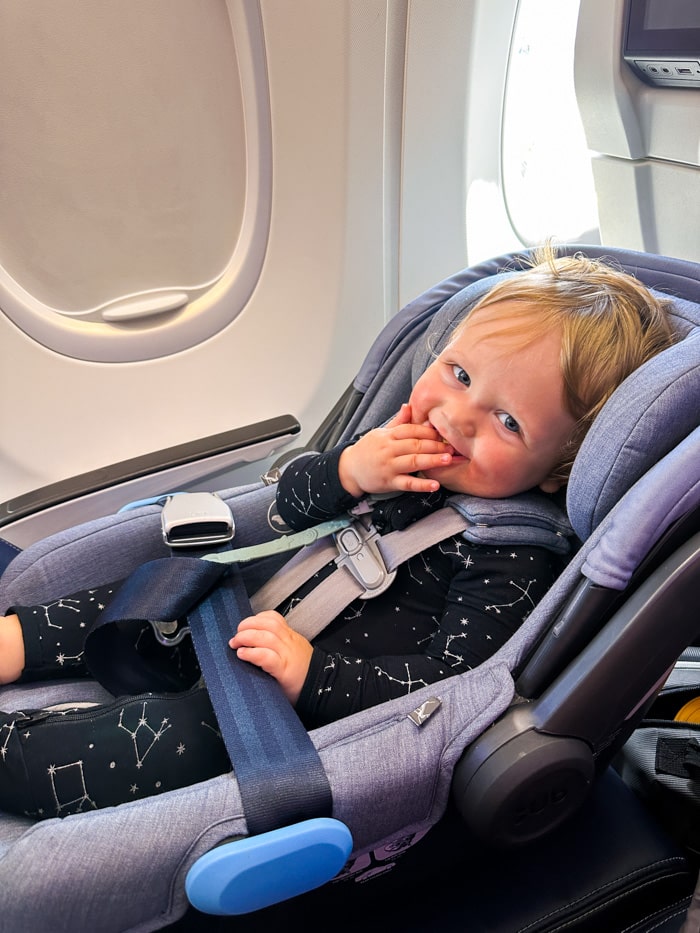
The best location is usually a window seat. This keeps the car seat from blocking a passenger’s path and leaves the aisle open for the crew.
A center seat may also work if the airline allows it and the restraint does not interfere with another passenger. An aisle seat can create problems because the car seat may obstruct movement or evacuation.
Avoid these locations:
- Exit rows
- Seats directly in front of or behind an exit row when the airline prohibits child restraints there
- Seats where the car seat blocks access to the aisle
- Seats where the car seat prevents another passenger from reaching an emergency exit
- Bulkhead seats if the fixed armrests or limited space prevent a proper installation
The exact rules can vary by aircraft and airline. Ask the airline whether your seat location is suitable before boarding.
Measure the car seat
Aircraft seats are often narrower than vehicle seats. Measure the car seat at its widest point, including side wings, armrests, cup holders, or other parts that cannot be removed.
Then compare that measurement with the airline’s published seat width or ask the airline for guidance. A car seat may fit in one aircraft seat but not another.
A narrow travel seat can be easier to install, but do not choose a seat based only on width. It must also fit the child correctly, meet the approval rules, and work safely in your vehicle after landing.

Prepare the car seat before leaving home
The easiest flight starts with a car seat that you already understand. Read the car seat manual and practice installing it with only a lap belt.
Remove accessories that are not needed during the flight, such as:
- Large cup holders
- Unapproved seat covers
- Hanging toys
- Travel bags that remain attached during use
- Extra padding not supplied or approved by the manufacturer
Do not add pillows, blankets, harness covers, or inserts unless the car seat maker approves them. Extra items can change how the harness fits.
Pack the car seat manual in your carry-on bag. It can help if an airline employee has questions about installation.
Helpful items to pack
Consider bringing:
- The car seat manual
- A soft bag for carrying the seat through the airport
- A luggage cart that is approved for the car seat
- A small towel for comfort, if the manufacturer allows it
- Snacks and activities for the child
- A backup plan for transportation at the destination
Do not use a car seat travel bag as proof that the seat is safe to use on the aircraft. A bag protects the seat while carrying or checking it, but it does not change the seat’s approval status.

How to take a car seat through the airport
You can usually bring an approved child restraint to the gate when the child has a ticketed seat. The seat may travel through security as a carry-on item, but Transportation Security Administration (TSA) screening procedures can vary by airport.
A car seat may be awkward to carry. Some parents use a car seat cart, stroller system, or approved harness designed to move the seat. Make sure the child remains safe and supervised while moving through the airport.
At the gate, ask whether the airline offers family or early boarding. Early boarding can give you extra time to install the seat before other passengers enter.
Do you need to tell the airline?
You may not need advance approval for an approved car seat, but contacting the airline is still useful. Ask about:
- The maximum car seat width
- Approved seat locations
- Whether the aircraft has a seat-specific restriction
- Gate-check procedures
- Whether the airline permits a car seat on an empty adjacent seat
- What happens if the airline changes your aircraft
Carry a copy of the car seat approval information if the label is hard to read.

How to install a car seat on an airplane
Install the car seat with the aircraft’s lap belt, following the car seat manual. The airplane seat belt takes the place of the vehicle seat belt.
Step-by-step installation
Place the car seat in the airplane seat.
Put a rear-facing seat rear-facing, or a forward-facing seat forward-facing, as allowed by the instructions.Route the lap belt through the correct belt path.
Use the path marked for aircraft or lap-belt installation. Some seats use the same path for vehicles and aircraft, while others use a different path.Buckle the airplane belt.
Keep the buckle in the location allowed by the car seat instructions. Do not place it across the child or through an incorrect opening.Tighten the belt.
Press down on the car seat while pulling the belt tight. Remove slack from the belt path.Check movement.
Hold the seat near the belt path and try to move it side to side and front to back. A properly installed seat should not move more than about 1 inch in any direction at the belt path, unless the manufacturer gives different instructions.Secure the child.
Adjust the harness so it lies flat and fits snugly. The chest clip, if the seat has one, should sit at armpit level.Check the recline and harness.
Use the recline position required by the manual. Make sure the child’s head is supported and that no straps are twisted.
Do not use these airplane features
Do not attach the car seat to:
- Lower anchors, because airplane seats do not have vehicle LATCH anchors
- A top tether, because aircraft seats generally do not provide an approved tether point
- An adult’s seat belt
- An unapproved extension or strap
- A tray table or armrest
The car seat must rely on the aircraft lap belt unless the manufacturer and airline provide another approved method.

Rear-facing versus forward-facing on a plane
A rear-facing car seat is allowed on an airplane when it has the proper approval label and fits in the seat. The child should remain rear-facing until reaching the car seat maker’s height or weight limit.
A rear-facing seat may look unusual in a narrow airplane row, but do not turn it forward-facing just to make it easier for another passenger. Follow the car seat instructions and ask the crew for help if the seat appears to interfere with the row.
A forward-facing seat must face the front of the aircraft. The child should meet the seat’s minimum requirements for forward-facing use.
If the car seat cannot fit in the assigned seat in the required direction, tell the flight attendant before the aircraft doors close. Do not force the seat into an unsafe position.

What to do if the car seat does not fit
If the car seat is too wide, check whether the armrests can be raised. Do not remove or alter an airplane seat part unless the airline crew instructs you to do so.
If the seat still does not fit:
- Ask a flight attendant for help.
- Check whether you are in the correct seat.
- Confirm that the seat is routed through the correct belt path.
- Ask whether another approved seat is available.
- Follow the airline’s instructions if the restraint cannot be used safely.
Do not place the car seat sideways, in the aisle, on the floor, or on an empty seat without securing it. Do not hold a child in the car seat on your lap during takeoff or landing.
If another passenger wants the seat
If you paid for the child’s seat, the child and approved restraint should use that assigned seat. A passenger does not have the right to use the seat simply because the car seat looks inconvenient.
Stay calm and ask a flight attendant to resolve the issue. Avoid arguing with another passenger in the aisle.

Can you gate-check or check a car seat?
Yes, airlines commonly allow passengers to check car seats at the ticket counter or gate. Policies differ, and checked items may be subject to airline-specific procedures.
Using the seat on the airplane is generally preferable when the child has a ticketed seat. It lets you use the restraint during the flight and keeps the seat with you.
If you check the car seat:
- Place it in a strong, padded travel bag.
- Remove loose parts and pack them inside the bag.
- Label the bag with your name and contact details.
- Ask whether it will be returned at the aircraft door or at baggage claim.
- Inspect the seat before using it in a vehicle.
A gate-checked car seat can still be damaged by handling or baggage equipment. If the seat has visible damage, missing parts, a cracked shell, bent components, or unclear function, do not use it until the manufacturer confirms that it is safe.
Never use a car seat after a crash unless the manufacturer’s replacement guidance says it remains safe. The FAA and NHTSA provide general travel guidance, but the car seat manufacturer controls the instructions for that specific model.

Flying with a car seat on a connecting flight
Keep the car seat with you between flights whenever possible. A connection gives you time to check the installation again and handle an aircraft change.
Before leaving the first aircraft, check for:
- Toys or food under the seat
- A twisted harness
- A loose aircraft belt
- Missing seat parts
- Damage from moving the restraint
- A changed seat assignment
If the next aircraft is smaller, ask the airline whether the car seat will fit. A last-minute aircraft change can create a width or seat-location problem.
For international connections, check the rules for the other country and airline. U.S. approval does not automatically mean that every foreign airline will use the same procedures.

Common mistakes to avoid
The most common errors involve approval, seat location, or belt routing.
Bringing a booster seat for use during the flight
A booster needs a shoulder belt, so it usually cannot serve as a restraint on an airplane. Use an approved harnessed seat for the flight when the child needs a restraint.
Assuming every car seat is aircraft-approved
Check the label. A seat without the required aircraft certification may not be used during flight.
Using the LATCH connectors
Aircraft seats do not have vehicle LATCH anchors. Secure the car seat with the airplane lap belt.
Installing the seat in an exit row
Child restraints cannot be used in exit rows. They may also be restricted in nearby rows.
Leaving the harness loose
A loose harness cannot protect the child as intended. Pinch the harness webbing at the shoulder after tightening. If you can pinch extra webbing, tighten it more.
Adding a thick cover or cushion
Unapproved padding can affect the harness fit and change the way the child sits in the restraint.
Waiting until the plane is full
Install the car seat during early boarding if possible. It is easier to solve a fit problem before the aisle fills.

A simple flight-day checklist
Use this checklist before leaving for the airport:
- The child has a ticketed seat if the car seat will be used onboard.
- The car seat has an aircraft-approval label.
- The child meets the seat’s height and weight limits.
- The seat fits within the airline’s width rules.
- The seat is not assigned to an exit row.
- The car seat manual is packed.
- The airline’s policy has been checked.
- The correct lap-belt path has been reviewed.
- The child’s harness fits snugly.
- The car seat has no recalled, broken, or missing parts.
- The destination vehicle is ready for the same restraint.

Frequently asked questions
Can I bring a car seat on a plane for a child under 2?
Yes, if the child has a separate ticketed seat and the car seat is approved for aircraft use. A child under 2 may also travel as a lap infant on many U.S. flights, but using an approved restraint in the child’s own seat is the safer option.
Does a car seat count as a carry-on bag?
Airline baggage policies differ. A car seat used in the child’s assigned seat is not the same as a personal item placed in the overhead bin. Ask the airline how it counts a car seat, stroller, and travel bag.
Can I use a rear-facing infant car seat on an airplane?
Usually, yes. The seat must have the required aircraft approval label, fit in the airplane seat, and be installed according to its instructions.
Can I use a booster seat on an airplane?
A belt-positioning booster usually cannot be used during flight because the airplane seat has a lap belt rather than a vehicle shoulder belt. A combination seat may be used only in its approved harness mode.
Can I put a car seat in the window seat?
A window seat is often the easiest location because it keeps the aisle clear. The final decision depends on the aircraft, airline, seat width, and car seat size.
What if the airline says the car seat cannot be used?
Ask the flight attendant to explain the specific issue. Check the approval label, belt path, seat location, and width. If the restraint still cannot be installed safely, follow the airline’s instructions and do not force it into place.
Final answer: the safest way to fly with a car seat
For most U.S. flights, the safest and simplest plan is to buy the child a separate seat, bring an aircraft-approved car seat, place it in a window seat, and secure it with the airplane’s lap belt. Practice the installation at home, check the airline’s width and seat rules, and keep the manual with you.
If the car seat does not fit or the approval label is missing, stop and ask the airline or manufacturer for help. A short delay is better than using a restraint in a way it was not designed to handle.