
For most drivers in the United States, the Continental TerrainContact A/T is one of the best all-terrain tires for gas mileage. It has a mild all-terrain tread, low road noise, and strong highway manners.
For a crossover or SUV that spends nearly all its time on pavement, the Falken Wildpeak A/T Trail is another strong choice. It is lighter and more road-focused than many truck all-terrain tires.
The best tire for your vehicle still depends on tire size, load rating, inflation pressure, vehicle weight, speed, and how much off-road traction you need. No all-terrain tire will usually match a highway tire for fuel economy.
Introduction
Drivers across the United States often choose all-terrain tires for snow, gravel roads, camping trips, work sites, and light trails. The trade-off is that a deep, stiff tread can increase rolling resistance and reduce fuel economy.
A good fuel-saving all-terrain tire uses a less aggressive tread, a moderate weight, and a casing designed for stable highway driving. It should also have the correct size and load rating for the vehicle.
The short answer is simple: choose a mild, road-focused all-terrain tire in the original equipment size, and keep it properly inflated.
What Makes an All-Terrain Tire Good for Gas Mileage?
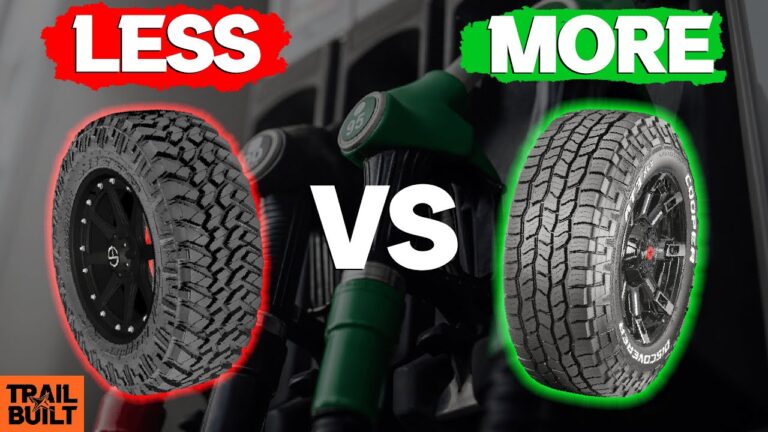
The best all-terrain tire for fuel economy has low rolling resistance without giving up the traction you need. Rolling resistance is the energy a tire uses as it rolls along the road.
Several tire features affect that energy loss:
- Tread depth: Deeper tread often flexes more and can use more energy.
- Tread pattern: Large gaps and heavy blocks improve loose-surface grip but may increase drag.
- Tire weight: A heavier tire takes more energy to start and stop.
- Sidewall stiffness: Strong sidewalls help off-road control but may add weight.
- Tire width: A wider tire can create more road contact and aerodynamic drag.
- Load range: Heavy-duty LT tires often weigh more than passenger-rated tires.
- Inflation pressure: Low pressure increases flex and rolling resistance.
- Wheel size: A larger wheel may require a heavier tire and reduce efficiency.
A tire with an aggressive mud-terrain pattern may look capable, but that design is rarely the best choice for highway fuel economy. A mild all-terrain tire is usually the better middle ground.
The U.S. Department of Energy explains that tire pressure and tire choice affect fuel use. Its FuelEconomy.gov tire guidance also recommends following the vehicle maker’s pressure advice.
Highway tire versus all-terrain tire
A highway tire has a smoother tread and usually creates less rolling resistance. It is often the best option for maximum miles per gallon.
An all-terrain tire has larger tread blocks and open grooves. These features help the tire find grip on gravel, dirt, mud, and snow. The cost is usually more noise, weight, tread movement, and fuel use.
If you drive on paved roads almost all the time, a highway tire may save more fuel than any all-terrain model.

Best All-Terrain Tires for Gas Mileage
The following tires suit different types of U.S. drivers. They are not ranked by a single laboratory fuel-economy test. Tire performance changes with size, vehicle, load, weather, and pressure.
1. Continental TerrainContact A/T: Best overall for highway fuel economy
The Continental TerrainContact A/T is a strong choice for drivers who want all-terrain ability but spend most of their time on pavement.
Its tread is less aggressive than a mud-focused all-terrain tire. That design can help reduce road noise and rolling resistance. It also gives the tire a more stable feel on highways.
Best for:
- Crossovers and SUVs
- Light-duty pickup trucks
- Highway driving with occasional gravel or dirt roads
- Drivers who want a quiet all-terrain tire
Main strengths:
- Road-focused tread design
- Comfortable highway behavior
- Moderate off-road traction
- Good fit for mixed daily driving
Limitations:
- Not the best choice for deep mud
- May not provide the same rocky-trail grip as a heavy-duty all-terrain tire
- Actual fuel economy depends on the tire size and load rating
This is the best starting point for many drivers who want a true all-terrain tire with a strong pavement bias.
2. Falken Wildpeak A/T Trail: Best for crossovers
The Falken Wildpeak A/T Trail is designed for crossover SUVs and similar vehicles. It is a more road-friendly option than many truck-oriented Wildpeak tires.
The tire is suited to drivers who need extra traction for snow, gravel, forest roads, and light trails. Its vehicle-specific design can make it a practical choice for models such as compact and midsize SUVs.
Best for:
- Subaru Outback-style vehicles
- Compact and midsize SUVs
- Drivers who see snow and gravel
- Daily commuting with occasional outdoor trips
Main strengths:
- Crossover-friendly construction
- Useful winter and gravel traction
- Less extreme than a rugged truck tire
- Good balance of comfort and capability
Limitations:
- Not intended for serious rock crawling
- May use more fuel than the original highway tires
- Availability varies by vehicle size
For a crossover, the A/T Trail may be a better fit than a heavy LT all-terrain tire. A lighter tire often places less demand on the vehicle.
3. Yokohama Geolandar A/T G015: Best balanced daily-driver option
The Yokohama Geolandar A/T G015 is a mild all-terrain tire with a broad range of vehicle applications. It is made for drivers who need more traction than a highway tire but still want civil road manners.
Its tread pattern works well for normal roads, gravel, light dirt, and some snow. It is not as aggressive as many tires made for heavy off-road use.
Best for:
- Pickup trucks and SUVs
- Mixed pavement and gravel driving
- Drivers who want a moderate all-terrain tread
- Light outdoor and work use
Main strengths:
- Balanced road and off-road behavior
- Many available sizes
- Comfortable for daily driving
- Suitable for light snow and dirt roads
Limitations:
- Not the most fuel-efficient choice in every size
- Not a dedicated mud tire
- Some heavy-duty versions can be relatively heavy
The G015 makes sense when you need a familiar all-terrain design without moving to a very aggressive tread.
4. BFGoodrich Trail-Terrain T/A: Best for mostly paved use
The BFGoodrich Trail-Terrain T/A is aimed at drivers who want a rugged look and light trail ability without choosing a more aggressive all-terrain tire.
It suits paved roads, gravel, packed dirt, and mild snow. Its road-focused design makes it more appropriate for daily driving than the company’s more aggressive all-terrain and mud-terrain options.
Best for:
- SUVs and light trucks
- Drivers who want a mild all-terrain appearance
- Mostly paved driving
- Light trails and gravel roads
Main strengths:
- Highway-friendly tread
- Mild off-road capability
- Better road comfort than aggressive designs
- Useful option for mixed driving
Limitations:
- Limited performance in deep mud
- Not ideal for demanding rocky trails
- Fuel economy still may drop compared with a highway tire
This tire can work well when appearance and light trail use matter, but maximum fuel economy remains the goal.
5. Michelin Defender LTX M/S 2: Best if you do not need a true all-terrain tire
The Michelin Defender LTX M/S 2 is primarily a highway all-season tire, not a traditional all-terrain tire. It deserves mention because many drivers use the phrase “all-terrain” when they really want a tire for highways, rain, light snow, and occasional gravel.
A highway tire like this will often be more efficient than a rugged all-terrain tire. It may also be quieter and smoother.
Best for:
- Mostly highway driving
- Pickup trucks and SUVs
- Light snow and rain
- Occasional well-maintained gravel roads
Main strengths:
- Highway-focused design
- Low noise compared with aggressive all-terrain tires
- Strong everyday road manners
- Often a better fuel-economy choice than true all-terrain tires
Limitations:
- Not a true all-terrain tire
- Limited traction in mud and loose dirt
- Not suited to serious trails
If your vehicle rarely leaves pavement, this type of tire may save more fuel than an all-terrain model.

Quick Comparison Table
This table shows the basic trade-offs. It is a guide, not a promise of a specific miles-per-gallon result.
| Tire | Best use | Road focus | Off-road focus | Fuel-economy outlook |
|---|---|---|---|---|
| Continental TerrainContact A/T | Mixed highway and light off-road use | High | Moderate | Strong for a true A/T |
| Falken Wildpeak A/T Trail | Crossovers and snow | High | Moderate | Strong when correctly sized |
| Yokohama Geolandar A/T G015 | General mixed use | Medium-high | Moderate | Usually balanced |
| BFGoodrich Trail-Terrain T/A | Pavement and light trails | High | Light-moderate | Favorable for its class |
| Michelin Defender LTX M/S 2 | Mostly pavement | Very high | Low | Often best if A/T ability is not needed |
A tire’s real fuel effect can change sharply between sizes. For example, a passenger-rated tire in the original size may be much lighter than an LT tire with the same outside diameter.
How Much Gas Mileage Can an All-Terrain Tire Cost?
There is no single fuel-economy penalty for all-terrain tires. A change of tire can have little effect in one vehicle and a noticeable effect in another.
A simple example shows why:
- Assume a vehicle gets 22 mpg with highway tires.
- Assume fuel costs $3.50 per gallon.
- Assume a heavier all-terrain tire reduces fuel economy by 3%.
- Fuel economy would fall to about 21.3 mpg.
- At 12,000 miles per year, the vehicle would use about 24 more gallons.
- That equals roughly $84 more per year at that fuel price.
This is a hypothetical calculation. It is not a measured result for any specific tire.
The fuel difference may be larger when you change several things at once, such as:
- Increasing tire width
- Increasing tire diameter
- Switching from P-metric to LT tires
- Adding a higher load range
- Using heavy wheels
- Lowering pressure for off-road use
- Choosing a deep, aggressive tread
The most useful comparison is to test the same vehicle on the same roads, in similar weather, with correct pressure and similar loads. Fuel economy shown by the vehicle display can be inaccurate, so compare gallons used and miles driven over several tanks.

How to Choose an All-Terrain Tire for Better MPG
Use the following process before buying.
1. Start with your vehicle’s original tire size
Read the tire placard on the driver’s door or door frame. It lists the recommended size and cold inflation pressure.
Staying with the original size usually avoids unnecessary changes in weight, gearing, speedometer accuracy, and handling.
Do not choose a tire only because it fits the wheel. Check the full tire specification.
2. Choose the lightest suitable load rating
A heavier load range can improve carrying capacity, but it can also increase rolling resistance.
For normal use, a passenger-rated or standard-load tire may be more efficient than a heavy LT tire. A truck used for towing, hauling, or commercial work may require an LT tire.
Use the vehicle maker’s requirements and the tire maker’s load tables. Never choose a lower load capacity than the vehicle needs.
3. Pick a mild tread pattern
Look for:
- Closely spaced tread blocks
- Moderate tread depth
- Solid center ribs
- Small voids between blocks
- A design made for highways and light trails
Avoid a mud-terrain tire if fuel economy is your main goal. Large tread gaps help clear mud, but they can increase noise and rolling resistance on pavement.
4. Keep the correct pressure
Use the pressure on the vehicle’s door label, not the maximum pressure printed on the tire sidewall.
Check pressure when the tires are cold. Temperature changes can alter pressure readings. A tire pressure monitoring system may warn you about a large pressure loss, but it does not replace a pressure gauge.
Do not overinflate the tires to chase better mileage. Excess pressure can reduce wet and uneven-road grip, change handling, and cause uneven wear.
5. Compare total weight, not just the tread name
Two tires in the same size can have very different weights. Check the manufacturer’s specifications for:
- Tire weight
- Load range
- Speed rating
- Maximum load
- UTQG information, when listed
- Severe-snow rating, if winter traction matters
A lighter tire is not automatically better. It still must meet the vehicle’s load, speed, and traction needs.

Are LT All-Terrain Tires Bad for Fuel Economy?
LT all-terrain tires are not bad, but they are often less efficient than passenger-rated tires.
“LT” means the tire is built for light trucks and heavier work. It may have stronger sidewalls, a higher load capacity, and a heavier casing.
Those features can help with:
- Heavy cargo
- Trailer towing
- Work-site use
- Sharp rocks
- Low-pressure off-road driving
They can also bring trade-offs:
- More tire weight
- Firmer ride
- More rolling resistance
- Higher purchase cost
- Possible loss of fuel economy
A half-ton pickup used as a daily commuter may not need an LT tire. A truck that regularly hauls heavy loads may need one. Check the door label, owner’s manual, axle ratings, and tire placard before changing load type.
Does a Bigger Tire Improve Gas Mileage?
A bigger tire usually does not improve gas mileage in normal driving.
A larger diameter can reduce engine revolutions at a given road speed. However, the larger tire is often heavier and wider. It may also change the vehicle’s effective gearing and speedometer reading.
If the new tire is much larger than the original, the odometer may record fewer miles than the vehicle actually travels. That can make calculated fuel economy look different.
A larger tire can also affect:
- Acceleration
- Transmission shift points
- Braking
- Steering feel
- Suspension clearance
- Electronic safety systems
For fuel economy, the safest general choice is the original equipment size.

Do 3PMSF All-Terrain Tires Use More Fuel?
A 3PMSF tire carries the Three-Peak Mountain Snowflake symbol. It has passed a standardized test for severe-snow performance.
The symbol does not tell you the tire’s rolling resistance or exact fuel effect. Some severe-snow-rated all-terrain tires use more open tread and may be heavier than highway tires.
Still, a 3PMSF tire can be worthwhile if you drive in areas with regular snow. Better snow traction may be more important than a small fuel difference.
The best choice depends on your conditions:
- Rare snow: A highway tire with good wet performance may be enough.
- Regular snow: Consider a 3PMSF all-terrain tire.
- Severe winter roads: Dedicated winter tires may perform better than all-terrain tires.
All-terrain tires are not a substitute for safe speed, clear visibility, or proper winter driving.
How to Improve MPG After Installing All-Terrain Tires
A tire change does not have to cause a large fuel penalty. These steps can help:
- Set pressure when the tires are cold.
- Check pressure at least once a month and before long trips.
- Keep the original tire size when possible.
- Avoid unnecessary wheel spacers and oversized wheels.
- Rotate the tires according to the vehicle maker’s schedule.
- Keep the alignment within specification.
- Remove unused cargo from the vehicle.
- Use two-wheel drive on pavement when appropriate.
- Avoid hard acceleration and high speeds.
- Measure fuel use over several tanks.
Wheel alignment matters because toe misalignment can create tire scrub. That resistance wastes energy and can wear the tread quickly.
Uneven wear, pulling, steering vibration, or a new humming sound should be checked by a qualified tire or repair professional.

Common Mistakes That Reduce Fuel Economy
Choosing the most aggressive tread
A rugged tread may be useful off-road, but it is rarely efficient on pavement. Match the tread to your actual driving.
Buying the largest tire that fits
A tire that clears the fender may still affect gearing, handling, braking, and fuel use.
Using the sidewall’s maximum pressure
The maximum sidewall pressure is not usually the vehicle’s recommended setting. Follow the door placard unless a qualified professional provides a specific, safe adjustment.
Mixing tire sizes or tread designs
Different sizes or major differences in tread can affect handling and drivetrain operation. Some all-wheel-drive vehicles require close matching between all four tires.
Ignoring wheel weight
A heavy wheel and tire package can reduce efficiency even when the tire tread looks mild.
Comparing fuel economy after only one tank
Wind, traffic, temperature, cargo, fuel blend, and driving style can hide a small tire-related difference. Use several tanks and similar routes.

Safety Limits to Keep in Mind
Fuel economy should never override tire safety.
Confirm that the replacement tire has:
- The correct size
- Enough load capacity
- A suitable speed rating
- Proper wheel fit
- Adequate clearance
- The correct inflation range
- Compatibility with the vehicle’s drive system
Replace tires when the tread, age, damage, or wear reaches an unsafe condition. Inspect for cuts, bulges, exposed cords, punctures, and uneven wear.
If you are unsure whether a tire fits, ask a tire professional to verify the vehicle, wheel, axle load, and intended use. Tire shops can also check alignment and suspension parts that may be causing rapid wear.
Frequently Asked Questions
What is the most fuel-efficient all-terrain tire?
A mild, road-focused all-terrain tire in the original equipment size is usually the most fuel-efficient type. The Continental TerrainContact A/T and Falken Wildpeak A/T Trail are practical starting points, especially for drivers who spend most of their time on paved roads.
Are all-terrain tires worse for gas mileage than highway tires?
Usually, yes. All-terrain tires often have deeper tread, heavier construction, and more open patterns. These traits can increase rolling resistance. The difference varies by vehicle, size, load rating, pressure, and tire model.
Should I choose a P-metric or LT all-terrain tire?
Choose the type that meets your vehicle’s load and towing needs. P-metric tires are often lighter and more comfortable. LT tires may be necessary for heavier loads, towing, or demanding work use.
Can proper tire pressure improve gas mileage?
Yes. Underinflation increases tire flex and rolling resistance. Use the pressure listed on the vehicle’s door label. Check the pressure when the tires are cold.
Is a 3PMSF all-terrain tire better for winter?
It is tested for severe-snow performance, so it can be a better choice than a non-rated all-terrain tire in regular snow. A dedicated winter tire may still offer stronger cold-weather grip and braking.
Should I buy a highway tire instead of an all-terrain tire?
Buy a highway tire if you drive almost entirely on paved roads and want the best chance of lower fuel use, less noise, and a smoother ride. Choose an all-terrain tire when gravel, dirt, snow, or light trails are a regular part of your driving.
Final Recommendation
For most U.S. drivers who need a real all-terrain tire but care about gas mileage, start with the Continental TerrainContact A/T in the vehicle’s original size and suitable load rating.
Choose the Falken Wildpeak A/T Trail if you drive a crossover and want a road-friendly tire for snow, gravel, and light trails.
If you rarely leave pavement, a highway tire such as the Michelin Defender LTX M/S 2 may provide better fuel economy than any true all-terrain option.
Before you buy, compare tire weight, load rating, size, pressure requirements, and tread design. The right tire is not the most aggressive one. It is the lightest suitable tire that safely handles the roads you actually drive.