
Neither tire is automatically wider. The numbers 55 and 60 show the tire’s aspect ratio, not its width.
For example:
- 225/55R17 and 225/60R17 have the same listed width: 225 millimeters
- The 225/60R17 tire has a taller sidewall
- To find tire width, read the first number, not 55 or 60
This rule applies to passenger cars, SUVs, and light trucks sold in the United States. Always compare the full tire size and follow your vehicle maker’s fitment and safety guidance.
Tire Size Basics: What Do 55 and 60 Mean?
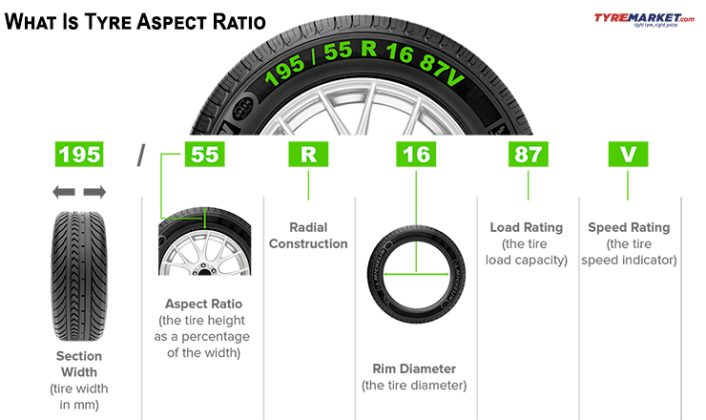
The number after the slash is the tire’s aspect ratio. It shows the sidewall height as a percentage of the tire’s width.
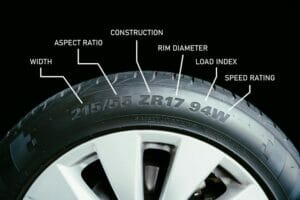
In the tire size 225/55R17:
- 225 = nominal tire width in millimeters
- 55 = sidewall height equal to 55% of the tire width
- R = radial construction
- 17 = wheel diameter in inches
In 225/60R17, the first number stays the same. The sidewall ratio rises from 55% to 60%.
Example: 225/55R17 vs. 225/60R17
| Tire size | Listed width | Sidewall height | Overall diameter |
|---|---|---|---|
| 225/55R17 | 225 mm | 123.75 mm | About 679 mm |
| 225/60R17 | 225 mm | 135 mm | About 702 mm |
The 60-series tire is about 11.25 mm taller on each side. Its total diameter is about 22.5 mm larger, assuming the same tire design and wheel size.
So, the 225/60R17 is taller, not wider.

How to Tell Which Tire Is Wider
Compare the first number in each complete tire size.
Example 1: Same width
- 215/55R17
- 215/60R17
Both tires are listed as 215 mm wide. The 60-series tire has a taller sidewall.
Example 2: Different width
- 225/55R17
- 215/60R17
The 225/55R17 is wider because 225 is greater than 215. The 60 in the second size does not make it wider.
Example 3: Both width and height change
- 235/55R18
- 225/60R18
The 235/55R18 is wider by 10 mm. The 225/60R18 has a taller sidewall ratio, but it is still narrower.
Use this quick rule:
Higher first number = wider nominal tire. Higher second number = taller sidewall compared with the tire’s width.
The first number is a nominal measurement. The actual section width can vary by tire brand, model, rim width, and measuring standard. For an exact fit, check the tire maker’s specification sheet.

What Changes When You Move From a 55-Series to a 60-Series Tire?
Moving from a 55-series tire to a 60-series tire usually adds sidewall height. It may change ride comfort, steering response, ground clearance, speedometer readings, and clearance.
It does not automatically add tread width.
Ride comfort
A 60-series tire often has more sidewall than a 55-series tire when both use the same listed width. That extra sidewall may flex more over potholes and rough pavement.
This can make the ride feel softer. The result also depends on tire construction, air pressure, vehicle suspension, and load.
Steering response
A shorter sidewall often feels more direct during steering. A taller sidewall may feel less sharp during quick turns.
This is a general effect, not a guarantee. Two tires with the same size can still handle very differently because of their tread design and internal construction.
Overall diameter
A taller sidewall increases the tire’s overall diameter if the wheel size and listed width stay the same.
Use this formula:
Sidewall height = tire width × aspect ratio
Overall diameter = (sidewall height × 2) + wheel diameter
Convert the wheel diameter to millimeters before calculating.
For a hypothetical comparison:
225/55R17:
225 × 0.55 = 123.75 mm sidewall
17 × 25.4 = 431.8 mm wheel diameter
(123.75 × 2) + 431.8 = 679.3 mm overall diameter

225/60R17:
225 × 0.60 = 135 mm sidewall
(135 × 2) + 431.8 = 701.8 mm overall diameter
The 60-series tire is about 3.3% larger in diameter in this example.
Speedometer and vehicle systems
A larger tire travels farther with each wheel rotation. If the vehicle was calibrated for the smaller original tire, the speedometer may not read the same.
A significant diameter change can also affect:
- Anti-lock braking systems
- Traction control
- Electronic stability control
- All-wheel-drive systems
- Odometer readings
- Gear selection and engine speed
Modern vehicles use wheel-speed data for several safety systems. Do not assume that a tire with the same wheel diameter is automatically a safe substitute.
Does a 60 Tire Give More Traction Than a 55 Tire?
Not by itself. The 55 or 60 number does not directly tell you how much traction a tire has.
Traction depends on many factors, including:
- Tire width
- Tread compound
- Tread pattern
- Tire temperature
- Road surface
- Weather
- Tire pressure
- Vehicle weight
- Load index
- Tire age and condition
A 60-series tire may have a taller sidewall. That can help absorb bumps and keep the tire in contact with uneven pavement in some conditions. But it does not guarantee better grip.
A 55-series tire may provide a quicker steering feel. That does not guarantee shorter stopping distances.
For wet, snowy, or icy roads in the United States, choose a tire designed and rated for those conditions. Check the tire’s severe snow service marking when winter performance matters. A taller sidewall alone does not make a tire a winter tire.

How to Compare 55 and 60 Tires Before Buying
Use the full tire size, not just the aspect-ratio number.
1. Read the vehicle’s recommended size
Check:
- The driver-side door-jamb label
- The owner’s manual
- The vehicle maker’s approved tire-size list
- The current tire sidewall
The door-jamb label also lists the correct cold inflation pressure for the original tire size.
2. Compare the first number
The first number tells you which tire has the greater listed width.
For example:
- 205 is narrower than 215
- 215 is narrower than 225
- 235 is wider than 225
Do not use the 55 or 60 number to judge width.
3. Compare wheel diameter
The last number must match the wheel size unless you are changing the wheel as part of a complete, approved setup.
A 17-inch tire will not fit a 16-inch wheel. The letter “R” does not show wheel diameter. The final number does.
4. Check load index and speed rating
A replacement tire should meet or exceed the vehicle maker’s required load index and speed rating unless a qualified tire professional confirms another approved option.
A tire that fits the wheel may still be unsuitable for the vehicle.
5. Check physical clearance
The tire must clear:
- Suspension parts
- Fenders
- Inner wheel wells
- Brake components
- Steering parts
- Mud flaps and liners
Clearance can change when the suspension moves or the steering reaches full lock.
6. Check the diameter difference
A small change may be accepted for some vehicles, but the correct limit depends on the vehicle and drivetrain. Four-wheel-drive and all-wheel-drive vehicles can be especially sensitive to differences in rolling circumference.
Use the vehicle manufacturer’s guidance. Do not rely only on a general percentage rule from an online tire calculator.
7. Confirm the final specification
Tire manufacturers publish detailed specifications for many models. These may include:
- Approved rim-width range
- Actual section width
- Overall diameter
- Revolutions per mile
- Maximum load
- Inflation limits
The same nominal size can vary slightly between tire models.

Common Mistakes When Comparing Tire Width
Mistake 1: Thinking 60 means wider
The 60 is an aspect ratio. It describes sidewall height compared with the tire’s width.
Mistake 2: Comparing only two numbers
“55 tire” and “60 tire” are incomplete descriptions. A 205/60R16 tire and a 245/55R18 tire are very different sizes.
Mistake 3: Assuming a taller tire is always safer
A taller sidewall may improve comfort on rough roads. But an incorrect overall diameter can affect handling, electronic safety systems, and clearance.
Mistake 4: Ignoring rim width
A tire’s approved rim-width range affects its shape and measured width. Mounting a tire on an unsuitable rim can create poor handling and unsafe bead seating.
Mistake 5: Mixing sizes on the same axle
Do not mix different tire sizes on one axle unless the vehicle maker specifically permits it. Replace tires in axle pairs when possible, and follow the vehicle manufacturer’s instructions for staggered setups.
Mistake 6: Using door-sticker pressure for every tire without checking
The door label gives the vehicle’s recommended cold pressure for its approved setup. If the tire size or load rating changes, ask a qualified tire professional to confirm the correct pressure.
55 vs. 60: Quick Comparison
| Feature | 55-series tire | 60-series tire |
|---|---|---|
| Width | Depends on the first number | Depends on the first number |
| Sidewall | 55% of listed width | 60% of listed width |
| Ride feel | Often firmer | Often more cushioned |
| Steering feel | Often more direct | May feel softer |
| Overall diameter | Depends on the full size | May be larger when width and wheel stay the same |
| Traction | Not determined by the ratio alone | Not determined by the ratio alone |
| Vehicle fit | Must be checked | Must be checked |
The key comparison is simple: 55 and 60 describe height relative to width. They do not identify tire width by themselves.
Frequently Asked Questions
Is a 60 tire wider than a 55 tire?
No. The 60 and 55 numbers show aspect ratio. Compare the first number in the full tire size to determine which tire is wider.
Is 225/60R17 wider than 225/55R17?
No. Both have a listed width of 225 mm. The 225/60R17 has a taller sidewall and a larger overall diameter.
Which is better, 55 or 60 profile?
Neither is always better. A 55-series tire may offer a firmer, more responsive feel. A 60-series tire may provide more sidewall and a softer ride. The correct choice is the size approved for your vehicle.
Can I replace 55 tires with 60 tires?
Only if the complete size is approved for your vehicle and the tire clears all parts. Check diameter, load index, speed rating, wheel width, drivetrain requirements, and the vehicle manufacturer’s guidance first.
Does a 60-series tire use more gas?
It can, but the result is not predictable from the aspect ratio alone. Weight, tread design, inflation pressure, rolling resistance, alignment, road conditions, and driving style also affect fuel use.
Final Answer: Which Tire Is Wider, 55 or 60?
Neither one is wider simply because it says 55 or 60. Those numbers describe sidewall height as a percentage of tire width.
To find the wider tire, compare the first number:
- 225/55R17 vs. 225/60R17: same width
- 225/55R17 vs. 215/60R17: 225/55R17 is wider
- 235/55R18 vs. 225/60R18: 235/55R18 is wider
Before changing sizes on a U.S. vehicle, confirm the full tire specification, wheel fit, load rating, speed rating, clearance, and electronic-system compatibility. When those details are uncertain, have a qualified tire professional verify the fit before installation.