

Yes. Many cars, trucks, and SUVs are built in the United States. Ford, General Motors, Tesla, Toyota, Honda, Subaru, BMW, Mercedes-Benz, Volkswagen, Hyundai, Kia, Nissan, and other automakers operate U.S. assembly plants.
The catch is that “made in America” can mean different things. A vehicle may have its final assembly in the United States while using engines, batteries, electronics, or other parts from Canada, Mexico, Asia, or Europe. Some vehicles are also built in more than one country, depending on the plant, trim, or model year.
If you want a vehicle with strong U.S. content, check its Monroney window sticker, the manufacturer’s assembly details, and the latest parts-content information from the National Highway Traffic Safety Administration (NHTSA).

What does “made in America” mean for a car?
For cars sold in the United States, “made in America” usually refers to one of three things:
- Final assembly — where workers put the finished vehicle together.
- U.S. parts content — the share of the vehicle’s parts that come from the United States and Canada.
- U.S. manufacturing — where the body, engine, battery, transmission, or other major parts are made.
These measures are not the same. A vehicle assembled in Ohio may still use a transmission from Japan. A vehicle assembled in Alabama may contain many parts from North America but also use imported electronics or battery cells.
The legal label on a new vehicle helps separate these details. Under the American Automobile Labeling Act, the window sticker must show the vehicle’s final assembly point, the percentage of U.S. and Canadian parts, and the countries that supplied the engine and transmission. It may also list the vehicle’s city and highway fuel-economy figures.
Final assembly is not the same as total U.S. production
Final assembly is the easiest fact to understand. It tells you where the completed vehicle was put together.
It does not tell you that every part was made in the United States. Modern vehicles use global supply chains. Even vehicles from U.S.-headquartered companies may contain parts made outside the country, while vehicles from foreign-headquartered companies may be assembled in American plants with substantial U.S. labor and parts.
That is why a Ford built in Mexico is not automatically more American than a Toyota built in Kentucky. The answer depends on which measure matters to you.
Which cars are made in the United States?
Many current models have final assembly in the United States. The exact list can change by model year, plant capacity, trim, and production location, so treat the examples below as a starting point rather than a permanent ranking.
| Brand | Examples of models assembled in the U.S. | Common U.S. production locations |
|---|---|---|
| Ford | F-150, Super Duty, Mustang, Bronco, Ranger | Michigan, Missouri, Kentucky, Ohio |
| General Motors | Chevrolet Silverado, Tahoe, Suburban, Corvette; GMC Sierra, Yukon; Cadillac Lyriq | Michigan, Texas, Kentucky, Tennessee, Missouri |
| Tesla | Model S, Model X, Model 3, Model Y, Cybertruck | California, Texas |
| Jeep | Wrangler, Grand Cherokee, Gladiator | Ohio, Michigan |
| Honda | Accord, Civic Hatchback, Passport, Pilot, ridgeline, Odyssey | Ohio, Alabama, Indiana |
| Toyota | Camry, Highlander, Grand Highlander, Sienna, Tundra, Sequoia | Kentucky, Indiana, Texas, Mississippi |
| Subaru | Outback, Ascent, Legacy, Impreza | Indiana |
| Nissan | Altima, Leaf, Pathfinder, Rogue, Infiniti QX60 | Tennessee, Mississippi |
| BMW | X3, X5, X6, X7, XM | South Carolina |
| Mercedes-Benz | GLE, GLS, EQE SUV, EQS SUV | Alabama |
| Volkswagen | ID.4 | Tennessee |
| Hyundai | Sonata, Elantra, Santa Fe, Tucson, Santa Cruz, Genesis models in some production programs | Alabama, Georgia |
| Kia | Telluride, Sorento, Sportage, K5 in selected U.S. production programs | Georgia |
This table shows final assembly, not a complete measure of domestic content. Some models in the same family may come from different plants. Imported versions may also be sold beside U.S.-built versions.
American-made electric vehicles
Several electric vehicles are assembled in the United States, including:
- Tesla Model 3 and Model Y
- Tesla Model S and Model X
- Tesla Cybertruck
- Chevrolet Equinox EV
- Chevrolet Blazer EV
- Chevrolet Silverado EV
- Cadillac Lyriq
- Ford F-150 Lightning
- Ford Mustang Mach-E
- Volkswagen ID.4
- Rivian R1T and R1S
- Lucid Air and Gravity
- Jeep Wrangler 4xe and Grand Cherokee 4xe
Electric vehicles make the “made in America” question more complex. The battery pack can account for a large share of a vehicle’s value, and battery cells, modules, minerals, and processing may come from different countries.
The vehicle may be assembled in the United States while its battery supply chain remains partly international. For tax-credit purposes, the rules are separate and can change often. Do not assume that U.S. assembly alone qualifies an electric vehicle for a federal incentive.
Which American car brands build vehicles in the United States?
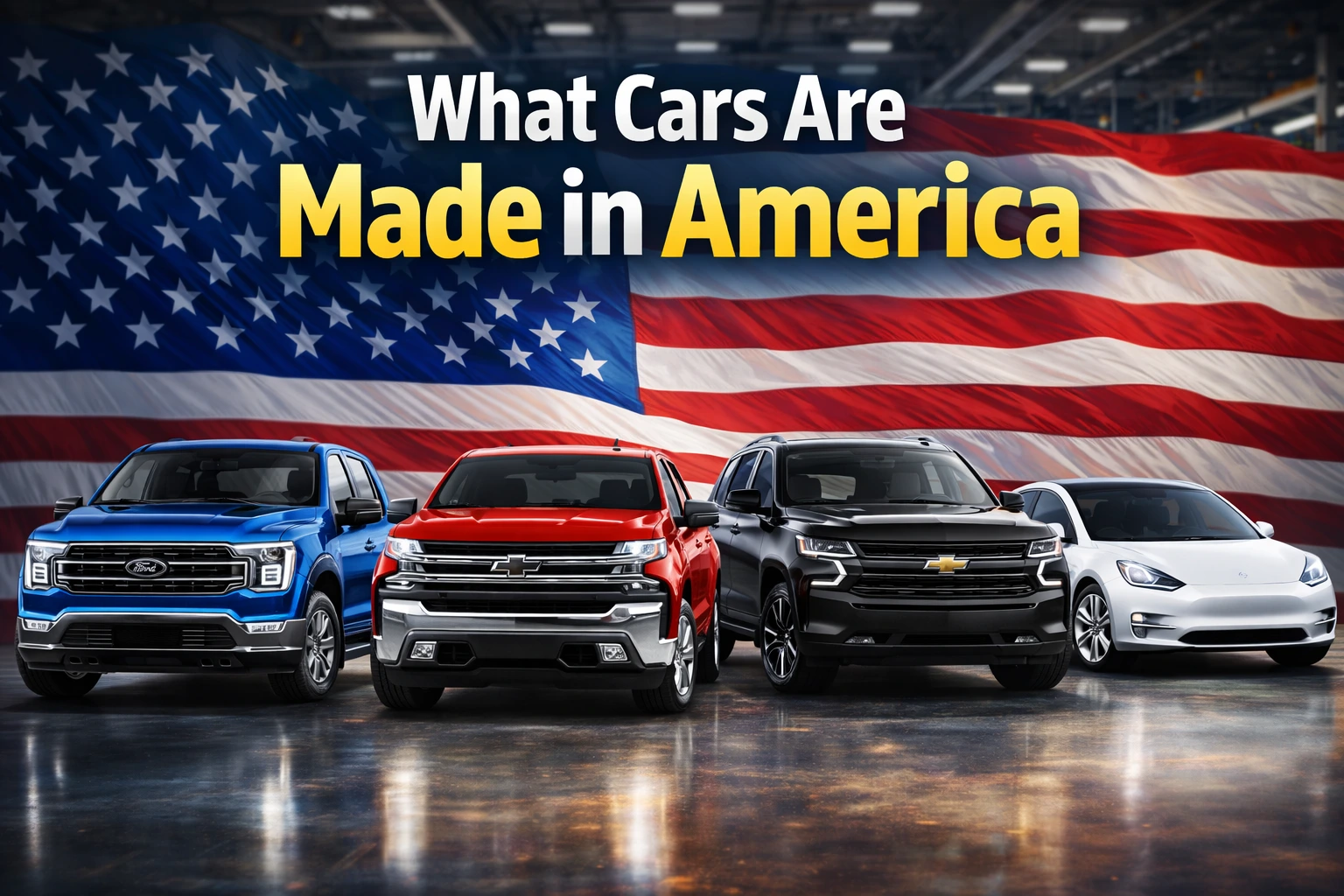
The major U.S.-headquartered automakers are General Motors, Ford Motor Company, Stellantis, and Tesla. They all build vehicles in the United States, but none builds every model here.
Ford
Ford builds several high-volume vehicles in U.S. plants. Examples include the F-150, Super Duty trucks, Mustang, Bronco, and Ranger.
Ford also builds some vehicles outside the United States. The Maverick, for example, has been assembled in Mexico. The Mustang Mach-E has also been produced in Mexico. The brand name alone does not tell you where a specific vehicle was built.
General Motors
General Motors builds Chevrolet, GMC, Cadillac, and Buick vehicles in several U.S. plants. Large examples include the Chevrolet Tahoe and Suburban, GMC Yukon, Chevrolet Silverado, GMC Sierra, and Chevrolet Corvette.
GM also builds vehicles in Canada, Mexico, and other countries. A Chevrolet badge does not guarantee U.S. final assembly.
Stellantis
Stellantis owns brands such as Jeep, Ram, Chrysler, and Dodge. U.S.-assembled examples include the Jeep Wrangler, Jeep Gladiator, Jeep Grand Cherokee, Ram 1500, Dodge Durango, Chrysler Pacifica, and Chrysler Voyager, depending on model year and production plan.
Other Stellantis vehicles, such as the Jeep Compass and some Ram models, may be built outside the United States.
Tesla
Tesla is an American company with major vehicle plants in California and Texas. It builds Model S, Model X, and some Model 3 and Model Y vehicles in Fremont, California. The Austin, Texas, plant builds Model Y and Cybertruck vehicles.
Tesla production can vary by plant and configuration. The vehicle identification number, window sticker, and delivery documents provide the best confirmation for a particular vehicle.

Which foreign car brands build cars in America?
A foreign-owned automaker can build a vehicle in the United States. “Foreign brand” and “foreign-built vehicle” are not the same thing.
Toyota
Toyota operates major U.S. plants in Kentucky, Indiana, Texas, Mississippi, and other states. U.S.-assembled examples include the Camry, Highlander, Grand Highlander, Sienna, Tundra, and Sequoia.
Toyota also imports many popular models. The RAV4, Corolla Cross, Tacoma in some production periods, and other models may come from plants outside the United States. Always check the individual vehicle.
Honda and Acura
Honda builds several models in Ohio, Alabama, and Indiana. U.S.-assembled examples include the Accord, Civic Hatchback, Passport, Pilot, Ridgeline, and Odyssey.
Acura, Honda’s luxury brand, has built models such as the MDX and TLX in U.S. facilities. Acura also sells vehicles assembled in Canada and Japan.
Subaru
Subaru’s Indiana plant builds the Outback, Ascent, Legacy, and Impreza. Other Subaru models, including some Crosstrek, Forester, and Solterra vehicles, may come from Japan or other production sites.
BMW
BMW’s large plant in Spartanburg, South Carolina, builds many of the brand’s SUVs. These include the X3, X5, X6, X7, and XM.
BMW is a German company, but many BMW SUVs sold around the world are made in the United States. The brand’s country of ownership does not determine the vehicle’s assembly country.
Mercedes-Benz
Mercedes-Benz assembles several SUVs in Alabama. Examples include the GLE, GLS, EQE SUV, and EQS SUV.
Other Mercedes-Benz models, including many sedans and smaller vehicles, are imported. Check the label rather than relying on the badge.
Volkswagen
Volkswagen builds the ID.4 electric SUV in Chattanooga, Tennessee. Volkswagen’s other U.S. models may be imported from Mexico, Germany, or other countries.
Hyundai and Kia
Hyundai builds vehicles in Alabama, while Kia operates a major plant in Georgia. Examples of U.S.-assembled Hyundai vehicles include the Sonata, Elantra, Santa Fe, Tucson, and Santa Cruz.
Kia’s Georgia plant has built models such as the Telluride, Sorento, Sportage, and K5 during different production periods. Hyundai and Kia also import many vehicles, so model and year matter.

How can you tell where a specific car was made?
The most reliable method is to check the vehicle’s paperwork and label. Do not rely only on the brand, dealer listing, or VIN prefix.
1. Read the window sticker
For a new car, find the Monroney label on the window. Look for:
- Final assembly point
- U.S. and Canadian parts percentage
- Engine country
- Transmission country
- Fuel-economy information
- Suggested retail price
The label may say that the vehicle was assembled in a U.S. city, such as Georgetown, Kentucky, or Spartanburg, South Carolina. It may also show that the engine or transmission came from another country.
2. Check the VIN
The first character of the 17-character vehicle identification number often indicates the country where the vehicle was assembled. A VIN beginning with “1,” “4,” or “5” generally points to U.S. assembly. A VIN beginning with “2” often indicates Canada, while “3” commonly indicates Mexico.
The VIN is useful, but it should not replace the window sticker. VIN coding can identify the assembly country without telling you the percentage of U.S. parts.
3. Use the NHTSA AALA database
NHTSA provides American Automobile Labeling Act information for vehicles sold in the United States. The database can help you compare:
- Final assembly country
- U.S. and Canadian parts content
- Engine origin
- Transmission origin
Model-year data can change. Select the correct year and compare the exact model, not just the brand.
4. Ask the dealer for the exact vehicle
If you are shopping in person, ask the dealer for the vehicle identification number and a copy of the window sticker. This matters because two vehicles with the same name may be built in different plants.
For a used vehicle, the original sticker may be missing. In that case, use the VIN, factory records, and the vehicle history report as supporting evidence.

What is the most American-made car?
There is no single answer unless you define “most American-made.”
A ranking based on final assembly may differ from a ranking based on U.S. and Canadian parts. A ranking based on U.S. labor may differ from one based on engine or battery origin. Some lists also include vehicle sales, factory employment, and supplier activity.
The annual Cars.com American-Made Index uses factors such as U.S. assembly, parts content, U.S. manufacturing workforce, engine origin, and transmission origin. Its results are useful for comparison, but they are not a legal definition of “American-made.”
Vehicles that often appear near the top of American-made rankings have included models such as:
- Tesla Model Y
- Tesla Model 3
- Honda Passport
- Volkswagen ID.4
- Honda Ridgeline
- Toyota Tundra
- Jeep Gladiator
- Jeep Wrangler
- Ford F-150
- Chevrolet Colorado
The exact order changes with model year and production data. A ranking is best used as a shortlist. Before buying, verify the particular vehicle’s window sticker.

Are cars made in America better?
U.S. assembly does not automatically make a car more reliable, safer, cheaper, or better built.
Vehicle quality depends on the design, parts, factory process, maintenance, and the specific model year. A vehicle assembled in the United States can have reliability problems. An imported vehicle can perform very well for many years.
Buying a U.S.-assembled vehicle can still offer practical benefits:
- It supports work at U.S. assembly plants and suppliers.
- Parts may be easier to source in some regions.
- Certain models may qualify for purchase rules or incentives tied to domestic production.
- Some buyers prefer to keep more of their spending in the U.S. economy.
There can also be trade-offs. A U.S.-assembled model may use imported parts. A vehicle built in another country may have a lower price or a design that better fits your needs. The best choice depends on your priorities, not just the flag on the label.

Does buying an American car support American jobs?
Usually, but not in a simple all-or-nothing way.
A vehicle assembled in the United States supports plant workers, local contractors, transportation firms, dealers, and some parts suppliers. It does not mean that every dollar stays in the United States. Automakers have global owners, global suppliers, and factories in many countries.
A vehicle from a foreign-owned company can also support many U.S. jobs. Toyota, Honda, BMW, Mercedes-Benz, Hyundai, Kia, Subaru, Volkswagen, and other international automakers employ U.S. factory workers and buy from American suppliers.
If U.S. economic impact is your goal, consider more than the badge:
- Final assembly location
- U.S. and Canadian parts content
- Engine and transmission origin
- Battery sourcing for an electric vehicle
- U.S. manufacturing and supplier operations
- Long-term ownership cost
No single label captures the entire supply chain.

Common mistakes when shopping for an American-made car
Mistake 1: Assuming an American brand means U.S. assembly
Ford, Chevrolet, Jeep, and Tesla build vehicles in the United States, but they also build or source vehicles elsewhere. Check the individual model.
Mistake 2: Treating U.S. assembly as 100% U.S. content
A U.S.-assembled vehicle can contain imported engines, transmissions, batteries, electronics, glass, and other parts.
Mistake 3: Ignoring model-year changes
A factory can change which model it builds. A model assembled in the United States one year may move production or share production with another country later.
Mistake 4: Using a generic VIN decoder
Some online VIN tools provide only basic information. Use the original window sticker and official government data when the manufacturing details matter.
Mistake 5: Confusing “North American” with “American”
The AALA parts figure combines U.S. and Canadian content. Mexico is treated separately in that label. A high North American parts percentage does not mean the same thing as a high U.S.-only percentage.
Mistake 6: Assuming an electric vehicle qualifies for a tax credit
Federal clean-vehicle incentives use detailed rules for final assembly, battery components, and critical minerals. Eligibility can change, and income, price, purchase method, and vehicle configuration may also matter. Check the current IRS clean vehicle guidance before counting on a credit.
A simple way to choose an American-made vehicle
Use this four-step check before you buy:
Choose the model you actually need.
Compare safety, size, fuel use, range, price, repair costs, and warranty coverage.Confirm final assembly.
Read the window sticker or check the VIN.Review parts and powertrain origin.
Look at the U.S. and Canadian content percentage, engine country, transmission country, and battery details where available.Compare the exact vehicle, not just the model name.
Two vehicles with the same badge may have different assembly plants or equipment.
For example, if your main goal is to support U.S. assembly work, a U.S.-built Toyota, BMW, Honda, or Volkswagen may meet that goal. If you also want high domestic parts content, you need to compare the label figures. If you want a federal EV credit, you must perform a separate eligibility check.

Frequently asked questions
Are any cars 100% made in America?
Almost no modern mass-market vehicle is made entirely from U.S. materials and parts. Global supply chains are normal. Even a vehicle assembled in the United States may use imported minerals, electronics, glass, wiring, engines, transmissions, or battery components.
Are Toyota cars made in America?
Some Toyota models are assembled in the United States, including the Camry, Highlander, Grand Highlander, Sienna, Tundra, and Sequoia in relevant production programs. Toyota also imports many models, so check the vehicle’s window sticker and model year.
Are Ford cars made in America?
Some Ford vehicles, including the F-150, Super Duty, Mustang, Bronco, and Ranger, are assembled in U.S. plants. Ford also builds vehicles in Mexico, Canada, and other countries.
Are electric cars made in America?
Yes. Tesla, Ford, General Motors, Rivian, Lucid, Volkswagen, and other companies assemble electric vehicles in the United States. U.S. assembly does not guarantee that the battery or all battery materials come from the United States.
How do I find the country of origin for my used car?
Check the VIN, the original window sticker, the owner’s documents, and an official or reputable vehicle-history source. The VIN’s first character can indicate the assembly country, but it does not show the full parts supply chain.
The bottom line
Yes, many cars are made in America—but “made” usually means final assembly, not every part. American brands build vehicles here, and many foreign-owned automakers also operate large U.S. factories.
For the clearest answer, check the exact vehicle’s window sticker. Look at final assembly, U.S. and Canadian parts content, engine origin, and transmission origin. If you are comparing electric vehicles, review battery and incentive rules separately.
The best next step is simple: get the VIN for the vehicle you are considering and verify its official label before you buy.