

Introduction
A 205 tire is about 8.1 inches wide. The number 205 refers to the tire’s section width in millimeters, measured from sidewall to sidewall when mounted on a specified rim.
To convert it:
205 ÷ 25.4 = 8.07 inches
So, a tire marked 205 is commonly described as an 8.1-inch-wide tire. However, the number 205 does not tell you the tire’s full height, overall diameter, or the wheel size it fits. For that, you need the complete size, such as 205/55R16.
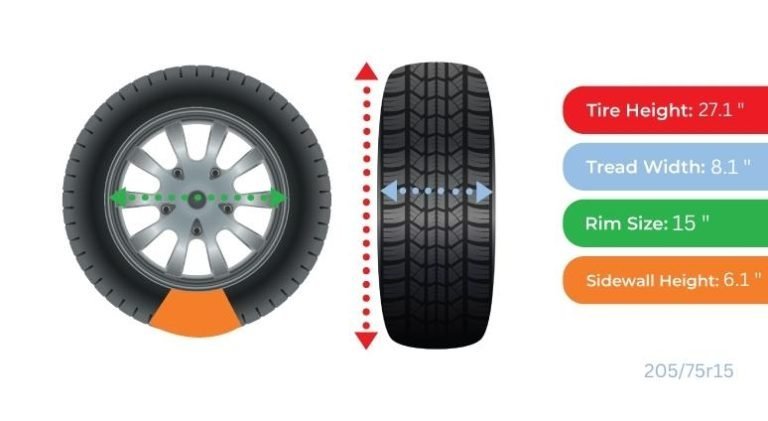
What Does “205” Mean on a Tire?
The number 205 is the tire’s nominal section width in millimeters. It measures the widest part of the inflated tire from one sidewall to the other.
For example:
- 205 mm = nominal tire width
- 205 mm ÷ 25.4 = 8.07 inches
- Rounded for everyday use, this is about 8.1 inches
This measurement is not the same as the tread width. The tread is the part that touches the road, while the section width includes the tire’s sidewalls.
Actual mounted width may vary slightly because of:
- Rim width
- Tire brand
- Tire model
- Inflation pressure
- Approved measuring rim
- Load and speed rating
Because of these variables, a 205 tire may measure a little more or less than 8.1 inches in real use. The 205 designation remains the standard nominal size.
Tire Size Example: 205/55R16
A complete tire size gives much more information than the first number alone. Consider 205/55R16:
| Marking | Meaning |
|---|---|
| 205 | Nominal width in millimeters |
| 55 | Aspect ratio |
| R | Radial construction |
| 16 | Wheel diameter in inches |
The 55 means the sidewall height is 55% of the tire’s width.
Calculating the sidewall height
First, convert the width to inches:
205 ÷ 25.4 = 8.07 inches
Then multiply by the aspect ratio:
8.07 × 0.55 = 4.44 inches
Each sidewall is about 4.44 inches tall.
Calculating the overall tire diameter
For a 205/55R16 tire:
- Sidewall height: 4.44 inches
- Two sidewalls: 4.44 × 2 = 8.88 inches
- Wheel diameter: 16 inches
- Overall diameter: 8.88 + 16 = 24.88 inches
So, a 205/55R16 tire is approximately 8.1 inches wide and 24.9 inches tall.
This is a calculated estimate. The tire manufacturer’s specification remains the best source for exact dimensions.

Common 205 Tire Sizes in Inches
The same 205 width can produce very different tire heights. The aspect ratio and wheel diameter change the result.
| Tire size | Approximate width | Approximate sidewall height | Approximate overall diameter |
|---|---|---|---|
| 205/50R15 | 8.1 in | 4.0 in | 23.1 in |
| 205/55R15 | 8.1 in | 4.4 in | 23.9 in |
| 205/60R15 | 8.1 in | 4.8 in | 24.7 in |
| 205/55R16 | 8.1 in | 4.4 in | 24.9 in |
| 205/60R16 | 8.1 in | 4.8 in | 25.7 in |
| 205/65R16 | 8.1 in | 5.2 in | 26.5 in |
| 205/50R17 | 8.1 in | 4.0 in | 25.1 in |
| 205/55R17 | 8.1 in | 4.4 in | 26.9 in |
These figures use standard tire-size calculations:
- Width in inches = 205 ÷ 25.4
- Sidewall height = width × aspect ratio
- Overall diameter = two sidewalls + wheel diameter
Actual tire measurements can differ slightly by model and rim.
How to Calculate Any 205 Tire Size
You can calculate the dimensions of any tire beginning with 205 by following three steps.
Step 1: Convert width to inches
Use this formula:
Width in inches = tire width in millimeters ÷ 25.4
For a 205 tire:
205 ÷ 25.4 = 8.07 inches
Step 2: Calculate the sidewall height
Use the aspect ratio shown after the slash.
For a 205/60 tire:
8.07 × 0.60 = 4.84 inches
The sidewall is about 4.84 inches tall.
Step 3: Calculate total diameter
Use this formula:
Overall diameter = wheel diameter + two sidewall heights
For a 205/60R16 tire:
- Wheel diameter: 16 inches
- Two sidewalls: 4.84 × 2 = 9.68 inches
- Overall diameter: 16 + 9.68 = 25.68 inches
The result is about 25.7 inches tall.

Is a 205 Tire the Same as an 8-Inch Tire?
A 205 tire is close to an 8-inch tire, but it is not exactly 8 inches wide.
- 205 mm = 8.07 inches
- Rounded to the nearest whole inch: 8 inches
- Rounded to the nearest tenth: 8.1 inches
In casual conversation, people may call it an 8-inch tire. For fitment work, use the complete metric size and the manufacturer’s approved rim range instead of relying on a rounded conversion.
The tire’s nominal width also does not guarantee that its tread is exactly 8.07 inches wide. Tread width and section width are separate measurements.
Will a 205 Tire Fit an 8-Inch Wheel?
A 205 tire may fit an 8-inch-wide wheel, but the answer depends on the exact tire model and its approved rim-width range.
Tire manufacturers publish approved rim widths for each tire. A 205 tire may be designed for a range of rims, such as a narrower or wider wheel within that range. The correct fit cannot be confirmed from the 205 number alone.
Before mounting one, check:
- The vehicle owner’s manual.
- The tire sidewall and manufacturer specifications.
- The wheel manufacturer’s approved tire range.
- Clearance near the suspension, fender, and steering components.
- Load index and speed rating.
- Whether the front and rear sizes must match.
Do not choose a tire solely because its calculated width appears close to the wheel width. An improper rim match can affect handling, bead seating, wear, and safety.
How Wide Is a 205 Tire Compared With Other Sizes?
The table below shows common nominal width conversions.
| Tire width | Approximate width in inches |
|---|---|
| 185 mm | 7.3 in |
| 195 mm | 7.7 in |
| 205 mm | 8.1 in |
| 215 mm | 8.5 in |
| 225 mm | 8.9 in |
| 235 mm | 9.3 in |
| 245 mm | 9.6 in |
A 205 tire is:
- About 0.4 inches wider than a 195 tire
- About 0.4 inches narrower than a 215 tire
- About 0.8 inches narrower than a 225 tire
These are nominal comparisons. The actual difference between two tire models may be somewhat different because manufacturers measure tires on different approved rims.

Does a 205 Tire Have a 205-Millimeter Tread?
No. The 205 number refers to the tire’s nominal section width, not necessarily its tread width.
Section width includes the full inflated tire from sidewall to sidewall. Tread width measures the portion designed to contact the road. A tire with a 205 section width may have a tread that is narrower than 205 millimeters.
This distinction matters when comparing:
- Road contact area
- Fender clearance
- Mudguard space
- Steering clearance
- Wheel fitment
- Tire-to-tire appearance
For precise comparisons, use the manufacturer’s specification sheet. Do not estimate tread width from the first number in the tire size.
Does a Wider 205 Tire Improve Grip?
Not automatically. A tire’s grip depends on much more than section width, including:
- Rubber compound
- Tread design
- Temperature
- Road surface
- Inflation pressure
- Vehicle alignment
- Tire condition
- Load
- Wet or dry conditions
A wider tire may change steering feel and the size of the contact patch, but it is not automatically safer or better. A tire with the correct size, load rating, speed rating, and vehicle fit is usually more important than a small width difference.
Follow the vehicle maker’s tire recommendations. The National Highway Traffic Safety Administration advises drivers to use tires that meet the vehicle’s required size and load specifications and to maintain proper inflation.
How Do You Read a Tire Marked 205/55R16?
A tire marked 205/55R16 91V contains several separate pieces of information:
- 205: Nominal width in millimeters
- 55: Sidewall height as a percentage of width
- R: Radial construction
- 16: Wheel diameter in inches
- 91: Load index
- V: Speed rating
The load index and speed rating are important. Replacing a tire with one that has a lower rating than the vehicle requires can create a safety and compliance problem.
The full marking may also include terms such as:
- M+S: Mud and snow designation
- 3PMSF: Severe snow service symbol
- XL: Extra-load construction
- Run-flat markings
- Manufacturer-specific original-equipment codes
Read the complete marking before buying a replacement.
Common Mistakes When Converting a 205 Tire
Mistake 1: Treating 205 as the tire diameter
The 205 is the width, not the height. The overall diameter depends on the aspect ratio and wheel size.
Mistake 2: Ignoring the aspect ratio
A 205/50 tire is much shorter than a 205/65 tire, even though both are 205 millimeters wide.
Mistake 3: Assuming every 205 tire measures the same
Different tire models can have different measured widths and tread designs. The approved rim also affects the mounted measurement.
Mistake 4: Matching only the wheel diameter
A 205/55R16 and a 205/60R16 both fit a 16-inch wheel, but they do not have the same overall diameter.
Mistake 5: Choosing a replacement by width alone
The correct replacement must also match the vehicle’s required diameter, load index, speed rating, construction, and clearance.
Mistake 6: Converting millimeters to inches by dividing by 12
Millimeters convert to inches by dividing by 25.4, not 12. The correct calculation is:
205 ÷ 25.4 = 8.07 inches
Does Changing From a 205 Tire Affect the Speedometer?
Yes, changing the complete tire size can affect the speedometer and odometer.
If the replacement tire has a larger overall diameter, it travels farther with each wheel revolution. The speedometer may then show a speed that differs from the vehicle’s actual speed. A smaller tire can produce the opposite effect.
For example, changing from 205/55R16 to 205/65R16 keeps the width at about 8.1 inches but increases the overall diameter from approximately 24.9 inches to 26.5 inches.
That change may also affect:
- Ground clearance
- Acceleration
- Braking feel
- Transmission shift points
- Anti-lock braking systems
- Traction control
- Fender clearance
Keep the replacement diameter close to the vehicle’s original specification unless a qualified tire professional confirms the change is suitable.
Frequently Asked Questions
How many inches wide is a 205 tire?
A 205 tire is 205 millimeters wide, which converts to 8.07 inches, or about 8.1 inches. This is the nominal section width, not necessarily the tread width.
What is the diameter of a 205 tire?
There is no single diameter for all 205 tires. The diameter depends on the aspect ratio and wheel size. For example, a 205/55R16 tire is about 24.9 inches in diameter, while a 205/65R16 tire is about 26.5 inches.
What does 205/55R16 mean?
It means the tire is 205 millimeters wide, has a sidewall height equal to 55% of its width, uses radial construction, and fits a 16-inch wheel.
Is a 205 tire wider than a 215 tire?
No. A 205 tire is narrower. A 205 tire is about 8.1 inches wide, while a 215 tire is about 8.5 inches wide.
Can I replace a 205 tire with a 215 tire?
Possibly, but not automatically. The 215 tire must fit the wheel, remain within the vehicle’s approved size range, provide the required load and speed ratings, and clear the suspension and body. Check the owner’s manual and tire manufacturer specifications first.
Key Takeaways
- A 205 tire is about 8.1 inches wide.
- The 205 measurement is in millimeters, not inches.
- The exact conversion is 205 ÷ 25.4 = 8.07 inches.
- The number 205 does not identify the tire’s overall diameter.
- Aspect ratio and wheel diameter determine the tire’s height.
- A 205/55R16 tire is approximately 8.1 inches wide and 24.9 inches tall.
- Always check the complete tire size, load index, speed rating, and approved rim range before replacing a tire.
Conclusion
A 205 tire converts to about 8.1 inches in width. That answer applies to the nominal section width, while the tire’s total height depends on the rest of its size marking.
For an exact fit, read the complete code, such as 205/55R16, and verify the vehicle’s approved specifications. If the tire size, rim width, load rating, or clearance is uncertain, ask a qualified tire professional before mounting it.