

The main difference between 55R and 60R tires is sidewall height. The number shows the tire’s aspect ratio, or sidewall height as a percentage of the tire’s width. A 60-series tire has a taller sidewall than a 55-series tire.
For example, on the same 225-mm-wide tire:
- A 225/55R17 tire has a sidewall about 123.8 mm tall.
- A 225/60R17 tire has a sidewall about 135 mm tall.
That 11.3-mm difference on each side changes the tire’s total diameter, ride comfort, handling, speedometer reading, and fit. In the United States, the safest choice is the tire size listed on your vehicle’s driver-door placard or owner’s manual unless a qualified tire professional confirms another size will fit and work correctly.
Introduction
If you are comparing tire sizes for a Ford, Chevrolet, Toyota, Honda, Subaru, or another vehicle sold in the United States, the first step is to read the complete size—not only “55R” or “60R.”
A tire marking such as 225/55R17 contains several separate details:
- 225 = tire width in millimeters
- 55 = sidewall height as a percentage of tire width
- R = radial construction
- 17 = wheel diameter in inches
The difference between 55R and 60R matters only when the other measurements are known. A 205/60R16 tire and a 225/55R17 tire do not have the same overall size, even though both contain one of the numbers in question.

55R vs. 60R: What Do the Numbers Mean?
The 55 or 60 is not the sidewall height in millimeters. It is a percentage.
A 55-series tire has a sidewall height equal to 55% of its section width. A 60-series tire has a sidewall height equal to 60% of its section width.
The basic formula is:
Sidewall height = tire width × aspect ratio
So, for a 225-mm-wide tire:
| Tire size | Calculation | Approximate sidewall |
|---|---|---|
| 225/55R17 | 225 × 0.55 | 123.8 mm |
| 225/60R17 | 225 × 0.60 | 135.0 mm |
The R does not mean “radius.” It means the tire uses radial construction, which is standard on nearly all modern passenger vehicles in the U.S.
A complete tire size also includes the wheel diameter. Therefore, “55R” by itself is incomplete. You need the width and wheel size to calculate the tire’s actual dimensions.
How Much Taller Is a 60-Series Tire?
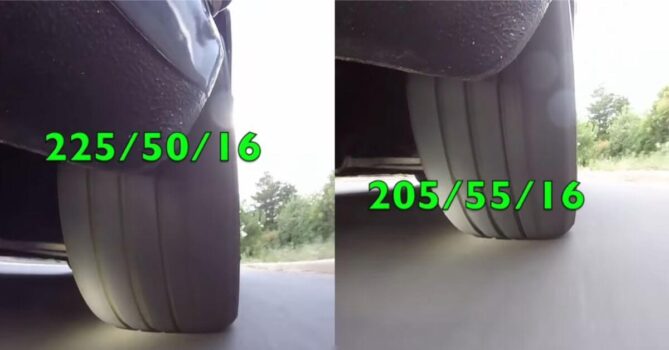
If the tire width stays the same, a 60-series tire has a sidewall that is 5% of the tire’s width taller than a 55-series tire.
For a 225-mm-wide tire:
- Difference in sidewall height: 225 × 0.05 = 11.25 mm
- Difference in overall tire diameter: 11.25 × 2 = 22.5 mm
- Approximate diameter increase: 2.9%
The difference is doubled because a tire has a sidewall above and below the wheel.
Example: 225/55R17 vs. 225/60R17
Approximate dimensions:
| Measurement | 225/55R17 | 225/60R17 |
|---|---|---|
| Width | 225 mm | 225 mm |
| Sidewall height | 123.8 mm | 135.0 mm |
| Wheel diameter | 17 inches | 17 inches |
| Overall tire diameter | 679.3 mm | 701.8 mm |
| Approximate diameter difference | — | 22.5 mm |
| Approximate percentage difference | — | 3.3% |
The exact published diameter can vary slightly by tire brand and model. Tread design, approved rim width, and manufacturing details affect the final measured size.
A taller tire also raises the vehicle by about half of the diameter difference. In this example, the vehicle may sit roughly 11 mm, or 0.4 inch, higher. That is a calculation, not a guarantee of actual ground clearance at every part of the vehicle.
Main Differences Between 55R and 60R Tires
The larger sidewall of a 60-series tire changes several driving traits. These changes are real, but their size depends on the tire model, tread compound, inflation pressure, vehicle suspension, and road surface.
Ride comfort
A 60-series tire usually provides a softer ride than a 55-series tire when both tires have the same width and construction.
The taller sidewall gives the tire more room to flex over potholes, cracks, and rough pavement. That can reduce sharp impacts felt through the steering wheel and seats.
A 55-series tire may feel firmer because its shorter sidewall bends less. However, tire design matters. A touring 55-series tire may ride more softly than an aggressive 60-series performance tire.
Handling and steering response
A 55-series tire often feels more direct during cornering and quick steering inputs. Its shorter sidewall usually flexes less, which can make the vehicle feel more stable and responsive.
A 60-series tire may feel slightly slower or softer in rapid turns. This does not make it unsafe by itself, but it can change the vehicle’s steering feel from the original factory setup.
The difference is most noticeable when:
- The tire width stays the same
- The vehicle has sensitive steering
- You drive on winding roads
- The tire has a soft sidewall
- The replacement size differs substantially from the factory size
Protection from potholes
A taller sidewall gives the wheel and tire more rubber between the road and the rim. That may provide better protection from pothole impacts and damaged pavement.
It does not make the tire immune to damage. A severe impact can still bend a wheel, break a tire’s internal cords, or cause a sidewall bulge. U.S. drivers should also check tire pressure regularly because low pressure increases the risk of impact damage.
Fuel economy
A 60-series tire does not automatically improve or reduce fuel economy.
If the 60-series tire is larger in diameter, the engine may run at slightly lower revolutions per mile. However, the tire may also weigh more, have greater rolling resistance, or use a different tread pattern. Those factors can offset or exceed any benefit from the larger diameter.
The practical result depends on the exact tire and vehicle. Do not choose a tire size for fuel savings alone.
Ground clearance
A larger-diameter 60-series tire can increase ground clearance slightly. In the 225/55R17 versus 225/60R17 example, the calculated increase is about 0.4 inch.
That may help the vehicle clear small obstacles, but it also reduces clearance around the wheel well. A tire that is too tall can rub against:
- Inner fenders
- Suspension parts
- Mud flaps
- Steering components
- The wheel well liner
Speedometer and odometer readings
A larger tire travels farther with each revolution. If the vehicle’s computer is calibrated for the smaller original tire, the speedometer may show a speed lower than the vehicle’s actual speed.
Using the example above:
- Original diameter: about 679.3 mm
- Replacement diameter: about 701.8 mm
- Diameter increase: about 3.3%
If the speedometer shows 60 mph, the vehicle could be traveling about 62 mph, assuming the speedometer was accurate with the original tire. The odometer may also record fewer miles than the vehicle actually travels.
This is an estimate. Tire wear, air pressure, production variation, and the vehicle’s original speedometer tolerance also affect the result.
Is a 60R Tire Better Than a 55R Tire?
Neither size is automatically better. The better choice is the size that matches the vehicle, wheel, driving needs, and manufacturer specifications.
A 60-series tire may be a better fit when you want:
- A smoother ride on rough streets
- More sidewall protection
- A less harsh feel from potholes
- A small increase in calculated ground clearance
A 55-series tire may be a better fit when you want:
- More immediate steering response
- A firmer cornering feel
- A lower sidewall appearance
- Better preservation of the vehicle’s original handling balance
These are general tendencies, not universal rules. A tire’s rubber compound, internal construction, tread pattern, load rating, and inflation pressure can have a larger effect than a five-point change in aspect ratio.
The vehicle manufacturer’s approved tire sizes should come first. The National Highway Traffic Safety Administration recommends following the vehicle and tire manufacturer’s safety information, including the tire information shown on the vehicle placard. See NHTSA’s tire safety guidance.
Can You Replace 55R Tires With 60R Tires?
Sometimes, but not automatically.
A 60-series tire may fit if the complete replacement size is approved for the vehicle and provides enough clearance. The width, wheel diameter, load index, speed rating, and overall diameter must all be checked.
Before changing sizes, confirm these points:
The wheel diameter matches.
A tire designed for a 17-inch wheel cannot be mounted on a 16-inch wheel.The tire fits the wheel width.
Every tire has an approved rim-width range. The wheel must fall within that range.The overall diameter is appropriate.
A large change can affect the speedometer, transmission behavior, electronic systems, and clearance.The load index meets or exceeds the vehicle requirement.
The load index is separate from the aspect ratio. A 60-series tire is not necessarily strong enough simply because it has a taller sidewall.The speed rating is suitable.
The speed rating is also separate from “55” or “60.” Use the vehicle maker’s specification as the baseline.The tire does not rub.
Check clearance with the steering turned fully left and right and with the suspension loaded. A tire shop should perform this check.The vehicle’s systems remain compatible.
Large changes in tire circumference can affect anti-lock brakes, traction control, stability control, and all-wheel-drive systems.
For vehicles with full-time or electronically managed all-wheel drive, replacing only one tire—or using tires with substantially different rolling circumferences—can create drivetrain problems. Follow the owner’s manual and tire manufacturer’s replacement guidance.
How to Calculate the Overall Tire Diameter
You can estimate tire diameter with this formula:
Overall diameter = wheel diameter in millimeters + (2 × sidewall height)
Convert the wheel diameter from inches to millimeters:
Wheel diameter in millimeters = wheel diameter in inches × 25.4
Example: 225/55R17
- Sidewall: 225 × 0.55 = 123.75 mm
- Wheel: 17 × 25.4 = 431.8 mm
- Overall diameter: 431.8 + (2 × 123.75) = 679.3 mm
Example: 225/60R17
- Sidewall: 225 × 0.60 = 135 mm
- Wheel: 17 × 25.4 = 431.8 mm
- Overall diameter: 431.8 + (2 × 135) = 701.8 mm
To compare sizes:
Percentage difference = (new diameter − original diameter) ÷ original diameter × 100
For these two sizes:
(701.8 − 679.3) ÷ 679.3 × 100 ≈ 3.3%
This calculation is useful for comparison, but it does not replace a vehicle-specific fitment check.
Why Tire Width Also Matters
The same aspect ratio can produce different sidewall heights when the tire width changes.
For example:
- 205/60R16 sidewall: 205 × 0.60 = 123 mm
- 225/55R17 sidewall: 225 × 0.55 = 123.8 mm
These two tires have nearly the same sidewall height, even though one is marked 60 and the other is marked 55. Their total diameters still differ because they use different wheel diameters.
This is why comparing only “55R” and “60R” can be misleading. Always compare the complete tire size, such as:
- 215/55R17
- 225/55R17
- 225/60R17
- 235/60R18
Width, aspect ratio, wheel diameter, load index, and speed rating all work together.
Common Mistakes to Avoid
Treating 55R or 60R as a complete tire size
Neither marking tells you the tire width or wheel diameter. Use the complete code printed on the tire sidewall.
Assuming a taller sidewall always improves safety
A taller sidewall may help cushion impacts, but it can also change steering response and vehicle behavior. Safety depends on correct fitment, tire condition, inflation, load capacity, and driving conditions.
Ignoring the load index
The load index must meet the vehicle maker’s requirement. A tire with the right diameter can still be unsuitable if it cannot carry the required load.
Mixing different sizes on one axle
Different tire sizes can have different rolling circumferences and handling characteristics. Do not mix sizes on the same axle unless the vehicle manufacturer specifically allows it.
Replacing only one tire on an all-wheel-drive vehicle
Some all-wheel-drive systems require very similar tire circumferences at all four corners. Read the owner’s manual before replacing fewer than four tires.
Relying only on visual clearance
A tire may look as if it fits while rubbing during turns, suspension movement, or heavy loads. A professional fitment check is safer than judging by appearance.
Changing tire pressure based on the sidewall number
The correct cold inflation pressure usually appears on the driver-door placard or in the owner’s manual. Do not use the maximum pressure molded into the tire sidewall as the vehicle’s normal pressure unless the manufacturer says to do so.
Quick Comparison Table
| Feature | 55-series tire | 60-series tire |
|---|---|---|
| Aspect ratio | 55% of tire width | 60% of tire width |
| Sidewall | Shorter | Taller |
| Ride feel | Usually firmer | Usually softer |
| Steering response | Often quicker | Often less immediate |
| Pothole cushion | Less sidewall flex | More sidewall flex |
| Overall diameter with same width and wheel | Smaller | Larger |
| Ground clearance | Slightly lower | Slightly higher |
| Speedometer effect when substituted | Baseline | May read lower than actual speed |
| Fitment risk | Depends on complete size | Depends on complete size |
The table describes typical results when width and wheel diameter remain the same. The exact outcome depends on the vehicle and tire model.
Key Takeaways
- 55 and 60 describe aspect ratio, not tire height in millimeters.
- A 60-series tire has a sidewall that is 5% of the tire width taller than a 55-series tire of the same width.
- A taller 60-series tire often offers a softer ride and more pothole cushioning.
- A 55-series tire often provides sharper steering response.
- A 60-series replacement may change ride height, speedometer accuracy, clearance, and electronic-system behavior.
- Never choose a replacement based on “55R” or “60R” alone.
- Check the complete size, load index, speed rating, wheel width, and vehicle manufacturer’s specifications.
Frequently Asked Questions
Does 60R mean the tire is 60 inches?
No. The “60” is the aspect ratio. It means the sidewall height is 60% of the tire’s width. The wheel diameter appears at the end of the tire code, such as the “17” in 225/60R17.
Is a 60-series tire wider than a 55-series tire?
Not necessarily. The width is the first number in the tire size. A 225/55R17 and a 225/60R17 are both about 225 mm wide. The 60-series tire has a taller sidewall, not a wider section.
Will 60-series tires make my car sit higher?
Usually, if the 60-series tire has the same width and wheel diameter as the 55-series tire, its larger overall diameter will raise the vehicle slightly. The increase in ground clearance is about half the increase in total tire diameter.
Will changing from 55 to 60 affect my speedometer?
It can. If the replacement tire has a larger overall diameter, it travels farther per revolution. The speedometer may display a speed lower than the vehicle’s actual speed, and the odometer may record fewer miles.
Can I use 55-series tires on one axle and 60-series tires on the other?
Do not do this unless the vehicle manufacturer specifically approves that arrangement. Different rolling circumferences can affect handling, braking, traction control, anti-lock brakes, and all-wheel-drive components.
Conclusion
The difference between 55R and 60R tires is mainly the sidewall aspect ratio. A 60-series tire has a taller sidewall than a 55-series tire of the same width, which can improve ride comfort and impact cushioning but may reduce steering sharpness and alter the tire’s overall diameter.
For a safe replacement in the United States, compare the full tire size and confirm the vehicle’s required load index, speed rating, wheel fit, clearance, and approved tire options. The most reliable next step is to read the driver-door tire placard and owner’s manual, then have a qualified tire professional verify any size change before installation.