
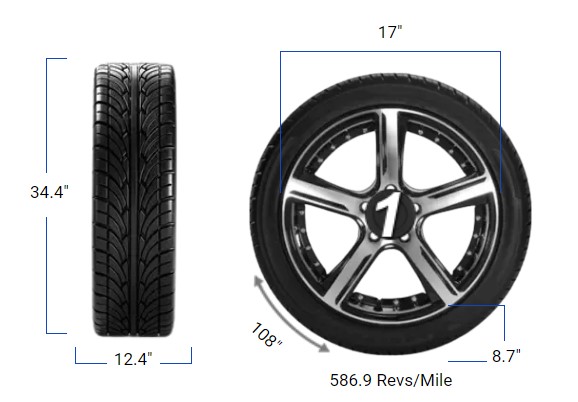
A 315/70 tire is about 12.4 inches wide and has a sidewall height of about 8.7 inches. Its total diameter depends on the wheel size:
- 315/70R17: about 34.4 inches tall
- 315/70R18: about 35.4 inches tall
- 315/70R20: about 37.4 inches tall
In the United States, a 315/70R17 is often described as a 35-inch tire. However, it is not exactly the same as a 35x12.50R17 tire. Actual measurements vary by tire brand, model, tread design, inflation pressure, and load.
What Does 315/70R17 Mean?
The numbers in 315/70R17 describe the tire’s width, sidewall ratio, construction, and wheel size.
- 315 means the tire is about 315 millimeters wide.
- 70 is the aspect ratio. The sidewall height equals 70% of the tire’s width.
- R means radial construction.
- 17 means the tire fits a 17-inch wheel.
The “315/70 tire” name is incomplete without the wheel diameter. A 315/70R17 and a 315/70R20 have the same nominal width and aspect ratio, but the 20-inch version is about 3 inches taller.
Converting 315 millimeters to inches
A 315-millimeter tire converts to:
315 ÷ 25.4 = 12.40 inches
So, the nominal section width is 12.4 inches.
The tire may measure slightly narrower or wider when mounted. Tire makers measure tires on a specified test rim, while your truck’s wheel width can change the final measurement.
Calculating sidewall height
The sidewall formula is:
Tire width × aspect ratio
For a 315/70 tire:
315 × 0.70 = 220.5 millimeters
Convert that to inches:
220.5 ÷ 25.4 = 8.68 inches
Each sidewall is therefore about 8.7 inches tall.

How Tall Is a 315/70 Tire?
The total tire height depends on the rim diameter. Use this formula:
Overall diameter = wheel diameter + 2 × sidewall height
For a 315/70R17:
- Wheel diameter: 17 inches
- Two sidewalls: 8.68 × 2
- Calculated diameter: 34.36 inches
The table below shows the approximate calculated size for common 315/70 tires.
| Tire size | Approximate width | Approximate diameter | Approximate sidewall |
|---|---|---|---|
| 315/70R17 | 12.4 in | 34.4 in | 8.7 in |
| 315/70R18 | 12.4 in | 35.4 in | 8.7 in |
| 315/70R20 | 12.4 in | 37.4 in | 8.7 in |
These are mathematical dimensions, not guaranteed measured dimensions. A manufacturer’s published specification is the best source for the exact tire model.
Is a 315/70R17 a 35-inch tire?
Practically, yes, but technically, it is usually slightly smaller than 35 inches.
A 315/70R17 calculates to about 34.4 inches tall. Tire manufacturers and truck owners often group it with “35-inch tires” because the difference is small and because real-world tire measurements vary.
A 315/70R18 calculates to about 35.4 inches. It is closer to a true 35-inch tire, although some models may measure differently.
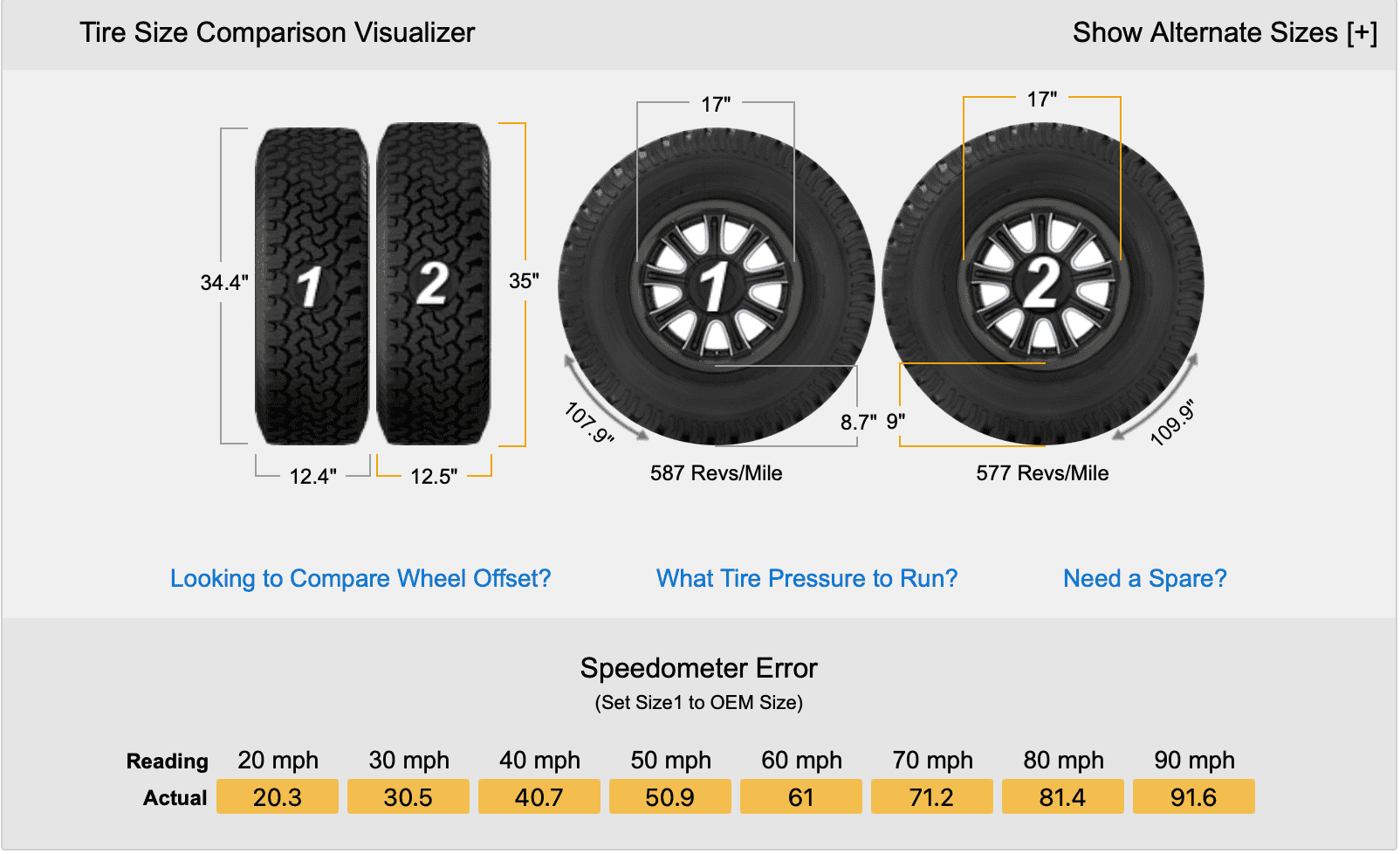
How does it compare with a 35x12.50 tire?
A typical 35x12.50R17 tire is nominally:
- 35 inches tall
- 12.5 inches wide
- Designed for a 17-inch wheel
A 315/70R17 is nominally:
- About 34.4 inches tall
- About 12.4 inches wide
- Designed for a 17-inch wheel
The two sizes are close, but they are not interchangeable by size alone. Check the tire manufacturer’s data and the vehicle maker’s fitment limits before changing sizes.

What Is the Closest Imperial Tire Size?
For a 315/70R17, the closest common inch-based description is about 34.5 inches by 12.5 inches. Many people call it a 35x12.50R17 equivalent, but the match is only approximate.
The closest comparison depends on what you are trying to match:
| Metric tire | Common inch-size comparison | Important difference |
|---|---|---|
| 315/70R17 | 35x12.50R17 | Usually slightly shorter |
| 315/70R18 | 35x12.50R18 | Often close in height |
| 315/70R20 | 37x12.50R20 | Usually shorter than a true 37-inch tire |
Metric and flotation sizes use different measuring systems. A tire marked 35 inches may not measure exactly 35 inches when mounted. The same applies to a tire marked 315 millimeters.
Is 315/70R17 the same as 315/70R18?
No. Both have the same nominal width and aspect ratio, but the 315/70R18 uses a one-inch larger wheel. Its overall diameter is therefore about one inch taller.
That change can affect:
- Fender and suspension clearance
- Speedometer readings
- Vehicle gearing
- Acceleration
- Braking feel
- Spare-tire fit
- Wheel-well clearance
Never assume that a tire will fit because only the final rim number changed.
What Trucks Use 315/70 Tires?
A 315/70 tire is a wide, large truck tire commonly used on full-size pickups, heavy-duty trucks, and some off-road builds in the United States. Exact fitment depends on the truck, suspension, wheel, axle rating, and tire type.
The size may appear on vehicles such as:
- Heavy-duty Ford, Chevrolet, GMC, Ram, and other full-size pickups
- Lifted or modified 4x4 trucks
- Off-road and overland vehicles
- Some commercial or work-truck applications
The vehicle’s original tire placard and owner’s manual control the approved replacement size. The label is usually found on the driver-side doorjamb. It lists the original tire size, recommended cold inflation pressure, and sometimes the approved load information.
A tire store or truck shop can check clearance, but the final responsibility still rests with the vehicle owner and installer.
Will a 315/70R17 fit a stock truck?
Sometimes, but there is no universal answer.
Fit depends on:
- The truck’s factory suspension height
- Wheel width
- Wheel offset and backspacing
- Steering angle
- Fender liner design
- Front axle and brake clearance
- Tire tread width
- Suspension travel
- Mud flap and bumper design
A 315 tire is wide. Even when the tire clears while parked, it may rub during a full steering turn, suspension compression, or off-road articulation.
A lift kit does not automatically solve every fitment issue. It may increase vertical clearance while leaving steering, inner-fender, or suspension clearance unchanged.

How Much Larger Is 315/70R17 Than a Stock Tire?
The answer depends on the original tire. You can compare the sizes with two calculations.
Diameter difference
Use:
New tire diameter − original tire diameter
For example, suppose a truck has a 275/70R18 tire.
Approximate dimensions:
- 275/70R18 diameter: 33.2 inches
- 315/70R17 diameter: 34.4 inches
- Difference: about 1.2 inches
The 315/70R17 would raise the axle by about half of that difference, or roughly 0.6 inch, if the tire dimensions were exact.
Speedometer difference
A taller tire travels farther with each revolution. If the truck’s speedometer is calibrated for a smaller tire, it may show a speed that is slightly lower than the truck’s actual speed.
The approximate calculation is:
Actual speed = indicated speed × new tire diameter ÷ original tire diameter
Using the example above:
60 × 34.4 ÷ 33.2 = about 62 mph
This is a hypothetical calculation. The real result depends on the actual measured rolling circumference and the vehicle’s calibration.
Modern trucks may also use tire-size data in systems that affect transmission control, stability control, traction control, and driver-assistance features. Follow the manufacturer’s procedures after a size change.

What Load Rating Does a 315/70 Tire Need?
The correct load rating depends on the truck and its axle requirements, not just the tire’s physical size.
Many 315/70 tires are sold as LT tires, meaning light-truck tires. Their sidewalls may include markings such as:
- LT315/70R17
- Load Range E
- A load index, such as a three-digit number
- A speed rating
These markings are not interchangeable. Two tires with the same 315/70 size can have different load capacities.
Check these items before buying:
- The vehicle’s doorjamb tire label
- The owner’s manual
- The front and rear axle ratings
- The tire’s load index and inflation table
- The wheel’s width and weight rating
- The tire’s intended use
Do not lower inflation pressure simply to improve ride comfort. For heavy loads, towing, or commercial use, use the pressure and load information supplied by the vehicle and tire manufacturers.
A tire with a higher load range does not automatically make a truck safe to exceed its axle, wheel, suspension, or gross vehicle weight limits.

What Wheel Fits a 315/70 Tire?
A 315/70 tire must be mounted on a wheel with the correct diameter, width, bolt pattern, offset, and load rating.
The wheel diameter is easy to identify:
- 315/70R17 requires a 17-inch wheel
- 315/70R18 requires an 18-inch wheel
- 315/70R20 requires a 20-inch wheel
Wheel width is more complex. Tire makers publish an approved rim-width range for each tire model. A 315 tire may require a wider wheel than the truck’s original wheel, but the exact range differs by brand and model.
The wheel must also match:
- Bolt pattern
- Center bore
- Offset
- Backspacing
- Brake and hub clearance
- Wheel load rating
Do not use a wheel based only on diameter. A wheel can have the right diameter and still fail to clear the brakes or place the tire too close to the suspension.
Tire mounting should be done by a qualified shop with the right equipment. Wide, stiff LT tires can be difficult and hazardous to mount without proper tools.

Common Problems When Switching to 315/70 Tires
A 315/70 tire can create problems even when its calculated diameter appears acceptable.
Rubbing
Rubbing may occur against:
- Inner fenders
- Fender liners
- Sway bars
- Control arms
- Leaf springs
- Bumpers
- Mud flaps
Check the truck at full left and right steering lock. Also check clearance while the suspension moves through its travel.
Reduced fuel economy
A larger, wider, or heavier tire can increase rolling resistance and aerodynamic drag. It can also add rotating mass. The result may be lower fuel economy, but the amount varies by tire design, pressure, wheels, terrain, and driving habits.
Slower acceleration
A larger tire can act like taller gearing. The engine and transmission may need more effort to turn it, especially when the tire is also heavier than stock.
Incorrect spare tire
A spare that differs greatly in diameter can be a problem for four-wheel-drive and all-wheel-drive systems. If the vehicle requires a full-size spare, match the tire size and keep the spare properly inflated.
Warranty and inspection concerns
Changing from the vehicle’s original size may affect warranty claims, inspection requirements, or insurance questions. Rules differ by state, so check the requirements that apply where the truck is registered.

How to Choose the Correct 315/70 Tire
Use this process before ordering:
- Confirm the full size. Determine whether you need 315/70R17, 315/70R18, or 315/70R20.
- Read the vehicle placard. Record the original size and recommended cold pressure.
- Check the tire’s exact specifications. Compare measured diameter, section width, load index, and approved rim width.
- Measure clearance. Check steering, suspension, brake, and fender clearance.
- Confirm wheel compatibility. Verify offset, backspacing, bolt pattern, center bore, and load rating.
- Consider the use. Highway, towing, snow, mud, rocks, and daily driving may require different tread designs.
- Recheck systems after installation. Watch for rubbing, pressure-monitor warnings, changes in handling, and speedometer differences.
- Have the tires balanced and aligned. A size change can reveal or worsen alignment problems.
The correct choice is not simply the tire with the largest advertised diameter. It is the size that fits the truck, carries the needed load, works with the wheels, and suits the intended driving conditions.

Frequently Asked Questions
Is a 315 tire the same as a 33-inch tire?
No. A 315/70R17 is about 34.4 inches tall, while a typical 33-inch tire is about 33 inches tall. The actual difference depends on the complete tire sizes being compared.
Is a 315 tire the same as a 12.5-inch tire?
They are close in nominal width. A 315-millimeter tire converts to about 12.4 inches, while a 12.50-inch tire is slightly wider on paper. Actual mounted width varies by tire model and wheel.
How much lift is needed for 315/70R17 tires?
There is no universal lift requirement. Some trucks may need no lift, while others may require suspension changes, trimming, different wheels, or limited steering stops. The truck model, wheel offset, tire design, and intended suspension travel decide the result.
Will 315/70 tires hurt towing?
They can change towing behavior. A taller or heavier tire may reduce acceleration and increase drivetrain load. Always remain within the truck’s rated towing, axle, payload, wheel, and tire limits.
Do 315/70 tires need higher air pressure?
Not automatically. Use the vehicle maker’s recommended pressure as the starting point, then follow the tire maker’s load-and-inflation table for the specific tire. The maximum pressure molded into the sidewall is not always the correct everyday pressure.
Final Answer: What Size Is a 315/70 Tire?
A 315/70 tire is about 12.4 inches wide, with an 8.7-inch sidewall. Its approximate overall height is:
- 34.4 inches on a 17-inch wheel
- 35.4 inches on an 18-inch wheel
- 37.4 inches on a 20-inch wheel
For many American truck applications, a 315/70R17 is treated as a near-35-inch tire. Before installing one, verify the full size, load rating, wheel specifications, clearance, and vehicle limits. The next practical step is to compare the tire maker’s published dimensions with the truck’s doorjamb label and measured wheel-well clearance.