

Introduction
For drivers in the United States, a 265/60R18 tire is about 30.5 inches tall and 10.4 inches wide. It fits an 18-inch wheel and has a 60-series sidewall.
The full size code gives four key details: tire width, sidewall height, tire construction, and wheel diameter. The actual size may vary slightly by tire brand, model, load range, and measuring method.

265/60R18 Tire Size in Inches
A 265/60R18 tire has these approximate dimensions:
| Measurement | Approximate size |
|---|---|
| Section width | 265 mm, or 10.4 inches |
| Sidewall height | 159 mm, or 6.3 inches |
| Wheel diameter | 18 inches |
| Overall tire diameter | 30.5 inches |
| Approximate circumference | 95.9 inches |
| Revolutions per mile | About 661 |
These numbers are calculated from the tire code. A tire’s published specification sheet can show a slightly different value because each tire is measured on a specified test rim.
How the size is calculated
The 265 is the tire’s nominal width in millimeters.
Convert the width to inches:
265 ÷ 25.4 = 10.43 inches
The 60 means the sidewall height equals 60% of the tire’s width:
265 × 0.60 = 159 mm
Convert the sidewall height to inches:
159 ÷ 25.4 = 6.26 inches
The tire has two sidewalls, one above and one below the wheel:
6.26 + 6.26 + 18 = 30.52 inches
So, the calculated overall diameter is about 30.5 inches.
The calculation is useful for comparison, but it is not a guarantee of the mounted tire’s exact size. Tread design, rim width, inflation pressure, and load can affect the final measurement.

What Does 265/60R18 Mean?
The code 265/60R18 breaks down as follows:
- 265: Nominal section width in millimeters
- 60: Sidewall height as a percentage of tire width
- R: Radial construction
- 18: Designed for an 18-inch wheel
265: Tire width
The first number, 265, refers to the tire’s approximate section width. It is measured from the outer sidewall to the inner sidewall when the tire is mounted on its specified measuring rim.
That does not always equal the width of the tread touching the road. The tread is usually narrower than the tire’s full section width.
60: Aspect ratio
The number 60 is the aspect ratio. It means the sidewall is about 60% as tall as the tire is wide.
A 265/60R18 tire has a sidewall height of about 159 millimeters, or 6.3 inches. A lower aspect ratio would create a shorter sidewall. A higher ratio would create a taller sidewall.
R: Radial construction
The letter R means the tire uses radial construction. Nearly all modern passenger tires, crossover tires, SUV tires, and light-truck tires sold in the United States use radial construction.
18: Wheel diameter
The final number means the tire must be mounted on an 18-inch wheel. It cannot be safely mounted on a 17-inch or 19-inch wheel.
The tire and wheel must also match in width, bolt pattern, offset, brake clearance, and load capacity. Diameter alone does not prove fitment.
How Big Is a 265/60R18 Tire Compared With Other Sizes?
A 265/60R18 tire is close to 30.5 inches tall. The table below compares it with several sizes that may appear in vehicle fitment searches.
| Tire size | Approx. diameter | Approx. width | Difference from 265/60R18 |
|---|---|---|---|
| 255/60R18 | 30.0 in | 10.0 in | About 0.5 in shorter |
| 265/60R18 | 30.5 in | 10.4 in | Reference size |
| 275/60R18 | 30.9 in | 10.8 in | About 0.4 in taller |
| 265/65R18 | 31.6 in | 10.4 in | About 1.1 in taller |
| 255/65R18 | 31.1 in | 10.0 in | About 0.6 in taller |
| 265/55R18 | 29.5 in | 10.4 in | About 1.0 in shorter |
These are calculated dimensions. Actual published dimensions differ by tire model.
265/60R18 vs. 265/65R18
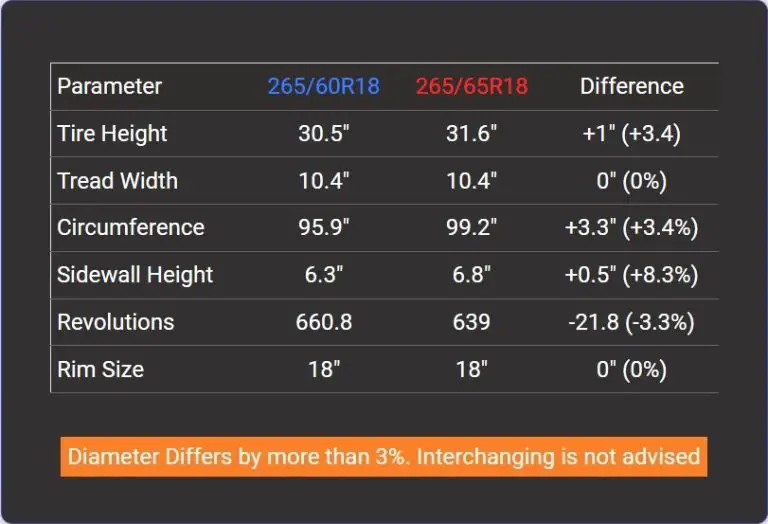
Both sizes are about 265 millimeters wide and fit an 18-inch wheel. The 265/65R18 has a taller sidewall and is about 1.1 inches taller overall.
That difference can reduce clearance at the fender, suspension, and mud flap. It can also change the speedometer reading and vehicle gearing.
265/60R18 vs. 275/60R18
A 275/60R18 is about 10 millimeters wider and roughly 0.4 inches taller. The wider tire may need more clearance, especially when the wheels are turned or the suspension is compressed.
A tire that is only slightly larger on paper can still rub in real-world driving. Wheel offset and suspension height matter as much as the tire dimensions.
265/60R18 vs. 255/60R18
A 255/60R18 is about 10 millimeters narrower and approximately 0.5 inches shorter. It may provide more sidewall clearance, but it is not automatically an approved replacement.
Use the vehicle manufacturer’s approved tire sizes as the starting point.

Is 265/60R18 the Same as a 30-Inch Tire?
No. A 265/60R18 tire is closer to 30.5 inches in diameter than to 30 inches.
Tire sellers and off-road owners sometimes use rounded inch measurements. For example, a 265/60R18 may be casually described as a “30-inch tire.” That label is only an approximation.
The metric size is more precise because it identifies the width, aspect ratio, and wheel diameter. The calculated diameter is:
30.52 inches
The advertised diameter can be different by a small amount depending on the tire model.
Will a 265/60R18 Tire Fit My Vehicle?
A 265/60R18 tire will fit only if the vehicle and wheel assembly allow it. Check the following items before buying:
Vehicle-approved tire size
Look at the driver-door placard, owner’s manual, or official manufacturer fitment information.Wheel width
The tire manufacturer lists an approved rim-width range. The wheel must fall within that range.Clearance
Check the inner sidewall, strut, control arm, brake parts, fender, and mud flap. Clearance must remain safe with the wheels turned and the suspension loaded.Load index
The replacement tire must meet or exceed the vehicle’s required load capacity.Speed rating
The tire should meet the vehicle manufacturer’s required speed rating unless a qualified professional confirms another option.Front and rear matching
Four-wheel-drive and all-wheel-drive vehicles can require closely matched tire diameters. Mixing sizes may place stress on the driveline.Wheel diameter and hardware
The tire needs an 18-inch wheel, but the wheel must also have the correct bolt pattern, offset, center bore, and brake clearance.
The safest source is the vehicle’s tire placard. In the United States, this label is commonly found on the driver-side door jamb. It lists the original tire size and the recommended cold inflation pressure.
A tire shop or vehicle manufacturer can confirm whether another size is acceptable. Do not rely only on an online tire-size calculator.
How Does 265/60R18 Affect Speedometer Accuracy?
Changing to a tire with a different overall diameter can change the speedometer and odometer readings.
A taller tire travels farther with each rotation. If the vehicle’s computer is calibrated for a smaller tire, the speedometer may show a speed that is slightly higher than the vehicle’s actual speed.
Example calculation
Suppose the original tire is 265/65R18, with an approximate diameter of 31.6 inches, and the replacement is 265/60R18, at about 30.5 inches.
The percentage difference is:
(30.5 − 31.6) ÷ 31.6 × 100
= about −3.5%
At an indicated 60 mph, the actual speed could be roughly 58 mph, assuming the calculated sizes match the real tires and the speedometer was accurate before the change.
This example is hypothetical. Use the published overall diameter for the exact tire models when calculating the difference.
A small change may be acceptable on some vehicles, but the vehicle maker’s limits control. A change in diameter can also affect acceleration, engine speed, braking behavior, traction-control operation, and fuel economy.
What Vehicles Use 265/60R18 Tires?
The 265/60R18 size is commonly associated with certain SUVs, crossovers, and pickup trucks. However, tire size can vary by:
- Model year
- Trim level
- Two-wheel drive or four-wheel drive
- Factory wheel package
- Tow or off-road package
- Suspension option
- Regional specification
The same vehicle name may use several different tire sizes. For that reason, a vehicle model alone is not enough to confirm fitment.
Check the tire placard on the specific vehicle. If the current tire is already 265/60R18, confirm that the replacement tire has the correct load index and speed rating.
Can I Replace 265/60R18 With a Different Size?
Sometimes, but a different size should be chosen by comparing more than width.
A suitable replacement usually needs to maintain:
- Similar overall diameter
- Adequate load capacity
- Correct speed rating
- Proper wheel-width compatibility
- Safe suspension and body clearance
- Compatibility with the vehicle’s traction systems
For an all-wheel-drive vehicle, all four tires often need to have nearly the same rolling circumference. Even a modest difference can cause problems if the vehicle’s drivetrain does not allow it.
Do not replace a 265/60R18 tire with a 265/65R18 simply because both sizes use an 18-inch wheel. The taller tire may rub or change the vehicle’s systems.
Common Mistakes When Reading 265/60R18
Mistaking width for tread width
The 265 number describes approximate section width, not the exact tread width. Two tires with the same size code can have different tread designs and measured widths.
Treating the aspect ratio as a height in inches
The 60 is not a 60-inch or 60-millimeter sidewall. It means the sidewall is 60% of the tire’s 265-millimeter width.
Ignoring the load index
The size code does not show the tire’s complete carrying capacity. A full tire marking may look like:
265/60R18 110H
The 110 is the load index, and the H is the speed rating. These markings must meet the vehicle’s requirements.
Assuming every 18-inch wheel will work
An 18-inch wheel may have the wrong width, offset, bolt pattern, or brake clearance. The tire and wheel must be compatible as a complete assembly.
Comparing only the diameter
Two tires with nearly identical diameters can still differ in width, sidewall shape, load rating, and approved rim width. Diameter is only one part of fitment.

265/60R18 Tire Size FAQ
How many inches tall is a 265/60R18 tire?
A 265/60R18 tire is approximately 30.5 inches tall. The exact mounted diameter depends on the tire model, wheel width, inflation pressure, and load.
How wide is a 265/60R18 tire?
Its nominal section width is 265 millimeters, or about 10.4 inches. The actual measured width can vary between brands and tire models.
What size wheel fits a 265/60R18 tire?
It fits an 18-inch wheel within the rim-width range approved by the tire manufacturer. The wheel must also match the vehicle’s bolt pattern, offset, center bore, and brake clearance.
Is 265/60R18 a truck tire size?
It can be used on some pickup trucks and SUVs, but the size code alone does not identify the tire’s intended vehicle type. Check the tire’s construction, load index, speed rating, and the vehicle manufacturer’s requirements.
Is 265/60R18 the same as 265/65R18?
No. The 265/65R18 has a taller sidewall and is about 1.1 inches taller overall than a 265/60R18. That difference may affect clearance, speedometer readings, and vehicle systems.
Final Answer: What Size Tire Is 265/60R18?
A 265/60R18 tire is approximately 30.5 inches tall, 10.4 inches wide, and designed for an 18-inch wheel.
Its sidewall is about 6.3 inches tall. The actual dimensions can vary slightly by tire model.
Before changing to this size, verify the vehicle placard, load index, speed rating, wheel width, clearance, and drivetrain requirements. The correct tire is not determined by diameter alone.