
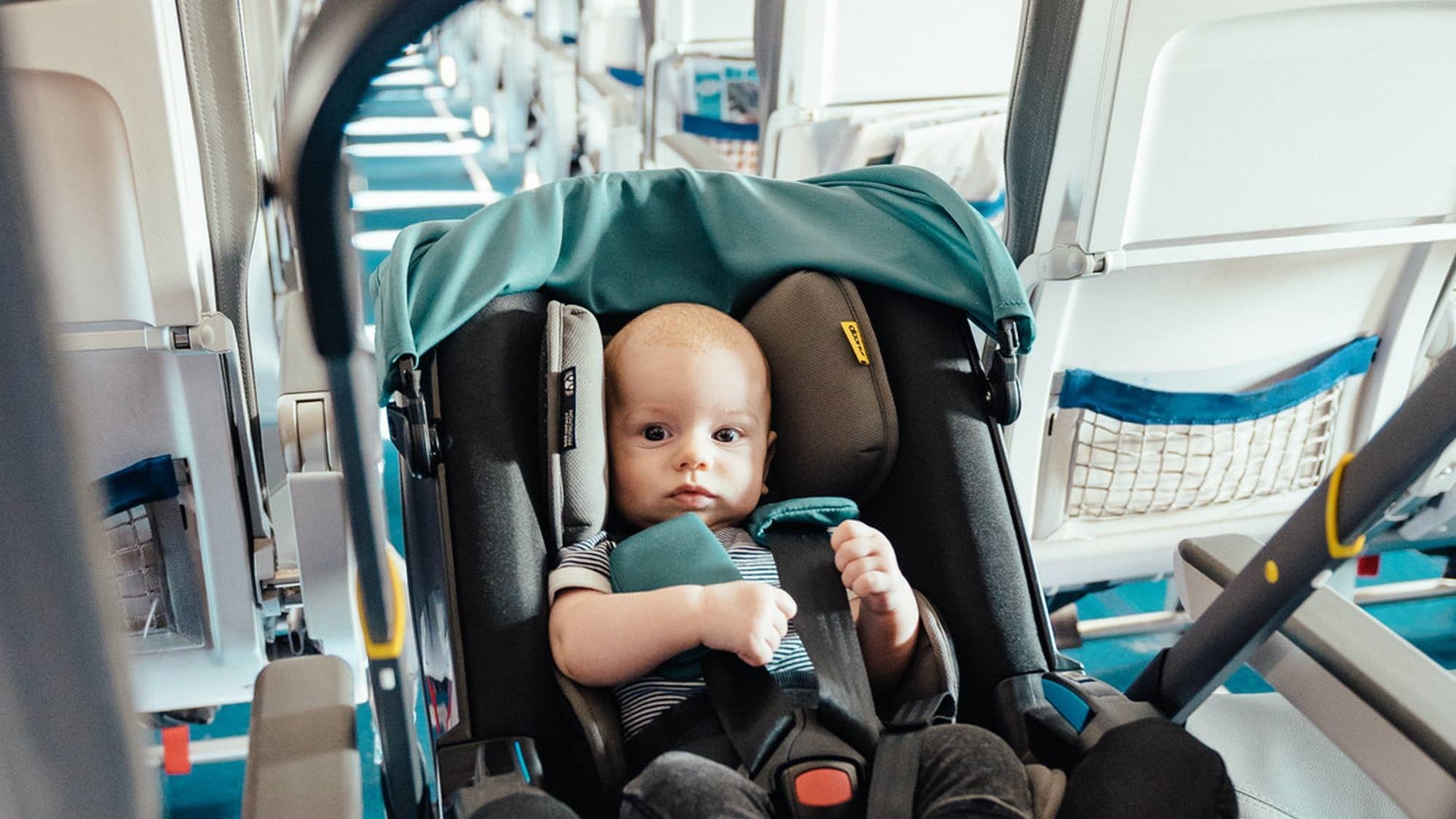
Yes. You can usually take a car seat on a plane in the United States, and you may use it during the flight if it is approved for aircraft use. The safest plan is to buy a separate seat for your child and secure the car seat in that seat.
The car seat must have an aircraft-approval label. Most airlines also require the seat to be placed in a window seat or another approved position. A car seat should never block another passenger’s path or sit in an exit row.
You may also check a car seat at the ticket counter or gate. However, checked seats can be damaged, delayed, or lost. The Federal Aviation Administration (FAA) and the American Academy of Pediatrics generally support using an approved child restraint on the aircraft rather than holding a young child on an adult’s lap.
Can you bring a car seat through airport security?
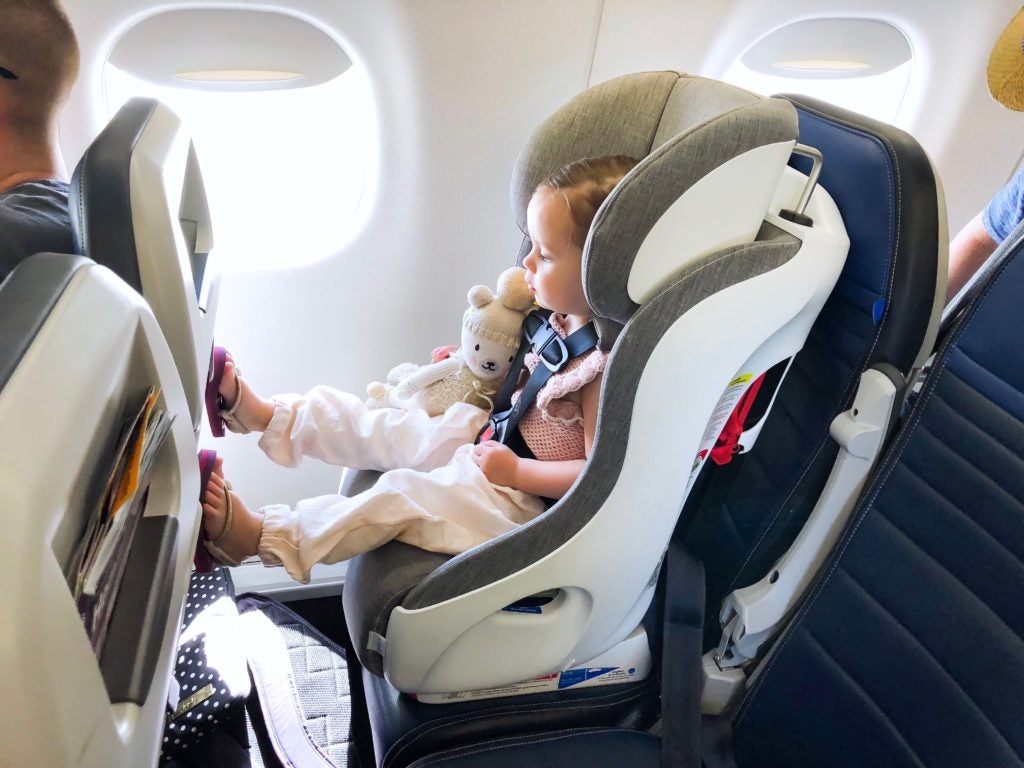
Yes. A car seat can go through the airport and onto the plane. TSA officers may inspect it, but a standard child restraint is allowed as carry-on equipment when you plan to use it in your child’s purchased seat.
At the security checkpoint:
- Remove items from the car seat pockets.
- Place loose toys, blankets, and bags in a bin.
- Follow the TSA officer’s instructions if the seat needs extra screening.
- Allow more time if the seat is large or difficult to place on the screening belt.
- Ask for help rather than lifting a bulky seat over a conveyor.
A car seat does not usually count as your child’s personal item. Still, airline baggage rules differ. Check your airline’s policy before you leave home, especially if you plan to carry a stroller, diaper bag, and other baby gear.
TSA rules and airline rules are not the same. TSA decides what may pass through the security checkpoint. The airline decides how the car seat may be carried, stored, or used on the aircraft.
Can a child use a car seat on an airplane?
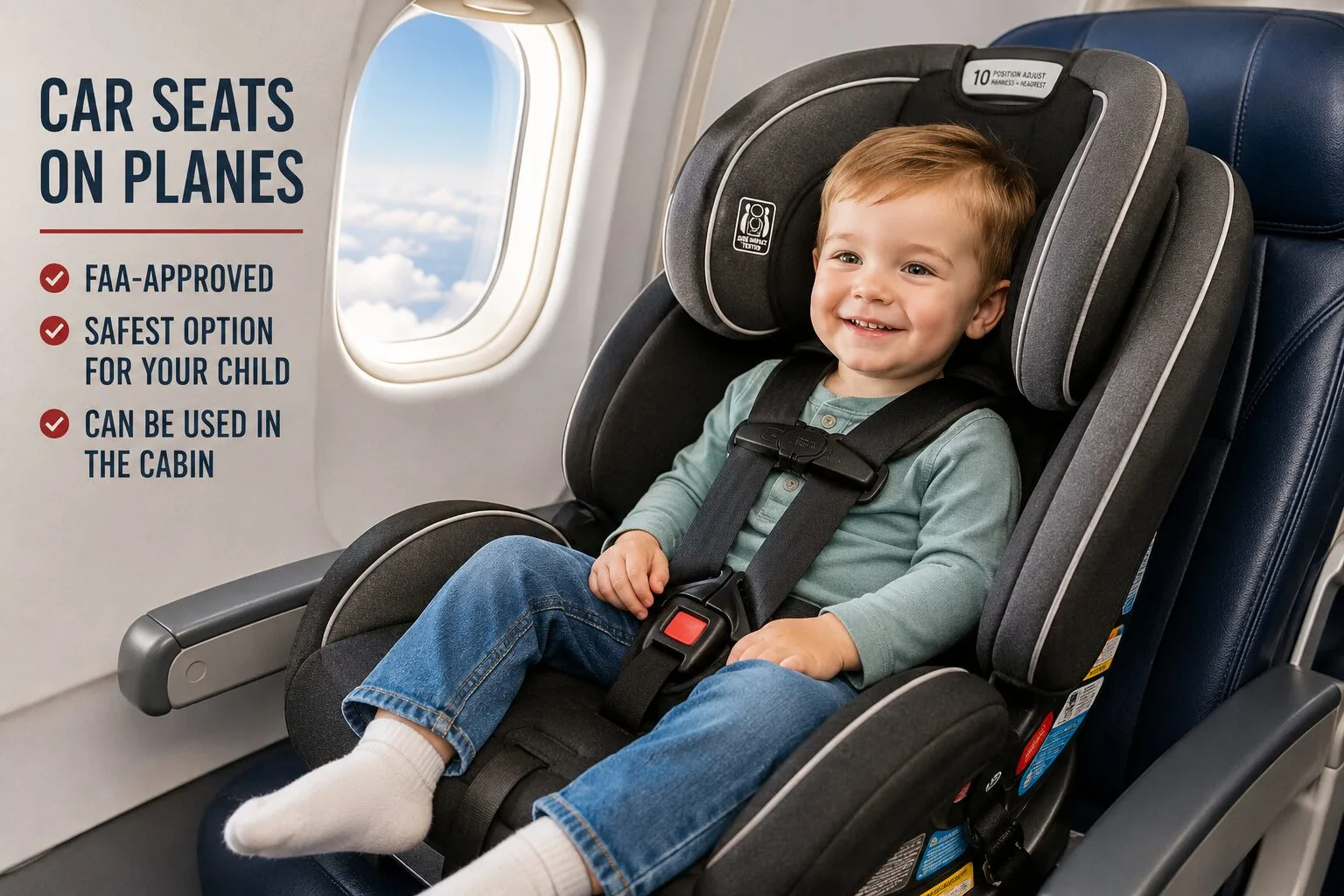
Yes, if the car seat is approved for aircraft use and fits the aircraft seat. The child must also have a ticketed seat. An airline generally cannot require you to hold a child in your lap when you bought a seat for that child, but crew members can require a different approved seating position if the restraint creates a safety problem.
Look for a label that says the seat is certified for use in motor vehicles and aircraft. The exact wording can vary by manufacturer, but the label should clearly state that the seat is approved for aircraft use.
Do not rely only on the fact that a car seat is legal for use in a vehicle. Some vehicle restraints are not approved for aircraft. Check the seat’s manual and label before your trip.
What types of child restraints can be used on a plane?
The following options are common:
| Child restraint | Usually allowed on an aircraft? | Important condition |
|---|---|---|
| Rear-facing infant car seat | Yes, if approved | Must fit the aircraft seat and follow the manual |
| Forward-facing harnessed car seat | Yes, if approved | Use the aircraft lap belt as directed |
| Convertible car seat | Yes, if approved | Check rear- and forward-facing instructions |
| Belt-positioning booster seat | Usually no for takeoff and landing | Aircraft seats have lap belts, not the shoulder belt needed by most boosters |
| Backless booster | Usually no for flight use | It does not provide the needed upper-body restraint |
| CARES child aviation restraint | Yes, for eligible children | Must be an approved model and used within its limits |
| Vest or harness not approved for aircraft | No | Do not use an unapproved product |
A booster seat normally cannot do its job on a plane. A booster raises a child so a vehicle’s lap-and-shoulder belt fits correctly. An aircraft seat usually has only a lap belt, so a booster does not provide the same protection.
The FAA’s child safety restraint guidance explains approved restraint use. The FAA Technical Center’s child restraint information also explains how to identify and use approved systems.

How do you know if a car seat is FAA approved?
Check three places before the trip:
- The side or back of the car seat. Look for the aircraft-use label.
- The instruction manual. It should include directions for aircraft installation.
- The manufacturer’s website or customer service team. Confirm the exact model, not just the product family.
The FAA does not approve every car seat model through a simple public “FAA-approved list.” The manufacturer is responsible for meeting the applicable standards and labeling the restraint correctly.
A label may say something similar to:
This restraint is certified for use in motor vehicles and aircraft.
Do not use a car seat on a plane if:
- The aircraft-use label is missing.
- The seat manual says it cannot be used on aircraft.
- The seat has been recalled.
- The seat is expired under the manufacturer’s rules.
- The seat has been in a crash.
- The shell, harness, buckle, or belt path is damaged.
- You cannot determine the exact model or instructions.
An FAA approval label does not mean every seat will fit every airplane. Approval covers the restraint’s use on an aircraft. You still need to check the seat width, belt path, recline position, and airline rules.

How do you install a car seat on a plane?
Install the seat in the child’s assigned seat before takeoff. Follow the car seat manual and the flight crew’s instructions.
Step 1: Choose the right seat
A window seat is usually the simplest choice. It keeps the car seat from blocking another passenger’s exit.
A middle seat may work when the car seat does not block anyone. A car seat should not be placed in an exit row. Some airlines also restrict car seats in rows next to exit rows or in certain bulkhead seats.
If you are traveling with two adults, one adult can sit beside the child. If the child uses a rear-facing seat, confirm that the seat in front can still recline and that the car seat does not interfere with the tray table.
Step 2: Put the car seat in the correct direction
Use the same direction allowed by the car seat manual.
- Install an infant seat rear-facing when the manual permits it.
- Install a convertible seat rear-facing or forward-facing based on the child’s size and the manufacturer’s limits.
- Do not turn a seat forward-facing just because the airplane space is tight without checking the instructions first.
The aircraft seat may not offer the same recline angle as a vehicle seat. That can be normal. Do not add towels, pillows, cushions, or other items under the seat unless the manufacturer specifically permits them.
Step 3: Route the aircraft lap belt correctly
Use the aircraft lap belt through the car seat’s approved belt path. The correct path differs by model and direction.
Check that:
- The belt is not twisted.
- The buckle is not resting on the child’s body.
- The belt is in the correct forward-facing or rear-facing path.
- The car seat is tight and stable.
- The seat does not move more than the amount allowed by the car seat manual.
A car seat may feel less tight on an airplane than in a vehicle because aircraft seats and cushions are shaped differently. The manual controls the correct installation method.
Step 4: Keep the harness snug
Fasten the child’s harness as you would in a vehicle. The straps should lie flat and pass through the correct slots.
The harness should be snug enough that you cannot pinch extra slack at the shoulder. Keep bulky coats and thick blankets out from under the harness. Place a blanket over the child after buckling if needed.
Step 5: Ask the flight crew for help if needed
Flight attendants can explain the airline’s seating rules, but they may not know how to install your specific car seat. You are responsible for knowing the restraint’s instructions.
If the seat does not fit:
- Ask whether another approved seat is available.
- Check whether the seat is in the correct direction.
- Confirm that you are using the right belt path.
- Do not force the seat into place.
- Do not use an extension belt or an unapproved attachment.

What if the car seat is too wide for the airplane seat?
A wide car seat may not fit between the armrests. The FAA does not set one universal aircraft-seat width, and airlines use different aircraft and seat layouts.
Before traveling, measure the car seat at its widest point. Then ask the airline for the seat width on your specific flight. The width listed online may not match the actual aircraft if the airline changes planes.
A seat that is about 17 to 18 inches wide may fit many economy seats, but there is no universal guarantee. Armrests, seat cushions, and aircraft design can affect the fit.
If the car seat is wider than the seat:
- Ask the airline whether the armrest may be raised.
- Confirm that raising the armrest is permitted and does not affect another passenger.
- Ask whether the airline can reseat your party.
- Avoid placing the car seat in a position that blocks another traveler.
- Do not assume a paid extra seat will solve the problem unless the airline confirms it.
Some airlines may require a larger car seat to be placed next to a window. Others may have special rules for certain aircraft cabins. Check the airline’s child restraint policy and call the carrier before departure.

Should you buy a separate seat for a child under age 2?
You do not always have to buy a separate seat for a child under 2 on a U.S. flight. Many airlines allow an infant under 2 to travel on an adult’s lap, subject to the airline’s rules.
However, the FAA states that the safest place for a young child during turbulence or an emergency is in an approved child restraint, not in an adult’s arms. A lap-held child can be difficult or impossible to hold securely during sudden movement.
Buying a separate seat gives you room to use an approved car seat. It also lets the child stay in a familiar restraint during the flight.
The trade-off is cost. Families should also consider:
- The child’s age, size, and ability to sit safely.
- The length of the flight.
- The chance of turbulence.
- Whether the car seat is needed at the destination.
- The cost of checking or renting another restraint.
- The airline’s ticket and seating rules.
If you choose a lap-held infant option, follow the airline’s instructions. Do not attach the infant to an adult with a belt or other device unless the airline and FAA specifically approve its use.

Can you check a car seat for free?
Many U.S. airlines allow a car seat to be checked without charging it as part of the passenger’s standard baggage allowance. The exact rule varies by airline and may change.
You may be able to check it:
- At the ticket counter.
- At the gate.
- As part of a stroller-and-car-seat combination.
- In a protective travel bag.
A car seat checked at the gate may be returned at the aircraft door, but this is not guaranteed on every flight or at every airport. Ask the gate agent where the seat will be returned.
Before checking the seat:
- Remove toys, cup holders, and loose accessories.
- Place the seat in a strong, padded bag.
- Add your name and contact information.
- Take a photo of the seat before handing it over.
- Keep the instruction manual with you.
- Inspect the seat before using it after the flight.
A padded bag can reduce dirt and minor handling damage, but it cannot guarantee that the seat will remain safe. If a checked car seat shows signs of damage, do not use it until the manufacturer confirms that it is safe.
For the least handling risk, bring the approved car seat into the cabin and use it in the child’s seat.

Can you take a car seat on a plane without a child?
Usually, yes, if the airline accepts it as carry-on equipment or checked baggage. But airline rules control how you transport an empty car seat.
If you bring it into the cabin without a child:
- The seat must fit within the airline’s carry-on limits or in a purchased seat.
- You may need to place it in an overhead bin.
- It must not block the aisle or another passenger.
- The crew may require you to stow it during taxi, takeoff, and landing.
An empty car seat cannot occupy another passenger’s seat unless you purchased that seat and the airline allows the restraint there. If you plan to use the seat during the flight, the child should have a ticketed seat and the restraint should be properly installed.

What is the CARES harness, and can it replace a car seat?
The CARES child aviation restraint is an FAA-approved harness designed for some children who can sit upright in their own aircraft seat. It is not a car seat and cannot be used in a vehicle.
The CARES system has specific height and weight limits. The manufacturer’s instructions state that it is intended for children who weigh more than 22 pounds and no more than 44 pounds, with a height limit listed by the manufacturer. Check the current manual and product labeling before relying on those limits.
A CARES harness may help when:
- The child is too large for a convenient car seat.
- You do not need a car seat at the destination.
- You want a lighter restraint for the aircraft.
- The airline accepts the approved device.
It may not be useful when:
- You need a restraint for a rental car.
- The child is outside the device’s limits.
- You are traveling with a child who needs a rear-facing position.
- You prefer one restraint for both the aircraft and the road.
A CARES harness is not automatically safer than an approved car seat in every situation. It is a different tool for aircraft travel. Follow the product instructions and tell the airline before boarding if you are unsure about its use.
What should you ask the airline before your flight?
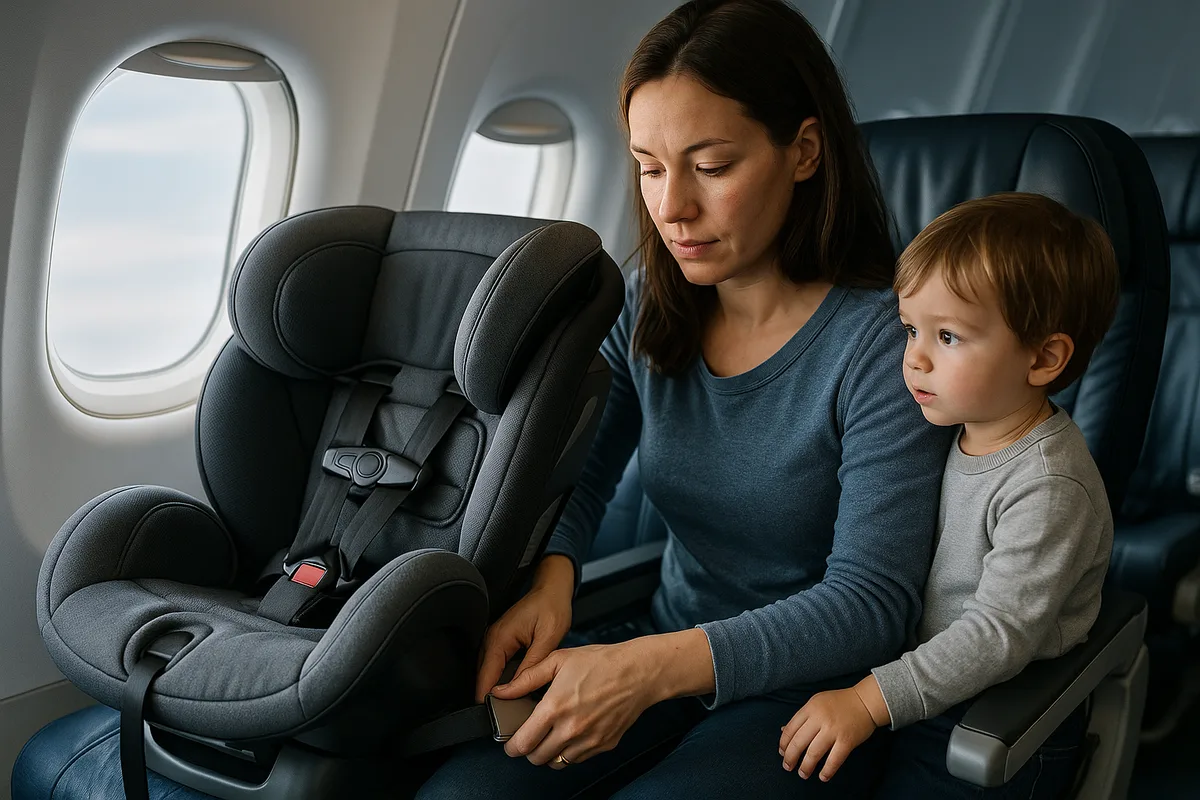
Call or message the airline before departure and ask about the exact flight if possible. Save the answer in the airline app or take a screenshot, but follow the crew’s instructions at the airport if the aircraft changes.
Ask these questions:
- Is my car seat allowed in the cabin?
- Does the seat need to be in a window seat?
- Can it be used in my assigned row and cabin?
- What is the aircraft seat width?
- Can I check the seat for free at the counter or gate?
- Will a gate-checked car seat be returned at the aircraft door?
- Are there restrictions near bulkhead, exit, or premium seats?
- What happens if the airline changes the aircraft?
- Can the car seat stay installed during takeoff, landing, and turbulence?
- What label or documentation should I bring?
Airline staff may not be able to guarantee the seat will fit if the aircraft changes. Arrive early so you have time to solve a seating problem without rushing.

Common mistakes to avoid
The most common problems come from treating an aircraft like a car. The restraint may be approved for both, but the seats, belts, and space are different.
Avoid these mistakes:
- Bringing a car seat with no aircraft-use label.
- Assuming a booster seat works with an aircraft lap belt.
- Holding a child in your arms while a separate paid seat sits empty.
- Putting a car seat in an exit row.
- Installing a car seat where it blocks another passenger.
- Using a car seat without checking the model’s manual.
- Adding a cushion to change the recline angle.
- Buckling the aircraft belt over the child instead of the car seat.
- Leaving the harness loose.
- Checking the only available car seat without a backup plan.
- Assuming every airline follows the same baggage policy.
- Using a damaged, recalled, or expired seat.
- Waiting until boarding to discover that the seat is too wide.
If the crew says the seat cannot be used in a particular position, stay calm. Ask for an approved alternative. Safety rules and aircraft conditions take priority over a planned seat assignment.
Quick decision guide
Use this guide before packing:
| Your situation | Practical choice |
|---|---|
| You need a car seat at your destination | Bring an approved car seat and buy the child a seat if possible |
| You want the safest aircraft setup | Use an approved car seat in a separate, ticketed seat |
| Your child is over the car seat’s limits but within CARES limits | Consider an approved CARES harness |
| You only have a booster seat | Check it or pack it; do not plan to use it during flight |
| You are worried about damage during baggage handling | Carry the car seat into the cabin |
| The car seat is too wide | Contact the airline and confirm aircraft-specific options |
| You are traveling with a lap infant | Follow the airline’s infant policy and consider buying a seat for an approved restraint |
| The seat has no aircraft label | Do not use it on the plane |

Frequently asked questions
Can I bring a rear-facing car seat on a plane?
Yes, if the seat has an aircraft-approval label and fits the aircraft seat. Follow the manufacturer’s rear-facing instructions. Confirm that the airline permits the seat in your assigned row.
Can I use a car seat in a middle seat?
Often, yes, as long as the car seat does not block another passenger and the airline allows it. A window seat is usually easier because it keeps the aisle clear.
Can I use a booster seat on an airplane?
Most booster seats are not useful during flight because aircraft seats usually have lap belts only. The booster needs a vehicle lap-and-shoulder belt to position the child correctly. Ask the airline whether the booster may be carried or checked instead.
Do I need to bring proof that my car seat is FAA approved?
The aircraft-use label on the restraint is the main proof. Bring the instruction manual too. It can help you and the crew confirm the correct installation method.
Can I use an inflatable seat belt with a car seat?
Usually not unless the car seat manufacturer specifically approves that combination. Inflatable aircraft or vehicle belts can change how the restraint works. Ask the airline and the car seat manufacturer before travel.
Can I use a car seat on an international flight from the United States?
Often, you can use an approved restraint, but the airline and destination country may have additional rules. Check the operating airline, codeshare carrier, and transit airports. The rules of the airline operating each flight matter most.
Final answer: bring it, label it, and plan the seat
You can take a car seat on a plane in the United States. The best setup is an FAA-approved car seat in a separate ticketed seat, installed according to the manual and the airline’s rules.
Before leaving home, check the aircraft-use label, measure the seat, confirm the airline policy, and decide whether to carry or check it. If anything changes at the airport, ask the crew for a safe, approved solution rather than forcing the original plan.