

Yes. Many cars, trucks, and SUVs are made in the United States. Ford, General Motors, Tesla, Rivian, and Lucid build vehicles in the USA. Toyota, Honda, Hyundai, Kia, BMW, Mercedes-Benz, Subaru, Volkswagen, and Volvo also assemble some models at American plants.
But “made in the USA” can mean different things. A vehicle may be:
- Built in the United States
- Designed by an American company
- Owned by an American company
- Made with mostly American parts
- Finished in the USA but powered by an engine made elsewhere
These details matter. The best way to check a car is to look at its window sticker and vehicle identification number, or VIN.

What does “made in the USA” mean?
A car made in the USA usually has its final assembly in an American factory. This means workers in the United States put the main vehicle parts together. It does not always mean every part came from the United States.
Modern cars use parts from many countries. A vehicle assembled in Alabama, Kentucky, Michigan, Ohio, South Carolina, or Texas may still use batteries, engines, transmissions, or other parts from outside the country.
There are four terms to keep apart:
| Term | Meaning |
|---|---|
| Final assembly | The location where the vehicle was put together |
| US parts content | The share of parts from the United States and Canada |
| Manufacturer ownership | The country where the parent company is based |
| Vehicle design | Where the vehicle was engineered or styled |
For example, a Toyota assembled in Kentucky is made in the USA in the final-assembly sense. Toyota is still a Japanese company. A Ford built in Mexico may come from an American company but is not assembled in the USA.
The American Automobile Labeling Act requires new vehicles sold in the United States to show information about final assembly, engine origin, transmission origin, and parts content. This information is usually listed on the vehicle’s window sticker.
Which cars are made in the USA?
The exact list changes as factories add, stop, or move production. The following examples are vehicles that have been assembled at US plants in recent model years. Availability can vary by trim, powertrain, and factory schedule.
Cars and electric vehicles built in America
Some well-known US-built cars and electric vehicles include:
- Tesla Model 3 — assembled at Tesla’s Fremont, California, plant for some versions
- Tesla Model Y — built in the United States, including at Tesla’s Texas and California facilities, depending on version
- Ford Mustang — assembled in Flat Rock, Michigan
- Chevrolet Corvette — assembled in Bowling Green, Kentucky
- Lucid Air — built in Casa Grande, Arizona
- Rivian R1T — built in Normal, Illinois
- Rivian R1S — built in Normal, Illinois
- Ford F-150 Lightning — built at Ford’s Rouge Electric Vehicle Center in Michigan
- Chevrolet Bolt EV and Bolt EUV — previously built in Michigan; production ended in 2023
Not every Tesla, Ford, Chevrolet, or electric vehicle has the same origin. A model may be built in more than one country. Check the specific car rather than relying only on the badge.
SUVs and trucks made in the usa
the United States produces a large share of the trucks and SUVs sold here. Examples include:
- Ford F-150 — assembled at several US facilities for different versions
- Ford Super Duty — built in Kentucky and Ohio
- Ford Ranger — built in Michigan for current US-market production
- Ford Bronco — built in Michigan
- Ford Explorer — built in Chicago, Illinois
- Jeep Wrangler — built in Ohio
- Jeep Gladiator — built in Ohio
- Jeep Grand Cherokee — built in Michigan
- Chevrolet Silverado — built at several plants, including facilities in Michigan and Indiana
- Chevrolet Tahoe — built in Arlington, Texas
- Chevrolet Suburban — built in Arlington, Texas
- GMC Yukon — built in Arlington, Texas
- GMC Canyon — built in Missouri
- Cadillac Escalade — built in Arlington, Texas
- Rivian R1T and R1S — built in Illinois
Large SUVs and pickup trucks often have high US and Canadian parts content, but the percentage differs by configuration. A gas model, hybrid model, and electric model can have very different supply chains.
Foreign-brand vehicles assembled in the USA
A vehicle does not need an American brand to be made in America. Several overseas automakers operate large US factories.
Examples include:
- Toyota Camry — assembled in Kentucky in recent production years
- Toyota Tundra — built in Texas
- Toyota Sequoia — built in Texas
- Honda Accord — built in Ohio
- Honda Pilot — built in Alabama
- Honda Odyssey — built in Alabama
- Honda Ridgeline — built in Alabama
- Subaru Outback — built in Indiana
- Subaru Ascent — built in Indiana
- BMW X3, X5, X6, X7, and XM — built in South Carolina
- Mercedes-Benz GLE and GLS — built in Alabama
- Volkswagen Atlas and Atlas Cross Sport — built in Tennessee
- Hyundai Santa Fe, Santa Cruz, and Palisade — built in Alabama
- Kia Telluride, Sorento, and Sportage — built in Georgia
- Mazda CX-50 — built in Alabama
- Volvo S60 — built in South Carolina in recent production years
Production plans can change. Some models listed above may be updated, replaced, or sourced from another plant in a later model year.

Which American car brands make vehicles in the USA?
Several American-owned brands build vehicles in the United States, but no major automaker makes every vehicle here.
Ford
Ford is one of the largest US automakers. Its American production includes vehicles such as the F-150, Super Duty, Bronco, Ranger, Mustang, Explorer, and Mustang Mach-E.
Ford also builds vehicles in Canada, Mexico, and other countries. The country of assembly depends on the exact model and version.
General Motors
General Motors owns Chevrolet, GMC, Cadillac, and Buick. US-built GM vehicles include several versions of the Chevrolet Corvette, Silverado, Tahoe, Suburban, GMC Yukon, and Cadillac Escalade.
GM also imports many vehicles. A Chevrolet badge alone does not prove that a vehicle was assembled in the United States.
Stellantis
Stellantis owns Jeep, Ram, Chrysler, and Dodge. Its US-built vehicles include the Jeep Wrangler, Jeep Gladiator, Jeep Grand Cherokee, Ram 1500 Classic, and several other products, depending on the production year.
The company also builds vehicles in Canada, Mexico, and other regions.
Tesla
Tesla is an American electric vehicle company. It has US production in California and Texas. Tesla vehicles can have different assembly locations and battery sources, so the exact vehicle identification number matters.
Tesla’s high level of vertical integration does not mean every component is American. Batteries and other parts may come from different supply chains.
Rivian and Lucid
Rivian builds its R1T pickup and R1S SUV in Normal, Illinois. Lucid builds the Air sedan in Casa Grande, Arizona.
Both companies are US-based, but their vehicles still use international parts. Final assembly and company headquarters are separate facts.
How can you tell if a specific car was made in the USA?
The most reliable method is to inspect the vehicle’s Monroney label, commonly called the window sticker.
1. Check the final-assembly line
Look for a statement such as:
Final assembly point: United States
This tells you where the vehicle was put together. It does not tell you that all parts are American.
2. Review the parts-content section
The label may show the percentage of parts from the United States and Canada. This number is useful, but it has limits:
- It combines US and Canadian content.
- It may apply only to a specific vehicle configuration.
- It does not necessarily include every small component.
- It may not reflect the full value of raw materials.
- Electric vehicles can have separate battery-sourcing rules.
A vehicle with 70% US and Canadian parts content has a stronger North American supply connection than one with 10%. Neither number means that the car is made entirely in the United States.
3. Check the engine and transmission origin
The label also identifies where the engine and transmission were made. A US-assembled vehicle may use an engine or transmission from Canada, Mexico, Japan, Germany, or another country.
This is especially useful when comparing two vehicles with the same model name but different engines.
4. Use the VIN
The VIN is a 17-character vehicle identification number. Its first character often indicates the country where the vehicle was built, but the VIN alone may not answer every parts-content question.
Use the VIN to confirm:
- The vehicle’s country of manufacture
- The plant or factory code
- The model year
- The exact vehicle configuration
A dealer can provide the VIN before purchase. You can also find it on the dashboard, driver-side door label, registration, and insurance documents.
5. Check the official manufacturer information
Automakers often list factory locations on their corporate websites. This can confirm where a model is normally built, but it may not identify the plant for a particular vehicle.
For the most accurate answer, combine the manufacturer’s information with the actual window sticker.

Does buying an American-made car support US jobs?
Usually, yes, but the effect is broader than final assembly.
A US-built vehicle supports work in areas such as:
- Factory assembly
- Parts manufacturing
- Engineering
- Shipping and logistics
- Dealership sales and service
- Battery and electronics production
- Tooling and factory maintenance
The effect depends on the vehicle’s parts content and supply chain. A car assembled in the United States with many imported parts may support fewer domestic manufacturing jobs than a vehicle with a higher North American parts share.
The parent company also matters, but it is not the only factor. A foreign-owned automaker may employ thousands of US workers and buy parts from American suppliers. An American-owned company may import a vehicle from another country.
For this reason, “American car” and “car made in America” are not exact synonyms.
Are electric cars made in the USA?
Yes. The United States produces several electric vehicles.
US-built electric vehicles include models from:
- Tesla
- Rivian
- Lucid
- Ford
- General Motors
Examples include the Tesla Model 3 and Model Y, Rivian R1T and R1S, Lucid Air, Ford Mustang Mach-E, Ford F-150 Lightning, and some Chevrolet and Cadillac electric vehicles.
However, electric vehicle origin is more complex than final assembly. The battery may contain materials mined and processed in several countries. Its cells may be made in one country, assembled into a battery pack in another, and installed into the vehicle in the United States.
Tax credits also use separate rules for final assembly, battery components, and critical minerals. These rules can change. Anyone choosing a vehicle because of a federal tax credit should check the current Internal Revenue Service requirements rather than rely on an older article or dealer claim.

Does “assembled in the USA” mean the car is fully American?
No. “Assembled in the USA” is a narrower claim.
Think of a car like a meal prepared in a kitchen. The kitchen may be in the United States, but the ingredients can come from many places. Final assembly tells you where the meal was prepared, not where every ingredient was grown.
A vehicle can be:
- US assembled with high North American parts content
- US assembled with moderate parts content
- US assembled with many imported parts
- Designed by a US company but built overseas
- Built in the USA by a foreign-owned automaker
None of these descriptions is automatically better. The right choice depends on what matters to you: US employment, supply-chain location, repair access, price, fuel economy, features, or eligibility for an incentive.
Common mistakes when looking for an American-made car
Mistake 1: Assuming an American badge means US assembly
Ford, Chevrolet, Jeep, and Tesla all sell vehicles made in different places. Always check the specific model and VIN.
Mistake 2: Treating the assembly location as the parts origin
A US factory may install imported engines, batteries, electronics, and other parts.
Mistake 3: Using an old list
Factories change products. A model built in the USA one year may move to another plant later. Check the model year.
Mistake 4: Confusing US and North American content
The government label may combine US and Canadian parts. That is not the same as US-only content.
Mistake 5: Relying on a dealer’s verbal claim
Ask to see the window sticker. Written vehicle-specific information is more useful than a general statement about the brand.

What is the best way to find an American-made car?
Use this short process:
- Choose the model and model year.
- Ask for the vehicle’s VIN or window sticker.
- Confirm the final assembly location.
- Check US and Canadian parts content.
- Review engine and transmission origins.
- Confirm current tax-credit rules separately, if relevant.
- Compare the exact vehicle with other models.
If you are buying used, inspect the original window sticker when possible. The current model’s production location may not match the location of an older model.
Frequently asked questions
Are all Ford cars made in the USA?
No. Ford builds vehicles in the United States and other countries. The F-150, Bronco, Mustang, and Explorer are examples of Ford vehicles with US production in recent model years, but the exact origin depends on the model and vehicle version.
Are Toyota cars made in the USA?
Some are. Toyota builds vehicles such as the Camry, Tundra, and Sequoia at US plants in recent production years. Toyota also imports vehicles, so check the specific model’s window sticker.
Is Tesla made in America?
Tesla is a US-based automaker with factories in California and Texas. Some Tesla vehicles are assembled in the United States, while others may come from different facilities. Check the VIN and vehicle label.
What is the most American-made car?
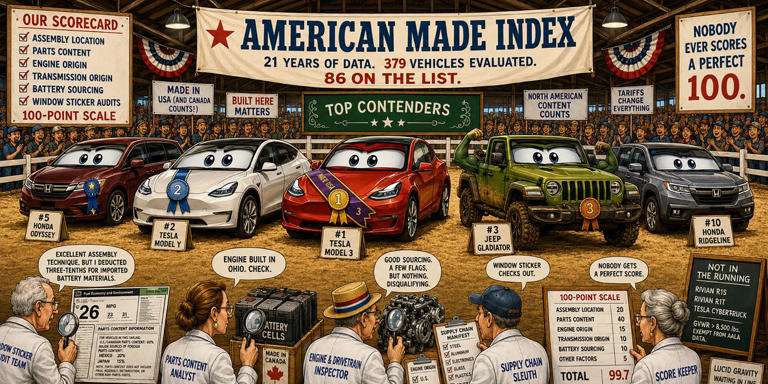
There is no permanent winner. Rankings change by model year, production site, parts content, and research method. The Cars.com American-Made Index is one known source, while the official window sticker gives vehicle-specific information.
Can a car made in the USA qualify for a federal tax credit?
Possibly, but US assembly alone does not guarantee eligibility. Current federal rules may also consider vehicle price, buyer income, battery components, and critical minerals. Check the latest IRS guidance for the exact vehicle and purchase date.
Sources and verification
For a specific vehicle, use these primary or established sources:
- NHTSA: American Automobile Labeling Act
- NHTSA: VIN Decoder
- IRS: Clean Vehicle Credits
- Cars.com American-Made Index
Factory locations and model production can change. Verify the model year, VIN, and window sticker before making a purchase decision.
Conclusion
Yes, many cars are made in the USA. The list includes vehicles from Ford, Chevrolet, Jeep, Tesla, Rivian, Lucid, Toyota, Honda, BMW, Mercedes-Benz, Hyundai, Kia, Subaru, Volkswagen, and other brands.
The key is to define “made in the USA” correctly. Final assembly, parts content, company ownership, and design location are separate facts. For the most accurate answer, check the vehicle’s window sticker and VIN—not just the brand name.