

The United States made about 10.6 million motor vehicles in 2024. That figure includes passenger cars, pickup trucks, SUVs, vans, and heavy commercial vehicles built in U.S. factories.
If you mean passenger cars only, the number is much lower. Most vehicles built in the United States today are light trucks, such as SUVs and pickups. So, the best short answer is:
America makes roughly 10 million to 11 million motor vehicles each year, but only a smaller share are traditional passenger cars.
The latest complete annual data from the International Organization of Motor Vehicle Manufacturers (OICA) records 10,562,188 motor vehicles produced in the United States in 2024. This includes vehicles made by both American and foreign-owned automakers at U.S. plants.
What does “made in America” mean?
“Made in America” usually means that a vehicle was assembled in the United States. It does not always mean that every part came from U.S. suppliers.
A vehicle may contain:
- A body assembled in Michigan, Alabama, Texas, or another U.S. state
- Engines or transmissions made in the United States, Mexico, Canada, Japan, or elsewhere
- Batteries and electronic parts from several countries
- Steel, aluminum, glass, and other materials from both U.S. and foreign sources
This distinction matters because vehicle production statistics count the location of final assembly. They do not measure the total American value inside each vehicle.
The term “car” also causes confusion. In everyday speech, people often call any personal vehicle a car. Industry data usually separates vehicles into categories such as:
- Passenger cars
- Light commercial vehicles
- Heavy trucks
- Buses
- Other commercial vehicles
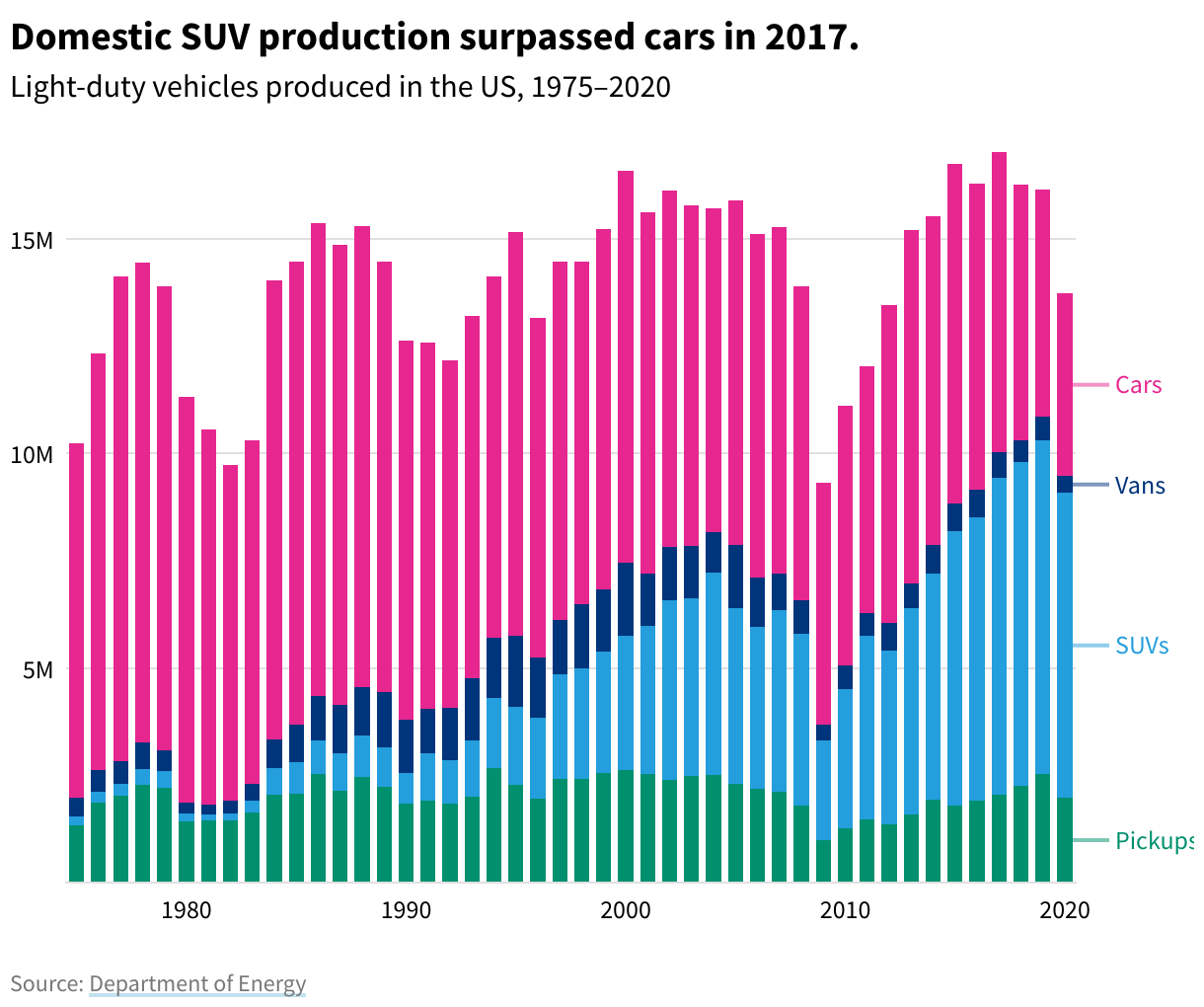
Many American buyers now choose SUVs and pickup trucks. Automakers often classify these vehicles as light trucks rather than passenger cars.
Strict passenger cars versus all motor vehicles
A strict count of passenger cars excludes most pickups, large SUVs, and commercial vehicles. That number is far below the total U.S. vehicle-production figure.
The broader figure of 10.56 million vehicles in 2024 is more useful for answering how many vehicles America makes each year. It is not a count of sedans and hatchbacks alone.
How many vehicles did the United States make in 2024?
The United States produced 10,562,188 motor vehicles in 2024, according to OICA’s country production data.
That total placed the United States among the world’s largest vehicle-producing countries. China produced far more, while Japan, India, South Korea, Germany, and Mexico were also major producers.
A simple view of recent U.S. output looks like this:
| Year | U.S. motor-vehicle production | What the number includes |
|---|---|---|
| 2022 | About 10.1 million | Cars, SUVs, pickups, trucks, and buses |
| 2023 | About 10.6 million | All major vehicle classes |
| 2024 | 10,562,188 | The latest complete OICA total |
The exact total changes from year to year. Plant shutdowns, parts shortages, interest rates, labor disputes, new-model launches, and consumer demand all affect production.
The 2024 number is best understood as an annual production total, not the number of vehicles sold to Americans. Some vehicles made in the United States are exported. At the same time, many vehicles sold in the United States are imported.
How many cars are made in America per day?
Using the 2024 total, U.S. factories made an average of approximately 28,858 motor vehicles per calendar day.
The calculation is:
10,562,188 vehicles ÷ 366 days = about 28,858 vehicles per day
2024 was a leap year, so the calculation uses 366 days.
This is only an average. Auto plants do not operate at the same output level every day. A factory may stop production for:
- Weekends and holidays
- Planned maintenance
- Model changeovers
- Parts shortages
- Severe weather
- Labor action
- Temporary demand changes
A better industry measure is often vehicles per operating day or production capacity. Even then, plants may run several shifts, and output can vary by model.
How many vehicles are made per hour?
A simple 24-hour average gives:
28,858 vehicles per day ÷ 24 hours = about 1,202 vehicles per hour
This does not mean the entire U.S. auto industry builds 1,202 vehicles every hour without stopping. It is only a way to understand the scale of annual production.
Which states make the most cars?
Vehicle production is spread across many states. The largest production centers include:
- Michigan
- Kentucky
- Ohio
- Indiana
- Alabama
- Tennessee
- Texas
- South Carolina
- Missouri
- Illinois
- Georgia
- Mississippi
Michigan remains closely linked with the U.S. auto industry because of Detroit and its long history of vehicle engineering, design, manufacturing, and supplier activity.
However, modern U.S. production is not concentrated in one state. Foreign-owned automakers have built large plants across the South and Midwest. Toyota, Honda, Hyundai, Kia, BMW, Mercedes-Benz, Subaru, Nissan, Volkswagen, Stellantis, Ford, and General Motors all have major U.S. manufacturing operations or production partnerships.
Why automakers build plants in different states
Automakers choose factory locations based on several factors:
- Access to suppliers
- Rail, road, and port connections
- Available land
- Local workforce
- Energy and utility costs
- State and local incentives
- Proximity to customers
- Existing manufacturing infrastructure
Battery plants are also changing the map. Electric vehicles require large battery packs, so automakers and battery companies are building facilities near vehicle assembly plants and major transportation routes.

Who makes cars in the United States?
Vehicles built in America come from both U.S.-based companies and foreign-owned companies.
Major automakers with U.S. production include:
- General Motors
- Ford
- Stellantis
- Toyota
- Honda
- Nissan
- Hyundai
- Kia
- BMW
- Mercedes-Benz
- Volkswagen
- Subaru
- Tesla
- Rivian
- Lucid
The nationality of a brand does not tell you where a particular vehicle was built. For example, an American brand may sell vehicles assembled in Canada or Mexico, while a Japanese, German, or South Korean brand may build vehicles in the United States.
The most reliable way to check a specific vehicle is to look at its:
- Vehicle Identification Number, or VIN
- Window sticker
- Manufacturer label
- National Highway Traffic Safety Administration VIN information
- American Automobile Labeling Act content label
The VIN can identify the assembly plant, but it does not provide a complete picture of the vehicle’s parts content.
Are electric vehicles included in the U.S. production total?
Yes. Electric vehicles are included in motor-vehicle production totals when they are assembled in the United States.
The total can include:
- Battery-electric vehicles
- Plug-in hybrid vehicles
- Hybrid vehicles
- Gasoline vehicles
- Diesel vehicles
- Pickup trucks
- SUVs
- Vans
- Buses and heavy trucks
Production statistics usually focus on the type of vehicle and its assembly location. They do not create a separate “American-made” total based on the percentage of U.S. parts.
Electric-vehicle production is growing, but the number of U.S.-built electric vehicles changes as new plants open and automakers adjust production plans. Some battery plants also serve more than one vehicle factory, so battery output and vehicle output are not the same measure.
Why electric vehicles can change the production count
An electric vehicle may require fewer mechanical parts than a gasoline vehicle, but it still needs:
- A battery pack
- Electric motors
- Power electronics
- Thermal-management systems
- Software and control units
- Specialized charging hardware
A plant may therefore change its equipment, workforce, and supplier network while keeping the same basic assembly function.
How much of an American-made car is actually American?
There is no single percentage that applies to every vehicle.
The American Automobile Labeling Act requires manufacturers to provide information about:
- The vehicle’s assembly location
- The countries that supplied major parts
- The percentage of parts content from the United States and Canada
- The engine and transmission origins
That label is more useful than a simple “American” or “foreign” label. Two vehicles from the same brand may have very different U.S. and Canadian parts content because they come from different plants or use different supply chains.
A vehicle assembled in the United States may still contain many imported parts. A vehicle assembled outside the United States may contain a substantial amount of North American content.
For a specific model, check the label for the exact model year and configuration. Content can differ between:
- Trim levels
- Powertrains
- Body styles
- Production plants
- Model years
- Optional equipment

Why does U.S. car production rise and fall?
U.S. vehicle production changes because the auto industry responds quickly to demand and supply conditions.
Consumer demand
Automakers build more of the vehicles that dealers and buyers want. In recent years, SUVs and pickups have taken a large share of U.S. demand. That shift has reduced the number of traditional sedans built in America.
Parts availability
A missing semiconductor, wiring harness, battery cell, or other small component can stop a production line. Modern vehicles contain many electronic systems, so one delayed part can affect thousands of vehicles.
Labor disputes
A strike or contract dispute can reduce output at an assembly plant and at its suppliers. The effect can spread across several states because one factory may depend on parts from many locations.
New-model launches
Production may slow when a factory changes from one model to another. Output can also rise after a new vehicle reaches full production.
Exports and imports
U.S. plants build vehicles for both domestic buyers and overseas markets. At the same time, U.S. dealers sell vehicles imported from Canada, Mexico, Asia, Europe, and other regions.
Economic conditions
High interest rates, weak consumer confidence, high vehicle prices, or tighter credit can reduce demand. Strong employment and fleet purchases can support production.
How does U.S. production compare with vehicle sales?
Production and sales are different numbers.
Production measures vehicles assembled in U.S. factories. Sales measure vehicles sold through the U.S. market, no matter where they were built.
For example:
- A vehicle built in Alabama and exported to another country counts as U.S. production but not a U.S. sale.
- A vehicle built in Mexico and sold in Ohio counts as a U.S. sale but not U.S. production.
- A vehicle built in Michigan and sold in Michigan counts as both.
Inventory also affects the relationship. Automakers may build vehicles before customers buy them, or dealers may sell vehicles from stock made in an earlier month.
This is why production totals should not be used as a direct substitute for U.S. sales totals.
What is the best source for yearly U.S. vehicle-production data?
For international comparisons, OICA is a strong starting point because it reports production by country and vehicle category.
Useful sources include:
- OICA production statistics
- U.S. Bureau of Economic Analysis
- Federal Reserve industrial production data
- U.S. Department of Energy vehicle technologies data
- National Highway Traffic Safety Administration vehicle information
Each source answers a slightly different question.
| Source type | Best for |
|---|---|
| OICA | Annual country production comparisons |
| Federal Reserve | Monthly U.S. industrial production trends |
| BEA | Economic contribution and national accounts |
| Department of Energy | Vehicle technology and alternative-fuel data |
| NHTSA | VIN, safety, and vehicle identification information |
| Automakers | Plant-level announcements and model assignments |
When comparing years, use the same source and definition. Mixing “passenger cars,” “light vehicles,” and “all motor vehicles” can produce a misleading result.
Common mistakes when counting American-made cars
Counting only U.S. brands
Brand ownership and assembly location are not the same. A foreign-owned company can build vehicles in the United States, and a U.S.-based company can build vehicles in another country.
Treating SUVs as passenger cars
Many SUVs are classified as light trucks. This is one reason strict passenger-car figures look much smaller than broad vehicle-production totals.
Adding production and sales together
Production is not an extra form of sales. They are separate measurements.
Using a plant’s maximum capacity as actual output
A factory may be able to build 250,000 vehicles per year but produce fewer because of demand, downtime, shortages, or model changes.
Assuming every part is domestic
Final assembly in America does not mean full domestic sourcing. Check the vehicle’s official parts-content label for a more precise answer.
Comparing incompatible data
Before comparing two numbers, check:
- The year
- The country
- The vehicle category
- The unit
- The source
- Whether the figure is production, sales, exports, or capacity
Frequently asked questions
How many cars does America make in one year?
The United States made 10,562,188 motor vehicles in 2024, according to OICA. That broad total includes passenger cars, SUVs, pickups, vans, trucks, and buses. Traditional passenger cars make up only part of the total.
Does the United States make more cars than Japan?
The answer depends on the year and category, but both countries are major vehicle producers. Use the same OICA category and year when comparing them. Comparing U.S. light-vehicle production with Japan’s passenger-car total would not be an equal comparison.
What U.S. state makes the most cars?
Michigan is the state most associated with U.S. vehicle production and remains a major manufacturing center. However, production is spread across many states, including Kentucky, Ohio, Indiana, Alabama, Tennessee, Texas, South Carolina, and Missouri.
Are Tesla vehicles counted as American-made?
A Tesla vehicle assembled at a U.S. plant counts as U.S. production. Tesla also operates production facilities outside the United States, so the assembly location depends on the specific vehicle and market.
How can I tell where my vehicle was built?
Check the VIN, the vehicle label, and the manufacturer’s American Automobile Labeling Act information. The first character of the VIN can help identify the region, while the full VIN can provide more detail about the vehicle and assembly plant.
Key takeaways
- The United States made 10,562,188 motor vehicles in 2024.
- America produces roughly 10 million to 11 million vehicles in a typical recent year.
- The broad total includes cars, SUVs, pickups, vans, trucks, and buses.
- Strict passenger-car production is much lower because many U.S.-built vehicles are classified as light trucks.
- Vehicles made in America can contain parts from many countries.
- Brand nationality does not prove where a vehicle was assembled.
- OICA is a useful source for comparing annual production by country.
Conclusion
America makes about 10.6 million motor vehicles per year, based on the latest complete OICA figure for 2024. The number includes far more than traditional cars: SUVs, pickup trucks, vans, heavy trucks, buses, hybrids, and electric vehicles also count.
For the most accurate answer, define the category first. If you mean all vehicles assembled in the United States, use the 10.56-million figure. If you mean only passenger cars, use a category-specific production table and exclude light trucks and commercial vehicles.